Tongkat ali and fadogia agrestis are often sold as a pair. The evidence behind them is very different. One has small trials in people. For the other, every study we could find was done in rats or in a chemistry lab. This page sets out what exists.
Tongkat ali vs fadogia agrestis at a glance
| Tongkat ali | Fadogia agrestis | |
|---|---|---|
| What it is | Eurycoma longifolia, a South-East Asian plant. The root is used[5] | A plant used in traditional African medicine. Studies use the stem[6, 10] |
| Evidence for testosterone | A significant rise when 5 human trials were pooled[1] | A rise in rats over 5 days. No human trial found[6] |
| Doses in the cited studies | 200 mg or 400 mg of extract a day in people[2, 4] | 18, 50 or 100 mg per kg of body weight in rats[6] |
| Main risks | Limited safety data. Reviewers ask for more[5] | Signs of harm to rat testes, liver and kidney cells[7, 8] |
| Who it suits | Men willing to try a herb with thin but real human evidence | No one, on the present evidence |
What is each plant?
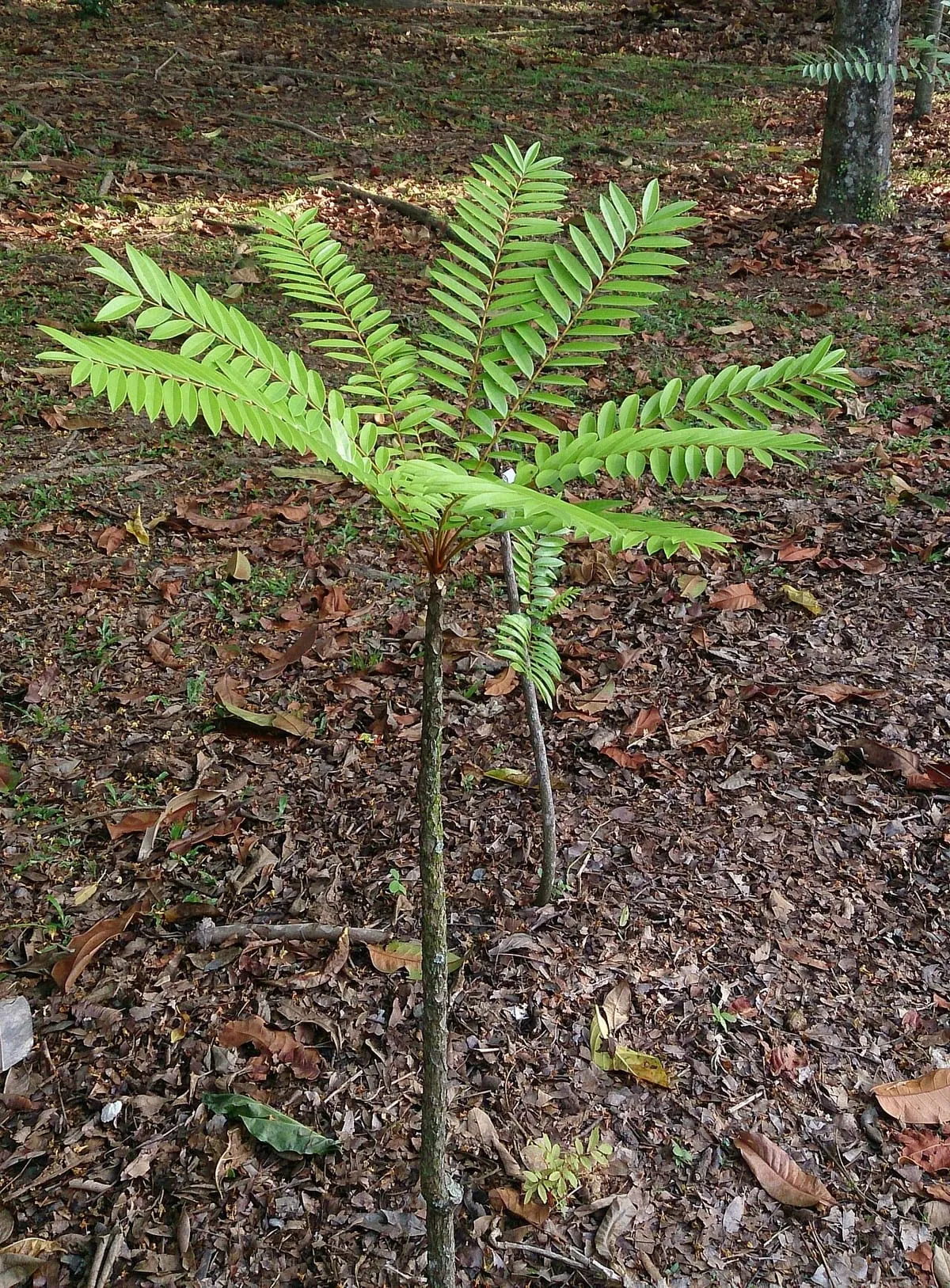
Tongkat ali is Eurycoma longifolia, a flowering plant native to Indonesia, Malaysia and Vietnam, among other countries. Its root is a traditional remedy for sexual problems.[5] Our tongkat ali guide covers it in full.
Fadogia agrestis is a plant used in traditional African medicine, including as an aphrodisiac.[6, 10]

What does the human evidence show for tongkat ali?
A 2022 review found nine human studies and pooled five randomised trials. Total testosterone rose significantly, including in men with low testosterone. The authors said more research is needed before it is used in practice.[1]
The individual studies are small:
- In 76 men with late-onset low testosterone, 200 mg a day for a month raised the share with normal levels from 35.5% to 90.8%. No placebo group is described.[2]
- In 63 moderately stressed adults, 4 weeks of extract lowered cortisol by 16% and raised testosterone status by 37% compared with placebo.[3]
- In 25 active adults aged 57 to 72, 400 mg a day for 5 weeks raised total and free testosterone.[4]
A 2024 review of testosterone boosters rated tongkat ali as possibly effective in men with late-onset low testosterone and in healthy men.[11]
What does the evidence show for fadogia agrestis?
We searched PubMed for the plant’s name on 23 November 2026. It returned ten records. None was a trial in people. The relevant ones are below.
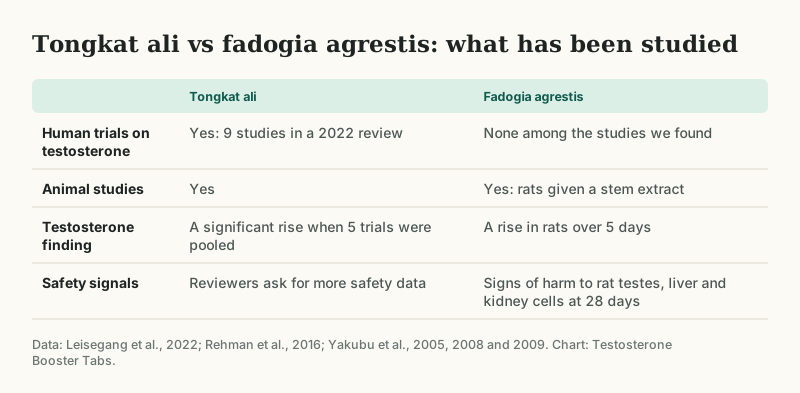
- The testosterone study, 2005. Male rats were given a water extract of the stem at 18, 50 or 100 mg per kg of body weight. Mating behaviour increased. Blood testosterone rose at days 1, 3 and 5, in a pattern that suggested a dose effect.[6]
- The testes study, 2008. Rats took the same doses for 28 days. Several markers of testicular function changed, and the authors read this as a sign of adverse effects on the testes. Some markers recovered after dosing stopped, mainly at the lowest dose.[7]
- The liver and kidney study, 2009. After 28 days, no rats had died. But enzyme changes suggested damage to the membranes of liver and kidney cells.[8]
- An erectile dysfunction study, 2023. In rats with drug-induced erection problems, the extract restored several chemical markers. The authors recommended its use only after clinical trials.[9]
That is the whole case for fadogia: one research group’s rat studies, with early safety warnings attached.
Is what is in the bottle what the label says?
Not always. In 2019, chemists tested 17 supplements that claimed to contain fadogia agrestis. Twelve contained the plant’s marker compounds. In five, none were detected.[10]
This is a wider problem. The US Food and Drug Administration does not have the authority to approve dietary supplements before they are marketed.[12] Our guide to testosterone booster side effects covers hidden and missing ingredients.
How do the risks compare?
Tongkat ali: a 2016 review reported no adverse changes in liver and kidney tests at normal doses, and called for more evidence on safety.[5] The human trials were short, from 4 weeks to 5 weeks.[3, 4]
Fadogia agrestis: there is no human safety data in the studies we found. The animal data is not reassuring. The same extract that raised testosterone in rats over five days altered their testes, liver and kidneys over 28.[6, 7, 8]
Rat studies cannot tell us what happens in people. That cuts both ways here. The benefit is unproven in men, and so is the harm.
Which one? Tongkat ali or fadogia agrestis
Tongkat ali is the only one of the two with evidence in humans. It is thin, but it exists, and a pooled analysis points to a rise in testosterone.[1]
Fadogia agrestis cannot be recommended on what is published. No human trial, a testosterone finding in rats only, and animal signs of organ harm.[6, 7, 8]
Taking both does not combine their evidence. No study we found tested the pair.
If you want a herb with more behind it, compare ashwagandha vs tongkat ali. For other pairings see ashwagandha vs ginseng and ashwagandha vs maca. And for the wider picture, read do testosterone boosters work? If you have symptoms, a blood test will tell you more than either plant.
The bottom line
Tongkat ali has small human trials and a modest pooled result. Fadogia agrestis has rat studies, no human trials that we could find, and warning signs for the testes, liver and kidneys in animals. On current evidence, the first is a maybe and the second is a no.
Common questions
Does fadogia agrestis increase testosterone?
In rats, yes: blood testosterone rose over five days of dosing with a stem extract. We found no study in people, so there is no evidence that it does so in men.[6]
Is fadogia agrestis safe?
Its safety in people has not been tested in any study we found. In rats, 28 days of the extract changed testicular measures in ways the authors called adverse, and affected liver and kidney cell membranes.[7, 8]
Sources
- Eurycoma longifolia (Jack) Improves Serum Total Testosterone in Men: A Systematic Review and Meta-Analysis of Clinical Trials (Leisegang et al., 2022) Medicina
- Standardised water-soluble extract of Eurycoma longifolia, Tongkat ali, as testosterone booster for managing men with late-onset hypogonadism? (Tambi et al., 2012) Andrologia
- Effect of Tongkat Ali on stress hormones and psychological mood state in moderately stressed subjects (Talbott et al., 2013) Journal of the International Society of Sports Nutrition
- Tongkat Ali as a potential herbal supplement for physically active male and female seniors--a pilot study (Henkel et al., 2014) Phytotherapy Research
- Review on a Traditional Herbal Medicine, Eurycoma longifolia Jack (Tongkat Ali): Its Traditional Uses, Chemistry, Evidence-Based Pharmacology and Toxicology (Rehman et al., 2016) Molecules
- Aphrodisiac potentials of the aqueous extract of Fadogia agrestis (Schweinf. Ex Hiern) stem in male albino rats (Yakubu et al., 2005) Asian Journal of Andrology
- Effects of oral administration of aqueous extract of Fadogia agrestis (Schweinf. Ex Hiern) stem on some testicular function indices of male rats (Yakubu et al., 2008) Journal of Ethnopharmacology
- Mode of cellular toxicity of aqueous extract of Fadogia agrestis (Schweinf. Ex Hiern) stem in male rat liver and kidney (Yakubu et al., 2009) Human & Experimental Toxicology
- Fadogia agrestis (Schweinf. Ex Hiern) Stem Extract Restores Selected Biomolecules of Erectile Dysfunction in the Testicular and Penile Tissues of Paroxetine-Treated Wistar Rats (Ogunro and Yakubu, 2023) Reproductive Sciences
- Quantification of Phenolic Compounds from Fadogia agrestis and Dietary Supplements using UHPLC-PDA-MS (Avula et al., 2019) Planta Medica
- Do "testosterone boosters" really increase serum total testosterone? A systematic review (Morgado et al., 2024) International Journal of Impotence Research
- Questions and Answers on Dietary Supplements US Food and Drug Administration
One of our side-by-side comparisons. New here? Start with do testosterone boosters work?