Ashwagandha and tongkat ali are the two herbs most often named when people ask about natural testosterone support. Both have human trials, which already puts them ahead of most ingredients covered in do testosterone boosters work? This page puts their evidence side by side.
Ashwagandha vs tongkat ali at a glance
| Ashwagandha | Tongkat ali | |
|---|---|---|
| What it is | Withania somnifera, a herb from Ayurvedic medicine[11] | Eurycoma longifolia, a South-East Asian plant whose root is used[5] |
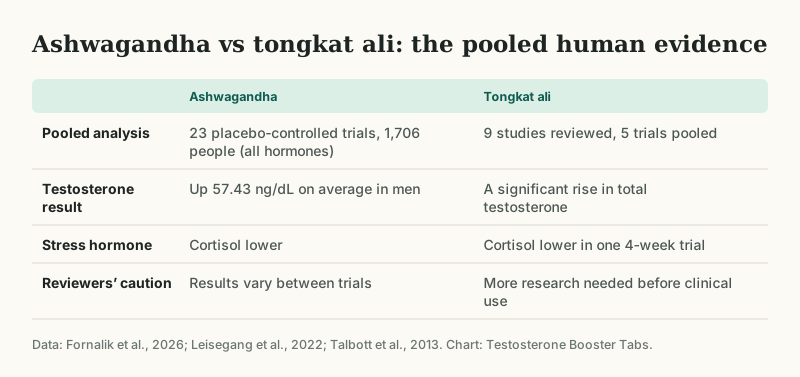
| Evidence for testosterone | Up 57.43 ng/dL on average in men, across pooled trials[1] | A significant rise when 5 trials were pooled[2] |
| Size of the evidence | 23 placebo-controlled trials, 1,706 people, several hormones[1] | 9 studies reviewed[2] |
| Doses in the cited trials | 300 mg of root extract twice a day[7, 13] | 200 mg or 400 mg of extract a day[8, 9] |
| Main risks | Stomach upset, drowsiness, rare liver injury, drug interactions[11, 12] | Less studied. Reviewers call for more safety evidence[5] |
| Who it suits | Men who also want help with stress, for a short course | Men who accept thinner evidence and less safety data |
What does the ashwagandha evidence show?
A 2026 pooled analysis gathered 23 randomised, placebo-controlled trials with 1,706 people. It looked at several hormones. In men, ashwagandha raised testosterone by 57.43 ng/dL on average. It had no such effect in women. It also lowered cortisol. The authors warned that results varied between trials.[1]
Individual trials give a feel for it:
- Overweight men aged 40 to 70 took an extract for 8 weeks in a crossover trial. Testosterone rose 14.7% more than with placebo. Fatigue, vigour and sexual wellbeing were no better than placebo.[6]
- Fifty men with low sexual desire took 300 mg of root extract twice a day for 8 weeks. Sexual function scores and blood testosterone both rose compared with placebo.[7]
- Men aged 18 to 50 doing resistance training took the same dose for 8 weeks. Their bench press improved by 46.0 kg, against 26.4 kg with placebo.[13]

Our ashwagandha and testosterone guide covers each study.
What does the tongkat ali evidence show?
A 2022 review found nine studies and pooled five randomised trials. Total testosterone rose significantly, and the result held in men with low testosterone. The authors still said more research is needed before it is used in practice.[2]
The best-known studies are weaker than they sound:
- 76 men with late-onset low testosterone took 200 mg of extract a day for a month. The share with normal testosterone rose from 35.5% to 90.8%. The report describes no placebo group.[8]
- 25 active older adults took 400 mg a day for 5 weeks. Total and free testosterone rose in men and women. This was a pilot study.[9]
- 63 moderately stressed adults took an extract or placebo for 4 weeks. Cortisol fell 16% and testosterone status rose 37%, measured in saliva.[10]
Our tongkat ali guide goes through them.
Which has the stronger evidence?
Ashwagandha, on volume and on independent review.
A 2021 systematic review of 13 herbs concluded that two had positive effects on testosterone in men: fenugreek and ashwagandha. Tongkat ali was not one of the two.[3] See fenugreek and testosterone for the other.
A 2024 review of “testosterone boosters” was kinder to both. It rated tongkat ali and ashwagandha as possibly effective in healthy men, and tongkat ali as possibly effective in men with late-onset low testosterone. Each herb had three studies in that review.[4]
Two cautions apply to both. The trials are small. And a rise on a blood test is not the same as feeling better: in the trial of overweight men, the hormone moved but the symptoms did not.[6]
How do the side effects compare?
Ashwagandha is better documented, which means its problems are better known. It may be safe for up to three months, and long-term safety is not established. It can cause drowsiness, stomach upset, diarrhoea and vomiting. It should be avoided in pregnancy and is not recommended for people with thyroid or autoimmune disorders. It may interact with medicines for diabetes, blood pressure, seizures and thyroid conditions.[11]
There are rare reports of liver injury. One case series described five people who developed jaundice 2 to 12 weeks after starting ashwagandha. Liver tests returned to normal within 1 to 5 months in the four who were followed up.[12]
Tongkat ali has less to go on. A 2016 review reported no adverse changes in liver and kidney tests at normal doses, but also said more evidence on safety is needed.[5]
In the United States, dietary supplements are not approved by the Food and Drug Administration before they are sold.[15] Our guide to testosterone booster side effects explains what that means for what is in the bottle.
Which one? Ashwagandha or tongkat ali
If you want the herb with the most human evidence, that is ashwagandha. Its pooled result rests on more trials, and an independent review of herbs backed it.[1, 3]
If stress is part of the picture, ashwagandha also has the stronger data: a pooled analysis of 9 trials found lower stress scores and lower cortisol.[14]
If you have a thyroid or autoimmune condition, or take regular medicines, ashwagandha is the one with known warnings.[11] That does not make tongkat ali safe. It means tongkat ali is less studied.
If your testosterone is truly low, neither herb is a treatment. See boosters vs TRT and get a blood test first.
More herb comparisons: tongkat ali vs fadogia agrestis, ashwagandha vs ginseng and ashwagandha vs maca.
The bottom line
Both herbs have small trials showing a rise in testosterone, and no trial compares them directly. Ashwagandha has more evidence and clearer safety warnings. Tongkat ali has promising but thinner data. Expect a modest change on a blood test at best, and keep any trial of either short.
Common questions
Is tongkat ali or ashwagandha better for testosterone?
There is no head-to-head trial. Both showed a rise in pooled analyses. Ashwagandha's analysis covered 23 placebo-controlled trials across several hormones, while tongkat ali's pooled 5 trials.[1, 2]
Can you take ashwagandha and tongkat ali together?
None of the trials cited here tested the combination, so its effect and safety are unknown. Ashwagandha can interact with several medicines, so check with a pharmacist first.[11]
Sources
- Hormonal Modulation with Withania somnifera: Systematic Review and Meta-Analysis of Randomized-controlled Trials (Fornalik et al., 2026) Planta Medica
- Eurycoma longifolia (Jack) Improves Serum Total Testosterone in Men: A Systematic Review and Meta-Analysis of Clinical Trials (Leisegang et al., 2022) Medicina
- Examining the Effects of Herbs on Testosterone Concentrations in Men: A Systematic Review (Smith et al., 2021) Advances in Nutrition
- Do "testosterone boosters" really increase serum total testosterone? A systematic review (Morgado et al., 2024) International Journal of Impotence Research
- Review on a Traditional Herbal Medicine, Eurycoma longifolia Jack (Tongkat Ali): Its Traditional Uses, Chemistry, Evidence-Based Pharmacology and Toxicology (Rehman et al., 2016) Molecules
- A Randomized, Double-Blind, Placebo-Controlled, Crossover Study Examining the Hormonal and Vitality Effects of Ashwagandha ( Withania somnifera) in Aging, Overweight Males (Lopresti et al., 2019) American Journal of Men's Health
- Effect of standardized root extract of ashwagandha (Withania somnifera) on well-being and sexual performance in adult males: A randomized controlled trial (Chauhan et al., 2022) Health Science Reports
- Standardised water-soluble extract of Eurycoma longifolia, Tongkat ali, as testosterone booster for managing men with late-onset hypogonadism? (Tambi et al., 2012) Andrologia
- Tongkat Ali as a potential herbal supplement for physically active male and female seniors--a pilot study (Henkel et al., 2014) Phytotherapy Research
- Effect of Tongkat Ali on stress hormones and psychological mood state in moderately stressed subjects (Talbott et al., 2013) Journal of the International Society of Sports Nutrition
- Ashwagandha: Usefulness and Safety National Center for Complementary and Integrative Health (NIH)
- Ashwagandha-induced liver injury: A case series from Iceland and the US Drug-Induced Liver Injury Network (Björnsson et al., 2020) Liver International
- Examining the effect of Withania somnifera supplementation on muscle strength and recovery: a randomized controlled trial (Wankhede et al., 2015) Journal of the International Society of Sports Nutrition
- Effects of Ashwagandha (Withania Somnifera) on stress and anxiety: A systematic review and meta-analysis (Arumugam et al., 2024) Explore
- Questions and Answers on Dietary Supplements US Food and Drug Administration
One of our side-by-side comparisons. New here? Start with do testosterone boosters work?