Do testosterone boosters work? For most products and most men, the honest answer is no.
“Testosterone booster” is a marketing term, not a medical one. It covers pills, capsules and powders that claim to raise your body’s own testosterone. Most are blends of herbs, vitamins and minerals.
This guide looks at two questions. Do the products do what they claim? And which ingredients, if any, have human research behind them?
What is a testosterone booster?
Boosters are sold as dietary supplements. In the United States, the Food and Drug Administration (FDA) does not have the authority to approve dietary supplements before they are marketed. A company does not have to prove that a product works before selling it.[6]
Boosters do not contain testosterone. They contain ingredients that are claimed to nudge your body into making more of its own. That makes them very different from prescription testosterone, which we cover in testosterone boosters vs TRT. And testosterone itself is a steroid hormone, which is one reason real testosterone is a controlled medicine.
Do testosterone boosters actually work? What product studies found
Two research teams have checked popular boosters against the published evidence.
The 50-product study. In 2020, researchers looked at 50 “T booster” supplements found through a Google search. Ninety percent claimed to boost testosterone. The products contained 109 different ingredients, with an average of about 8 per product.[1]
When the team searched the medical literature:[1]
- Only about 25% of the supplements had any data showing an increase in testosterone.
- About 10% contained ingredients with data showing a decrease.
- About 18% had data showing no change.
- For roughly 62%, there was no data on testosterone at all.
The Amazon study. In 2019, another team reviewed the five top-rated boosters on Amazon. Of 37 human studies on the most common ingredients, 30% reported a rise in testosterone, 46% found no effect, and 3% found a fall.[2]
The same team ran the products’ customer reviews through software that filters out untrustworthy reviews. After filtering, reports of increased libido fell by 91%, and reports of better strength or endurance fell by 93%.[2] Star ratings are not evidence.
Which testosterone booster ingredients have evidence?
A 2024 systematic review pulled together 52 studies on 27 proposed boosters. It asked whether each one raised total testosterone more than a placebo. Its conclusion: most fail.[3]
The review rated a small number as “possibly effective” in particular groups. These included tongkat ali for men with age-related low testosterone and for healthy men, and ashwagandha for healthy men.[3]
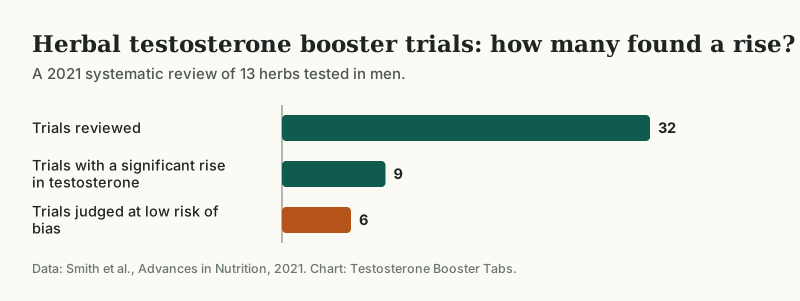
A separate 2021 review looked only at herbs. It found 13 herbs tested in 32 trials. Just 9 of the 32 trials showed a statistically significant rise in testosterone, and only 6 were judged to have a low risk of bias. Fenugreek seed extract and ashwagandha had the best support.[4]
The evidence for each ingredient
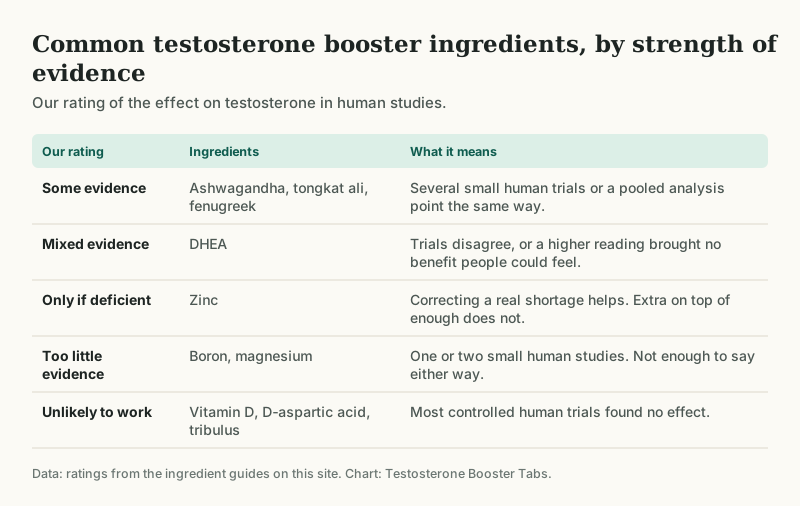
Each row links to a full guide, where the studies behind the rating are cited. Our editorial policy explains the labels.
| Ingredient | Our rating | Main caveat |
|---|---|---|
| Ashwagandha | Some evidence | Small, short trials. Rare cases of liver injury. |
| Tongkat ali | Some evidence | Few trials, most of them small and short. |
| Fenugreek | Some evidence | Mostly tested as branded extracts. |
| DHEA | Mixed evidence | It is a hormone, not a nutrient. Banned in sport. |
| Zinc | Only if deficient | No effect in men who already get enough. |
| Boron | Too little evidence | One study of eight men against one null trial. |
| Magnesium | Too little evidence | One small trial with no placebo group. |
| Vitamin D | Unlikely to work | Placebo-controlled trials found no effect. |
| D-aspartic acid | Unlikely to work | No effect in trained men. A high dose lowered testosterone. |
| Tribulus terrestris | Unlikely to work | Human trials consistently show no change. |
People also ask about gym supplements that are not sold as boosters. The best-known is covered in does creatine increase testosterone?
Do you feel anything when a booster raises testosterone?
Not necessarily. Even when a supplement raises testosterone in a trial, you may not notice anything.
A good example is a 2019 crossover trial of ashwagandha in 57 overweight men aged 40 to 70 with mild fatigue. Testosterone rose 14.7% more with ashwagandha than with placebo. Yet there were no significant differences between the groups in fatigue, vigour or sexual wellbeing.[5]
It also helps to know how wide the normal range is. See normal testosterone levels by age for the numbers.
Who might see a real effect?
The clearest effects show up in people who start with a problem that can be fixed.
- A nutrient deficiency. In one small study, older men who were marginally short of zinc saw their testosterone roughly double after 3 to 6 months of zinc.[9] Extra zinc does not help men who already get enough.
- Excess weight. In a pooled analysis of 24 studies, a low-calorie diet raised testosterone by an average of 2.87 nmol/L.[10]
- Short sleep. In a study of 10 young men, a week of 5-hour nights lowered daytime testosterone by 10 to 15%.[11]
Our guides to natural ways to support testosterone and foods that boost testosterone cover these in detail.
When is a booster the wrong tool?
Tiredness, low mood and a low sex drive have many causes. Low testosterone is only one of them.
The Endocrine Society’s guideline says low testosterone should be diagnosed only when a man has both symptoms and blood tests that are clearly and repeatedly low.[8] If that is you, the cause needs to be found, and treatment is a medical decision. A supplement can delay that.
Start with these guides:
How to read a testosterone booster label
If you are looking at a product anyway, these checks cost nothing.
- Be wary of “proprietary blends”. If the label does not give the amount of each ingredient, you cannot compare it with any study.
- Check the vitamins and minerals. In the 50-product study, boosters contained a median of 272% of the recommended daily amount of zinc and 1,291% for vitamin B12. Thirteen products exceeded official upper limits for zinc, vitamin B3 or magnesium.[1]
- Ignore the reviews. See the Amazon study above.[2]
- Think about what is not on the label. Between 2007 and 2016, the FDA identified 776 dietary supplements that contained hidden drug ingredients.[7] Our guide to testosterone booster side effects covers this.
The bottom line
Most testosterone boosters are not supported by human evidence. A few ingredients have produced modest rises in small, short trials, and correcting a real deficiency can help. None of that makes a booster a treatment for low testosterone. If you have symptoms, get tested.
Common questions
Do testosterone boosters actually work?
Most do not. A 2024 systematic review of 52 studies covering 27 proposed boosters concluded that most fail to increase total testosterone. A few herbal extracts, such as ashwagandha and tongkat ali, were rated possibly effective in some groups of men.[3]
Do testosterone supplements work for older men?
The evidence is thinner than the marketing suggests. In a 2021 review of herbal boosters, half of the trials were in men under 40, not the older men these products are usually sold to.[4]
How long do testosterone boosters take to work?
There is no reliable answer, because most ingredients have not been shown to work at all. A 2021 review of herbal trials also cautioned that extracts and doses varied widely between studies.[3, 4]
Sources
- 'Testosterone Boosting' Supplements Composition and Claims Are not Supported by the Academic Literature (Clemesha et al., 2020) The World Journal of Men's Health
- Testosterone Imposters: An Analysis of Popular Online Testosterone Boosting Supplements (Balasubramanian et al., 2019) The Journal of Sexual Medicine
- Do "testosterone boosters" really increase serum total testosterone? A systematic review (Morgado et al., 2024) International Journal of Impotence Research
- Examining the Effects of Herbs on Testosterone Concentrations in Men: A Systematic Review (Smith et al., 2021) Advances in Nutrition
- A Randomized, Double-Blind, Placebo-Controlled, Crossover Study Examining the Hormonal and Vitality Effects of Ashwagandha ( Withania somnifera) in Aging, Overweight Males (Lopresti et al., 2019) American Journal of Men's Health
- Questions and Answers on Dietary Supplements US Food and Drug Administration
- Unapproved Pharmaceutical Ingredients Included in Dietary Supplements Associated With US Food and Drug Administration Warnings (Tucker et al., 2018) JAMA Network Open
- Testosterone Therapy in Men With Hypogonadism: An Endocrine Society Clinical Practice Guideline (Bhasin et al., 2018) The Journal of Clinical Endocrinology and Metabolism
- Zinc status and serum testosterone levels of healthy adults (Prasad et al., 1996) Nutrition
- Body weight loss reverts obesity-associated hypogonadotropic hypogonadism: a systematic review and meta-analysis (Corona et al., 2013) European Journal of Endocrinology
- Effect of 1 week of sleep restriction on testosterone levels in young healthy men (Leproult and Van Cauter, 2011) JAMA
Browse every ingredient and question in the full list of testosterone guides.