Ashwagandha and maca often sit side by side in “male vitality” products. On testosterone, the trials give opposite answers. Ashwagandha has pooled evidence of a rise. Maca was tested and did not move it. This page sets out the detail.
Ashwagandha vs maca at a glance
| Ashwagandha | Maca | |
|---|---|---|
| What it is | Withania somnifera, a herb from Ayurvedic medicine[9] | Lepidium meyenii, an Andean plant of the mustard family. The root is used[4] |
| Evidence for testosterone | Up 57.43 ng/dL on average in men, across pooled trials[1] | No change at any time point in a 12-week trial[2] |
| Evidence for sexual function | Better scores in one 8-week trial of 50 men[7] | Limited evidence across 4 small trials[4] |
| Doses in the cited trials | 300 mg of root extract twice a day[7] | 1,500 mg or 3,000 mg a day[2] |
| Main risks | Drowsiness, stomach upset, rare liver injury, drug interactions[9, 10] | Not reported in the trial summaries cited here |
| Who it suits | Men whose main interest is testosterone or stress | Men interested in sexual desire, not hormone levels |
What is each one?
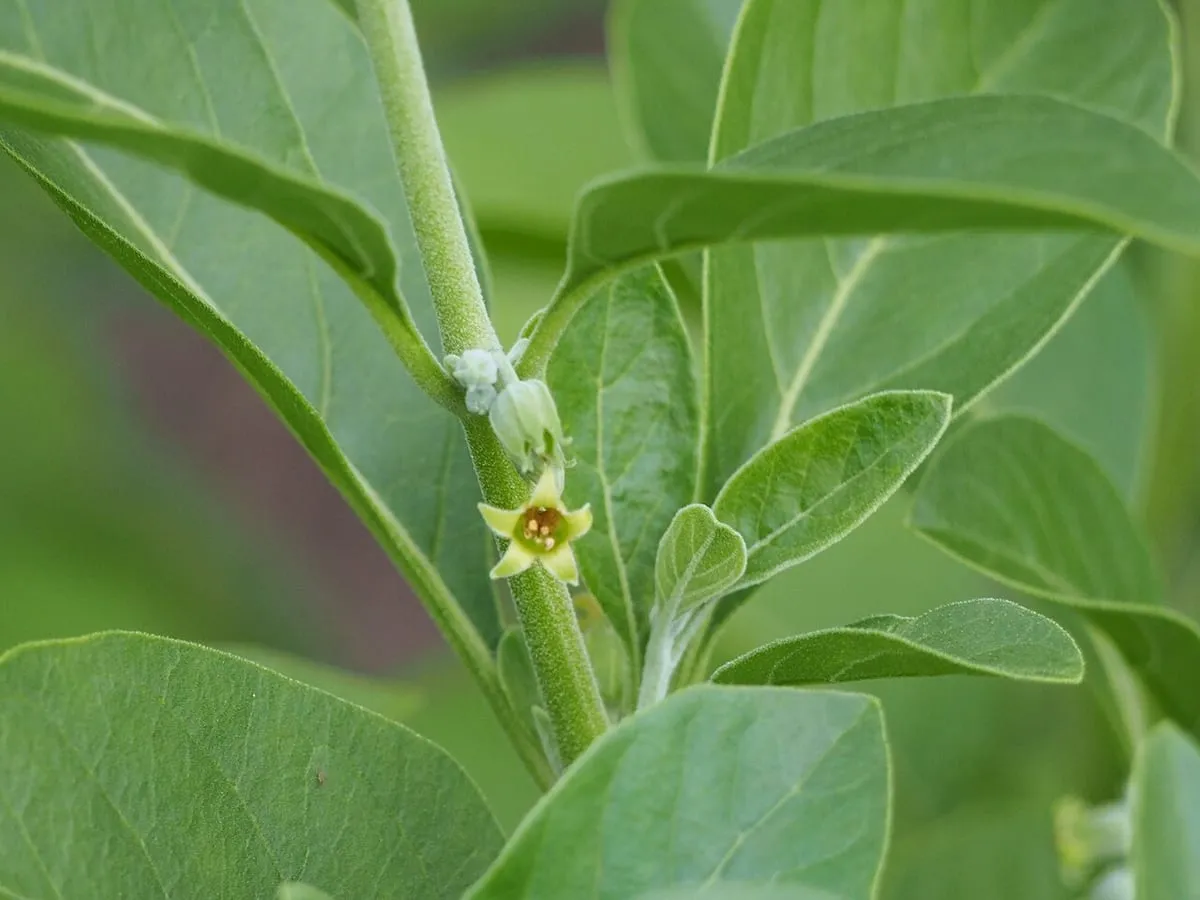
Ashwagandha is a shrub whose root has long been used in Ayurvedic medicine.[9] See our ashwagandha and testosterone guide.
Maca grows in the central Andes of Peru at 4,000 to 4,500 metres. It is traditionally used there as an aphrodisiac and to aid fertility.[2] It belongs to the mustard family, and it is the root that goes into supplements.[4]
Which one raises testosterone?
Ashwagandha, on the evidence so far.
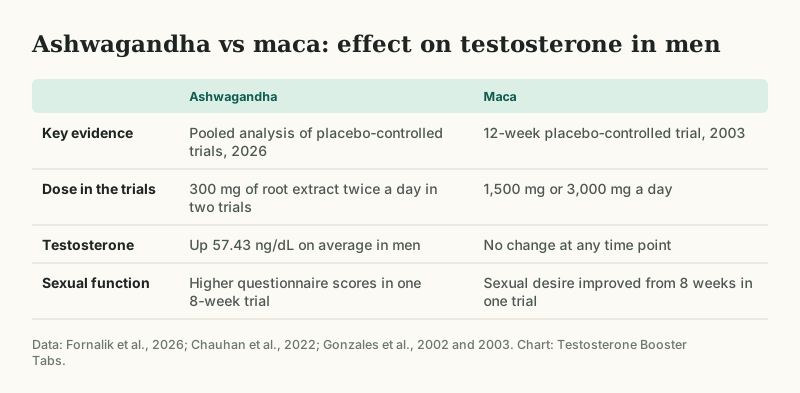
Ashwagandha. A 2026 pooled analysis of 23 placebo-controlled trials in 1,706 people found testosterone rose by 57.43 ng/dL on average in men, with results that varied between trials.[1] In one trial, overweight men aged 40 to 70 saw a 14.7% greater rise than with placebo over 8 weeks.[8] A 2021 systematic review of herbs named ashwagandha as one of two with positive effects on testosterone.[11]
Maca. Researchers gave men aged 21 to 56 either 1,500 mg or 3,000 mg of maca a day, or placebo, for 12 weeks. They measured testosterone, estradiol and other reproductive hormones at 2, 4, 8 and 12 weeks. Maca had no effect on any of them.[2]
A 2024 review of testosterone boosters found only two maca studies to assess.[6] Most ingredients in that review failed to show an effect, as our guide to whether testosterone boosters work explains.
Which is better for sex drive?
This is where maca has something to show.
In the same 12-week trial, men taking maca reported better sexual desire from week 8 onwards. The effect was independent of testosterone, estradiol, and depression and anxiety scores.[3] In other words, maca may affect desire without touching hormones.
The wider evidence is thin. A 2010 systematic review found four randomised trials. Two suggested a benefit for sexual desire or function, one found no effect in healthy cyclists, and one found an effect in men with erectile dysfunction. The reviewers called the evidence limited, and said the trials were too few and too small for firm conclusions.[4]
For ashwagandha, one trial stands out. Fifty men with low sexual desire took 300 mg of root extract twice a day for 8 weeks. Sexual function scores and blood testosterone both rose compared with placebo.[7] But in the trial of overweight older men, sexual wellbeing was no better than placebo.[8]

What about fertility?
Maca is traditionally used for fertility, but trials have not confirmed it. A 2022 review of five randomised trials found mixed results for semen quality in men with infertility and in healthy men. The pooled result for sperm concentration was no better than placebo.[5]
How do the side effects compare?
Ashwagandha has known cautions. It may be safe for up to three months, and its long-term safety is unknown. It can cause drowsiness, stomach upset, diarrhoea and vomiting. It is not advised in pregnancy or for people with thyroid or autoimmune disorders, and it may interact with several medicines.[9] Rare cases of liver injury have been reported.[10]
Maca is harder to judge. The trial reports and reviews cited here do not give safety results in their summaries, and the trials were small and short.[2, 4, 5] A lack of reported harm in small trials is not proof of safety.
Our guide to testosterone booster side effects covers the general risks of supplements.
Which one? Ashwagandha or maca
If your goal is testosterone, maca is the wrong choice. The trial that tested it found no change. Ashwagandha has a modest positive result.[1, 2]
If your goal is sexual desire, both have a little evidence and neither is proven. Maca’s effect did not depend on hormones.[3, 4]
If your goal is fertility, neither is established. Maca’s semen results are unclear.[5]
If you have ongoing symptoms, check the list in low testosterone symptoms and consider a blood test before buying anything.
Other pairings: ashwagandha vs tongkat ali, ashwagandha vs ginseng and tongkat ali vs fadogia agrestis. For food-based options, see foods that boost testosterone.
The bottom line
Ashwagandha has trial evidence for a modest rise in testosterone. Maca does not: it left hormones unchanged, though it improved sexual desire in one trial. No study we found compares the two directly. Choose by your goal, and keep expectations low for both.
Common questions
Does maca increase testosterone?
Not in the trial that tested it. Men took 1,500 mg or 3,000 mg of maca a day for 12 weeks, and testosterone was unaffected at every time point.[2]
Is maca or ashwagandha better for libido?
Each has a little evidence and no trial compares them. Maca improved self-reported sexual desire from 8 weeks in one trial. Ashwagandha improved sexual function scores in one 8-week trial of men with low desire.[3, 7]
Can you take maca and ashwagandha together?
We found no trial of the two together, so the effect of combining them is untested. Ashwagandha can interact with several medicines.[9]
Does maca help fertility?
The evidence is unclear. A 2022 review of 5 trials found mixed results for semen quality, and the pooled result for sperm concentration was no better than placebo.[5]
Sources
- Hormonal Modulation with Withania somnifera: Systematic Review and Meta-Analysis of Randomized-controlled Trials (Fornalik et al., 2026) Planta Medica
- Effect of Lepidium meyenii (Maca), a root with aphrodisiac and fertility-enhancing properties, on serum reproductive hormone levels in adult healthy men (Gonzales et al., 2003) The Journal of Endocrinology
- Effect of Lepidium meyenii (MACA) on sexual desire and its absent relationship with serum testosterone levels in adult healthy men (Gonzales et al., 2002) Andrologia
- Maca (L. meyenii) for improving sexual function: a systematic review (Shin et al., 2010) BMC Complementary and Alternative Medicine
- Maca (Lepidium meyenii Walp.) on semen quality parameters: A systematic review and meta-analysis (Lee et al., 2022) Frontiers in Pharmacology
- Do "testosterone boosters" really increase serum total testosterone? A systematic review (Morgado et al., 2024) International Journal of Impotence Research
- Effect of standardized root extract of ashwagandha (Withania somnifera) on well-being and sexual performance in adult males: A randomized controlled trial (Chauhan et al., 2022) Health Science Reports
- A Randomized, Double-Blind, Placebo-Controlled, Crossover Study Examining the Hormonal and Vitality Effects of Ashwagandha ( Withania somnifera) in Aging, Overweight Males (Lopresti et al., 2019) American Journal of Men's Health
- Ashwagandha: Usefulness and Safety National Center for Complementary and Integrative Health (NIH)
- Ashwagandha-induced liver injury: A case series from Iceland and the US Drug-Induced Liver Injury Network (Björnsson et al., 2020) Liver International
- Examining the Effects of Herbs on Testosterone Concentrations in Men: A Systematic Review (Smith et al., 2021) Advances in Nutrition
One of our side-by-side comparisons. New here? Start with do testosterone boosters work?