Testosterone booster side effects come from three places: the listed ingredients, doses of vitamins and minerals far above what you need, and things that are not on the label at all. Most people who take a booster notice nothing. A few have been seriously harmed.
This guide sets out what is known, and where the gaps are.
Why are side effects hard to pin down?
Boosters are dietary supplements. In the United States, the Food and Drug Administration (FDA) does not have the authority to approve dietary supplements before they are marketed. In general, a company does not have to give the FDA the evidence it relies on to show its product is safe.[1]
Two further problems follow.
- Blends. In a study of 50 boosters, products contained an average of 8.3 ingredients each, and 109 different ingredients in total.[3] If something goes wrong, it is hard to know which one was responsible.
- Short trials. The studies behind herbal ingredients are mostly small and short. A 2021 systematic review of 32 herbal trials said more research is needed before firm conclusions on safety can be made.[11]
For whether the products work at all, see do testosterone boosters work?
What are the side effects of common ingredients?
Ashwagandha
The US National Center for Complementary and Integrative Health (NCCIH) says ashwagandha can cause drowsiness, stomach upset, diarrhoea and vomiting. It also notes rare cases of liver injury.[4]
A case series from Iceland and the United States described five people with liver injury attributed to ashwagandha supplements. They developed jaundice 2 to 12 weeks after starting. None developed liver failure.[5]
NCCIH advises against ashwagandha in pregnancy and for people with autoimmune or thyroid disorders.[4] More in ashwagandha and testosterone.
Fenugreek
Possible side effects include diarrhoea, nausea and other digestive symptoms. Large doses may cause a harmful drop in blood sugar, and fenugreek can cause allergic reactions. It is not safe during pregnancy in amounts greater than those found in food.[6] See fenugreek benefits for men.
DHEA
DHEA stands apart because it is a hormone. Mayo Clinic says it might raise androgen levels and have a steroid effect, might lower HDL (“good”) cholesterol, and might cause oily skin, acne and unwanted hair growth in women. Its advice is to avoid it.[10] It is also banned in sport.[13] See DHEA and testosterone.
Tongkat ali, tribulus and D-aspartic acid
For these, the main issue is how little is known. Their trials were short and small. We cover each in tongkat ali, tribulus terrestris and D-aspartic acid.
One finding is worth knowing. In a trial of 24 trained men, 6 g of D-aspartic acid a day for 14 days lowered total and free testosterone.[12]
Can you get too much of the vitamins and minerals?
Yes, and boosters make it easy.
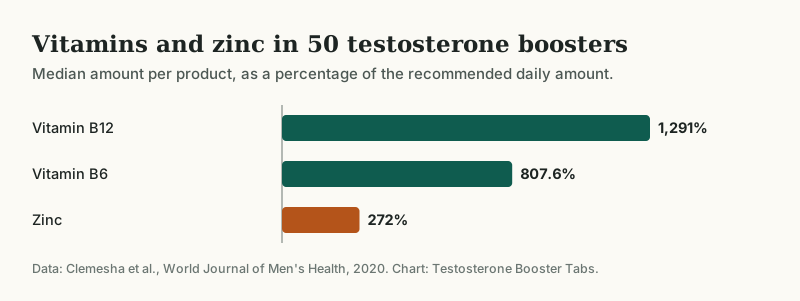
A 2020 study analysed 50 testosterone boosters found through a Google search. The products contained a median of 1,291% of the recommended daily amount of vitamin B12, 807.6% of vitamin B6 and 272% of zinc. Thirteen products exceeded official upper limits for zinc, vitamin B3 or magnesium.[3]
Why this matters:
- Zinc. High doses reduce the amount of copper the body can absorb, which can lead to anaemia and weakening of the bones. The NHS advises against taking more than 25 mg of zinc supplements a day unless a doctor says so.[7] See does zinc increase testosterone?
- Magnesium. Taking more than 400 mg for a short time can cause diarrhoea.[7] See magnesium and testosterone.
- Vitamin D. The safe upper limit for adults is 4,000 IU a day.[8] See vitamin D and testosterone.
- Boron. A review gives an upper level of 20 mg a day for adults.[14] See boron and testosterone.
If you take a booster and a multivitamin together, add up the totals.
What about ingredients that are not on the label?
This is the most serious risk, and you cannot check for it yourself.
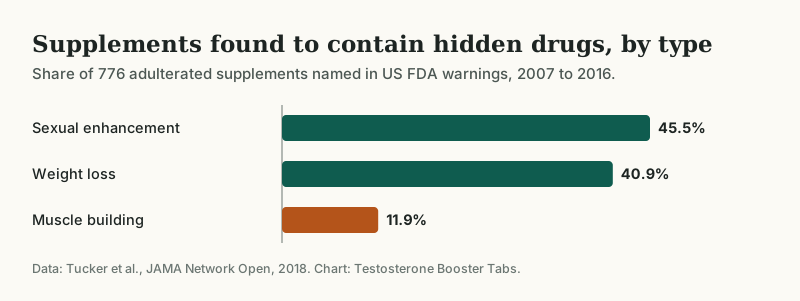
A 2018 study analysed FDA warnings from 2007 to 2016. The agency had identified 776 dietary supplements containing unapproved drug ingredients, sold by 146 companies.[2]
- 45.5% were marketed for sexual enhancement. The most common hidden drug was sildenafil, a prescription erection medicine.
- 40.9% were marketed for weight loss.
- 11.9% were marketed for muscle building. Of those 92 products, 89.1% contained synthetic steroids or steroid-like ingredients.
About one in five of the products contained more than one unapproved ingredient.[2] The authors warned that these drugs could cause serious harm through accidental misuse, overuse or interaction with other medicines.[2]
Testosterone boosters sit where two of those categories meet: sexual enhancement and muscle building.
Why hidden steroids matter
A product spiked with a steroid may well “work”, for the wrong reason. Anabolic steroids switch off the body’s own testosterone production and carry real risks. We explain these in is testosterone a steroid? Their effects on hair are covered in does testosterone cause hair loss?
They also matter if you compete. Anabolic agents are prohibited at all times under the World Anti-Doping Agency’s list.[13]
Can testosterone boosters harm your liver?
The evidence is limited to case reports, which cannot prove cause.
- The ashwagandha case series above: five people, all recovered without liver failure.[5]
- A 2018 case report described one athlete admitted with abdominal pain after courses of a commercial testosterone booster. His blood tests suggested the product might have affected liver function. The authors called for larger studies.[9]
Yellowing of the skin or eyes, dark urine or persistent abdominal pain after starting any supplement are reasons to stop and see a doctor promptly.
Can a booster make testosterone go down?
It is possible. In the study of 50 products, 10.1% of the ingredients had published data showing a decrease in testosterone.[3] The D-aspartic acid trial above is one example.[12]
By contrast, creatine, often stacked with boosters, has not been shown to change testosterone in either direction in most studies.
Who should be most careful?
Talk to a doctor or pharmacist before taking a booster if you:
- take any regular medicine. The FDA advises everyone to check with a health professional before using a supplement, because some interact with medicines.[1]
- have diabetes, since fenugreek may lower blood sugar.[6]
- have a thyroid or autoimmune condition, because of ashwagandha.[4]
- have, or have had, a hormone-sensitive cancer. Mayo Clinic warns that DHEA might raise the risk.[10]
- compete in a tested sport.[13]
Is prescription testosterone safer?
It is better understood, which is different. Prescription testosterone has known risks and is monitored with blood tests. We compare the two in testosterone boosters vs TRT. Too much testosterone has its own effects, set out in high testosterone in men.
The bottom line
The listed ingredients in most boosters cause mild side effects, if any. The larger risks are a rare liver reaction, vitamin and mineral doses well above safe limits, and hidden drugs that no label will reveal. Given how little most boosters do for testosterone, that is a poor trade.
Common questions
Do testosterone boosters have side effects?
They can. Ashwagandha can cause drowsiness, stomach upset, diarrhoea and vomiting, and fenugreek can cause diarrhoea and nausea.[4, 6] Products may also contain far more of a vitamin or mineral than you need.[3]
Can testosterone boosters damage your liver?
Rarely. A case series described five people with liver injury attributed to ashwagandha supplements. None developed liver failure.[5] A single case report described an athlete whose blood tests suggested effects on the liver after courses of a commercial booster.[9]
Are testosterone boosters regulated?
They are regulated as dietary supplements. The US Food and Drug Administration does not have the authority to approve them before they are marketed, and it generally does not approve their claims.[1]
Can testosterone boosters contain steroids?
Some supplements have. Of 92 adulterated muscle-building supplements named in FDA warnings from 2007 to 2016, 89.1% contained synthetic steroids or steroid-like ingredients.[2]
Sources
- Questions and Answers on Dietary Supplements US Food and Drug Administration
- Unapproved Pharmaceutical Ingredients Included in Dietary Supplements Associated With US Food and Drug Administration Warnings (Tucker et al., 2018) JAMA Network Open
- 'Testosterone Boosting' Supplements Composition and Claims Are not Supported by the Academic Literature (Clemesha et al., 2020) The World Journal of Men's Health
- Ashwagandha: Usefulness and Safety National Center for Complementary and Integrative Health (NIH)
- Ashwagandha-induced liver injury: A case series from Iceland and the US Drug-Induced Liver Injury Network (Björnsson et al., 2020) Liver International
- Fenugreek: Usefulness and Safety National Center for Complementary and Integrative Health (NIH)
- Vitamins and minerals: Others NHS
- Vitamin D MedlinePlus, US National Library of Medicine
- Effect of testosterone boosters on body functions: Case report (Almaiman, 2018) International Journal of Health Sciences
- DHEA Mayo Clinic
- Examining the Effects of Herbs on Testosterone Concentrations in Men: A Systematic Review (Smith et al., 2021) Advances in Nutrition
- Three and six grams supplementation of d-aspartic acid in resistance trained men (Melville et al., 2015) Journal of the International Society of Sports Nutrition
- The Prohibited List World Anti-Doping Agency
- Nothing Boring About Boron (Pizzorno, 2015) Integrative Medicine
Part of our testosterone guides. New here? Start with do testosterone boosters work?