To test for testosterone levels you need a blood test, ideally taken in the morning after fasting, and repeated if the first result is low.[3] This guide explains how the test works, the difference between free and total testosterone, what SHBG is, and how to make sense of the numbers.

How to test for testosterone levels
A blood sample is taken from a vein. The best time is between 7 am and 10 am.[2] There are three types of test:[1]
- Total testosterone measures both bound and free testosterone. This is the most common test.
- Free testosterone measures only the unattached form. It is less common.
- Bioavailable testosterone measures free testosterone plus testosterone attached to proteins other than SHBG. It is not commonly done.
The Endocrine Society’s guideline recommends starting with a fasting, morning total testosterone, using an accurate and reliable assay, and repeating it to confirm a low result.[3]
Why does the time of day matter?
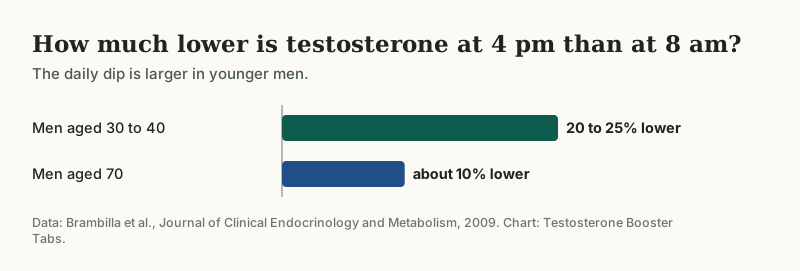
Testosterone is highest in the morning. In a study of 66 men, levels in men aged 30 to 40 were 20 to 25% lower at 4 pm than at 8 am. The gap shrank with age, to about 10% at age 70.[4]
That is enough to change a diagnosis. Seventeen men in the study had at least one afternoon reading below 300 ng/dL (10.4 nmol/L) but normal readings at every morning visit.[4]
Why fast before the test?
Food can lower the reading. In 74 men given a standard sugar drink, average testosterone fell by 25% and was still lower two hours later. Ten of the 66 men who started with normal levels dropped into the low range at some point. The researchers advised re-testing men with a low non-fasting result in the fasting state.[5]
Why is one test not enough?
Levels vary from day to day. In 132 men tested repeatedly, two measurements in the same man differed by more than 18 to 28% about half the time, depending on the hormone. The authors concluded that one sample is generally not enough to characterise a man’s hormone levels.[6]
Can you use an at-home testosterone test kit?
MedlinePlus says you may be able to test your testosterone with an at-home kit. These contain what you need to collect a blood or saliva sample and send it to a laboratory. It suggests talking to a health professional about whether a home test is right for you.[1]
The same rules apply to a kit as to a clinic test: sample in the morning, and treat one result as a starting point. A testosterone test alone cannot diagnose any health condition.[1]
Free vs total testosterone: what is the difference?
All the testosterone in your blood is either bound to proteins or unbound (free). Most is bound to sex hormone-binding globulin (SHBG) and albumin. When testosterone is bound, the body cannot use it as easily.[1]
Total testosterone counts all of it. Free testosterone counts only the unbound part.[1]
For most men, total testosterone is enough. The guideline recommends adding free testosterone when total testosterone is near the lower limit of normal, or when a man has a condition that alters SHBG.[3]
How is the free testosterone level measured?
Measuring it directly is difficult. MedlinePlus notes that the free testosterone blood test is often not very accurate.[2] The reference method, called equilibrium dialysis, is too slow for routine use. A 1999 study found that free testosterone calculated from total testosterone and SHBG was almost identical to the reference method, and that a common direct immunoassay was not reliable.[9]
So if your report shows “calculated free testosterone”, that is a recognised approach. The guideline accepts either equilibrium dialysis or an accurate formula.[3]
What is SHBG, and what does high SHBG mean?
SHBG is the main protein that carries testosterone in the blood. Doctors usually look at it alongside total testosterone to estimate how much testosterone is free.[8]
If SHBG is too high, less of your total testosterone is likely to be available to your tissues. High SHBG may be related to:[8]
- liver disease
- an overactive thyroid
- certain eating disorders
- oestrogen-containing medicines, such as menopause hormone therapy or birth control pills, in women.
If SHBG is too low, more of your total testosterone is likely to be free. Low SHBG may be related to an underactive thyroid, type 2 diabetes or insulin resistance, obesity, overuse of steroid medicines or anabolic steroids, and polycystic ovary syndrome in women.[8]
Age pushes SHBG up in men. In an Australian study of 1,786 men aged 35 to 80, older age went with higher SHBG, while more abdominal fat and higher triglycerides went with lower SHBG.[11] That is why an older, lean man can have a normal total testosterone and a lowish free testosterone, and an overweight man can have a low total with a normal free level.
Supplements such as boron are sold to lower SHBG. The evidence is one study of eight men, as we explain in boron and testosterone.
What do the results mean?
Results are reported in nanograms per decilitre (ng/dL) or nanomoles per litre (nmol/L). As a guide to converting, 300 ng/dL is 10.4 nmol/L.[4]
MedlinePlus gives these example normal ranges for total testosterone:[2]
- men aged 17 to 50: 249 to 836 ng/dL (8.6 to 29.0 nmol/L)
- men over 50: 193 to 740 ng/dL (6.7 to 25.7 nmol/L)
- women aged 17 to 50: 8.4 to 48.1 ng/dL (0.3 to 1.7 nmol/L)
- women over 50: 2.9 to 40.1 ng/dL (0.1 to 1.4 nmol/L).
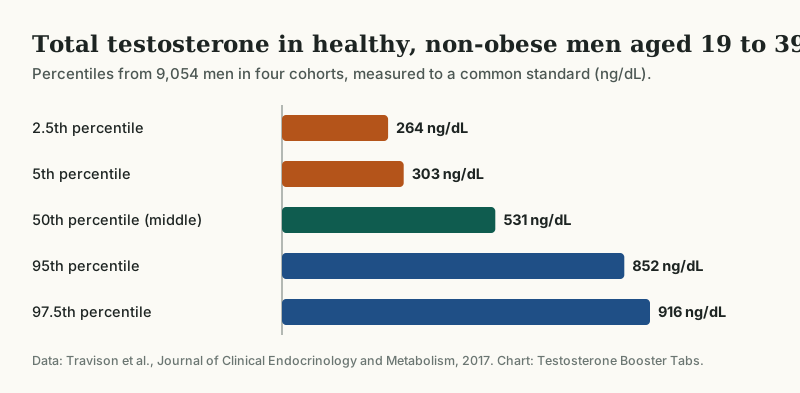
Normal ranges vary between laboratories.[2] A study that standardised measurements across four large cohorts put the range for healthy, non-obese men aged 19 to 39 at 264 to 916 ng/dL.[7]
For how levels change over a lifetime, see normal testosterone levels by age.
If your result is low
A low result with symptoms may point to a problem with the testicles or the pituitary gland, a long-term illness such as liver or kidney disease, or another cause.[1] Body weight and lifestyle matter too. In 208,677 UK men aged 40 to 69, testosterone was about 1.5 nmol/L lower at a body mass index of 30 than at 25.[12] Read low testosterone symptoms and testosterone and weight gain. Treatment options are in testosterone boosters vs TRT.
Some men wonder whether an earlier vasectomy could explain a low reading. A 2021 review concluded that vasectomy does not affect reproductive hormones in the long term.[13] See does a vasectomy affect testosterone?
If your result is high
In men, high testosterone may be caused by steroid use, a tumour in the testicles or an adrenal gland disorder. In women, causes include polycystic ovary syndrome.[1] See high testosterone in men and high testosterone in women.
What about free testosterone levels for women?
Women have much less testosterone than men, so the numbers are far smaller. A study of 161 healthy women aged 18 to 49 with regular cycles estimated these ranges (5th to 95th percentile) for a typical 30-year-old:[10]
- total testosterone: 15 to 46 ng/dL
- free testosterone: 1.2 to 6.4 pg/mL
- SHBG: 18 to 86 nmol/L.
The rise in testosterone at mid-cycle was small compared with the overall variation, so the authors said the ranges can be applied on any day of the cycle.[10] We cover symptoms in low testosterone in women.
The bottom line
Have the test in the morning, fasted, and repeat a low result. Total testosterone is the starting point. Free testosterone and SHBG help when the total is borderline or does not fit your symptoms. Always read your number against your own laboratory’s range, and let a doctor put it in context.
Common questions
How do you test for testosterone levels?
With a blood sample taken from a vein. The best time is between 7 am and 10 am, and a second sample is often needed to confirm a result that is lower than expected.[2]
What is the difference between free and total testosterone?
Total testosterone measures everything in the blood, both bound to proteins and unbound. Free testosterone measures only the unattached form, which the body can use most easily.[1]
What does high SHBG mean?
It likely means that less of your total testosterone is available for your tissues to use. High SHBG may be related to liver disease, an overactive thyroid, certain eating disorders and oestrogen-containing medicines.[8]
Are at-home testosterone test kits accurate?
MedlinePlus says you may be able to test with an at-home kit that collects a blood or saliva sample to send to a laboratory, and suggests talking to a health professional about whether it is right for you.[1] A single result, from any test, is not enough for a diagnosis.[3]
What are normal free testosterone levels for women?
One study of 161 healthy premenopausal women put the 5th to 95th percentile for a 30-year-old at 1.2 to 6.4 pg/mL for free testosterone and 15 to 46 ng/dL for total testosterone.[10] Ranges vary between laboratories.
Sources
- Testosterone Levels Test MedlinePlus, US National Library of Medicine
- Testosterone test MedlinePlus, US National Library of Medicine
- Testosterone Therapy in Men With Hypogonadism: An Endocrine Society Clinical Practice Guideline (Bhasin et al., 2018) The Journal of Clinical Endocrinology and Metabolism
- The effect of diurnal variation on clinical measurement of serum testosterone and other sex hormone levels in men (Brambilla et al., 2009) The Journal of Clinical Endocrinology and Metabolism
- Abrupt decrease in serum testosterone levels after an oral glucose load in men: implications for screening for hypogonadism (Caronia et al., 2013) Clinical Endocrinology
- Intraindividual variation in levels of serum testosterone and other reproductive and adrenal hormones in men (Brambilla et al., 2007) Clinical Endocrinology
- Harmonized Reference Ranges for Circulating Testosterone Levels in Men of Four Cohort Studies in the United States and Europe (Travison et al., 2017) The Journal of Clinical Endocrinology and Metabolism
- SHBG Blood Test MedlinePlus, US National Library of Medicine
- A critical evaluation of simple methods for the estimation of free testosterone in serum (Vermeulen et al., 1999) The Journal of Clinical Endocrinology and Metabolism
- Testosterone reference ranges in normally cycling healthy premenopausal women (Braunstein et al., 2011) The Journal of Sexual Medicine
- Cross-sectional and longitudinal determinants of serum sex hormone binding globulin (SHBG) in a cohort of community-dwelling men (Gyawali et al., 2018) PloS One
- Sociodemographic, lifestyle and medical influences on serum testosterone and sex hormone-binding globulin in men from UK Biobank (Yeap et al., 2021) Clinical Endocrinology
- Review of Vasectomy Complications and Safety Concerns (Yang et al., 2021) The World Journal of Men's Health
Part of our testosterone guides. New here? Start with do testosterone boosters work?