Ashwagandha and ginseng are both traditional herbs sold for energy, stress and male sexual health. They have been studied for different things. Ashwagandha’s trials lean towards stress and hormones. Ginseng’s lean towards erections. This page compares what each set of trials found.
“Ginseng” here means Asian ginseng, Panax ginseng. The trials cited used red ginseng, which is often sold as Korean red ginseng.[5, 6, 9]
Ashwagandha vs ginseng at a glance
| Ashwagandha | Asian ginseng | |
|---|---|---|
| What it is | Withania somnifera, a herb from Ayurvedic medicine[7] | Panax ginseng. Red ginseng is the form used in the cited trials[5, 6] |
| Evidence for testosterone | Up 57.43 ng/dL on average in men, across pooled trials[1] | Mixed: a rise in one trial, no difference in another[4, 5] |
| Evidence for sexual function | Better scores in one 8-week trial of 50 men[10] | Nine trials for erections. Gain judged trivial[2] |
| Doses in the cited trials | 300 mg of root extract twice a day[10] | 3 g of red ginseng a day[4, 5] |
| Main risks | Drowsiness, stomach upset, rare liver injury, drug interactions[7, 12] | Trouble sleeping; possible effects on blood sugar and clotting[6] |
| Who it suits | Men whose main interest is testosterone or stress | Men curious about erections who accept a small effect |
Which raises testosterone more?
Ashwagandha has the better case.
A 2026 pooled analysis of 23 placebo-controlled trials in 1,706 people found that ashwagandha raised testosterone in men by 57.43 ng/dL on average. Results varied between trials.[1] In one of those trials, overweight men aged 40 to 70 saw testosterone rise 14.7% more than with placebo over 8 weeks, with no difference in fatigue or sexual wellbeing.[11]
For ginseng, two trials point in different directions:
- 62 men with metabolic syndrome took 3 g of red ginseng a day for 4 weeks. Total testosterone rose compared with placebo.[4]
- 60 men with erectile dysfunction took 1,000 mg of Korean red ginseng three times a day for 12 weeks. Erection scores improved, but testosterone was no different from placebo.[5]
A 2021 systematic review of 13 herbs came to a similar view. It found positive effects on testosterone for fenugreek and ashwagandha, and only some evidence for Asian red ginseng.[3]
The full story is in our ashwagandha and testosterone guide.
Which is better for erections and sex drive?
Ginseng has been tested far more often. The results are modest.
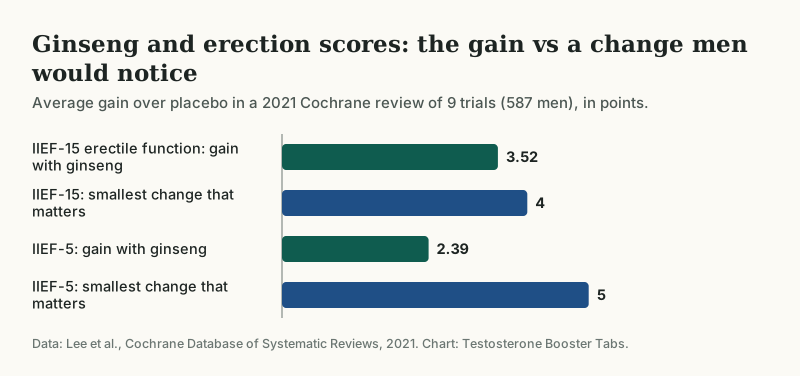
A 2021 Cochrane review pooled nine trials in 587 men with mild to moderate erectile dysfunction, lasting up to 12 weeks.[2]
- On one erection questionnaire, ginseng beat placebo by 3.52 points. The smallest change that matters is 4. The reviewers called the effect trivial, with low certainty.[2]
- On a shorter questionnaire, the gain was 2.39 points against a threshold of 5.[2]
- Men taking ginseng were more likely to say they could have intercourse.[2]
- Side effects were about as common as with placebo.[2]
An earlier review of seven red ginseng trials found a positive effect but rated the trials as low quality.[9] The US National Center for Complementary and Integrative Health says ginseng seems to improve sexual function in men with erectile dysfunction.[6]
Ashwagandha has less here. In 50 men with low sexual desire, 300 mg twice a day for 8 weeks improved sexual function scores and raised testosterone compared with placebo.[10]
Erection problems can be a sign of other conditions. Our guide to low testosterone symptoms explains when to see a doctor.
What about stress and energy?
Ashwagandha has the clearer stress data. A pooled analysis of 9 trials in 558 people found lower stress scores, less anxiety and lower cortisol.[13]
Ginseng is often sold for stamina. The evidence says otherwise: it does not appear to improve athletic performance.[6]
How do the side effects compare?
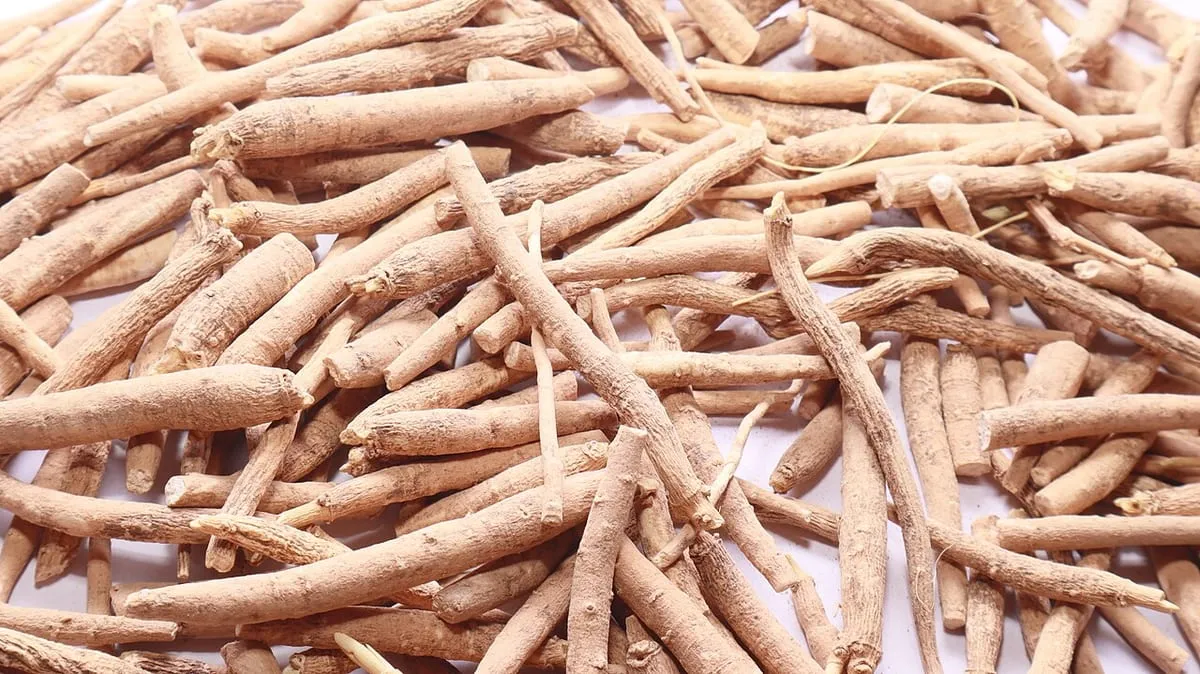

Ashwagandha may be safe for up to three months. Long-term safety is unknown. It can cause drowsiness, stomach upset, diarrhoea and vomiting, and it is not advised in pregnancy or for people with thyroid or autoimmune disorders.[7] Rare cases of liver injury have been reported, with jaundice starting 2 to 12 weeks after first use.[12]
Asian ginseng appears safe for most adults for up to six months. Trouble sleeping is the most common side effect. It may worsen autoimmune disorders, affect blood clotting and lower blood sugar.[6] An older safety review found side effects in trials were similar to placebo, most often headache, sleep problems and stomach trouble. It flagged possible interactions with warfarin, phenelzine and alcohol.[8]
Both herbs can interact with medicines.[6, 7] See testosterone booster side effects for the wider safety picture.
Which one? Ashwagandha or ginseng
For testosterone, ashwagandha. Its pooled evidence is positive, while ginseng’s trials disagree.[1, 4, 5]
For erections, ginseng has more trials, but expect little. The best review judged the gain too small to matter to most men.[2]
For stress, ashwagandha.[13]
If you take warfarin or diabetes medicines, be careful with ginseng in particular, and check with a pharmacist before either.[6, 8]
If you have symptoms of low testosterone, neither herb replaces a blood test. See boosters vs TRT.
More comparisons: ashwagandha vs tongkat ali, ashwagandha vs maca and tongkat ali vs fadogia agrestis. Or start with do testosterone boosters work?
The bottom line
Ashwagandha has the stronger evidence for testosterone and stress. Ginseng has more trials for erections, with a small average effect. No trial we found compares them head to head, and both come with interaction warnings.
Common questions
Does ginseng increase testosterone?
The trials disagree. Red ginseng raised total testosterone in one 4-week trial of 62 men with metabolic syndrome. In a 12-week trial of 60 men with erectile dysfunction, testosterone was no different from placebo.[4, 5]
Is ashwagandha or ginseng better for erectile dysfunction?
Ginseng has far more trials for erections, but a Cochrane review judged its effect on erection scores to be trivial. Ashwagandha improved sexual function scores in one 8-week trial of men with low desire.[2, 10]
Sources
- Hormonal Modulation with Withania somnifera: Systematic Review and Meta-Analysis of Randomized-controlled Trials (Fornalik et al., 2026) Planta Medica
- Ginseng for erectile dysfunction (Lee et al., 2021) The Cochrane Database of Systematic Reviews
- Examining the Effects of Herbs on Testosterone Concentrations in Men: A Systematic Review (Smith et al., 2021) Advances in Nutrition
- Effects of ginseng on peripheral blood mitochondrial DNA copy number and hormones in men with metabolic syndrome: A randomized clinical and pilot study (Jung et al., 2016) Complementary Therapies in Medicine
- Study of the efficacy of Korean Red Ginseng in the treatment of erectile dysfunction (de Andrade et al., 2007) Asian Journal of Andrology
- Asian Ginseng: Usefulness and Safety National Center for Complementary and Integrative Health (NIH)
- Ashwagandha: Usefulness and Safety National Center for Complementary and Integrative Health (NIH)
- Panax ginseng: a systematic review of adverse effects and drug interactions (Coon and Ernst, 2002) Drug Safety
- Red ginseng for treating erectile dysfunction: a systematic review (Jang et al., 2008) British Journal of Clinical Pharmacology
- Effect of standardized root extract of ashwagandha (Withania somnifera) on well-being and sexual performance in adult males: A randomized controlled trial (Chauhan et al., 2022) Health Science Reports
- A Randomized, Double-Blind, Placebo-Controlled, Crossover Study Examining the Hormonal and Vitality Effects of Ashwagandha ( Withania somnifera) in Aging, Overweight Males (Lopresti et al., 2019) American Journal of Men's Health
- Ashwagandha-induced liver injury: A case series from Iceland and the US Drug-Induced Liver Injury Network (Björnsson et al., 2020) Liver International
- Effects of Ashwagandha (Withania Somnifera) on stress and anxiety: A systematic review and meta-analysis (Arumugam et al., 2024) Explore
One of our side-by-side comparisons. New here? Start with do testosterone boosters work?