Zinc and magnesium are the two minerals most often added to testosterone supplements, sometimes together as ZMA. Both are essential nutrients. Whether extra amounts raise testosterone is a different question, and the answer depends mostly on whether you were short to begin with.
Zinc vs magnesium at a glance
| Zinc | Magnesium | |
|---|---|---|
| What it is | An essential mineral. Low levels can cause hypogonadism in males[8] | A mineral needed for more than 300 reactions in the body[9] |
| Evidence for testosterone | Rises when a zinc shortage is corrected[1, 2] | One small positive trial; a link in older men[5, 6] |
| Dose in the cited trials | Not given in the summaries we opened | 10 mg per kg of body weight a day for 4 weeks[5] |
| Daily amount for men | 9.5 mg[10] | 300 mg[10] |
| Main risks | High doses reduce copper absorption[10] | More than 400 mg can cause diarrhoea[10] |
| Who it suits | Men with a low zinc intake or a confirmed shortage | Men with a low magnesium intake |
What does the zinc evidence show?
Zinc matters most when it is missing.
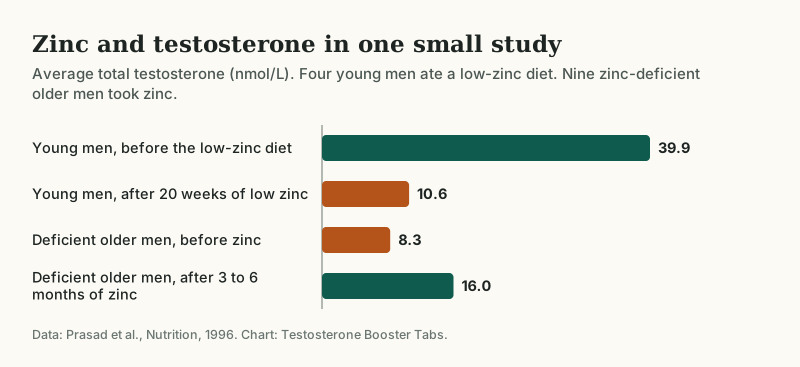
- Low-zinc diet. When young men were put on a diet low in zinc, their testosterone fell from 39.9 to 10.6 nmol/L.[1]
- Correcting a shortage. When older men who were marginally short of zinc took a supplement, testosterone rose from 8.3 to 16.0 nmol/L.[1]
- Infertile men. In 37 men, zinc raised testosterone and sperm count only in those whose testosterone was low at the start.[2]
A 2023 review of 38 papers reached the same conclusion: zinc deficiency lowers testosterone, and supplements raise it, with the size of the effect depending on starting zinc level, the form, the dose and how long it is taken.[7]
Hypogonadism in males is one of the listed signs of zinc deficiency.[8] Our zinc and testosterone guide has more, and zinc picolinate vs zinc gluconate compares the forms.
What does the magnesium evidence show?
There is less of it.
- One trial. Men took 10 mg of magnesium per kg of body weight a day for 4 weeks. Free and total testosterone rose in both sedentary men and tae kwon do athletes, and rose more in those who exercised.[5]
- One observational study. In 399 men aged 65 and over, higher magnesium in the blood went with higher total testosterone.[6] A link like this cannot show that magnesium caused the difference.
Magnesium is needed for nerve and muscle function and hundreds of other processes, but a true shortage is rare.[9] See our magnesium and testosterone guide.
Does ZMA work?
ZMA is a supplement that combines zinc and magnesium. Two trials tested it in men who exercise.
- 14 active men with adequate zinc. ZMA raised zinc in the blood. Total and free testosterone did not change.[3]
- 42 resistance-trained men. After 8 weeks of ZMA or placebo alongside training, there were no differences in hormones, body composition or strength.[4]
The first trial studied men who were not short of zinc. That fits the pattern above: topping up a mineral you already have enough of does little.
A 2024 review of testosterone boosters looked at five studies of zinc and magnesium products among its 52.[11] The general finding, covered in do testosterone boosters work?, was that most ingredients fail.
How much do you need, and how much is too much?
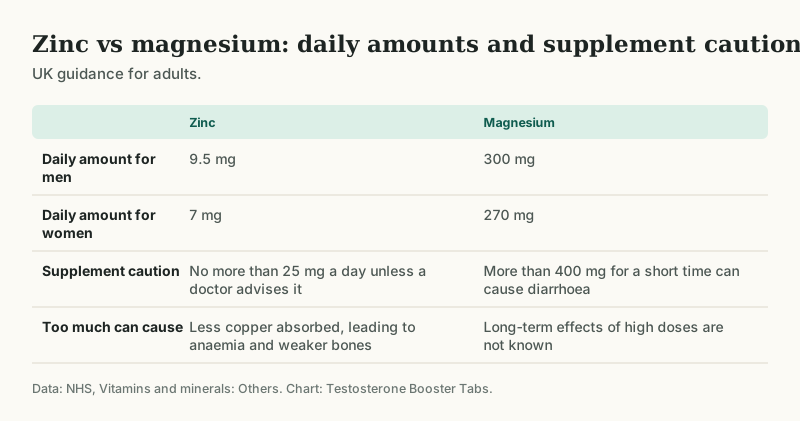
Zinc. Men need 9.5 mg a day and women 7 mg. Do not take more than 25 mg a day in supplements unless a doctor advises it. High doses reduce the copper the body can absorb, which can lead to anaemia and weaker bones.[10]
Magnesium. Men need 300 mg a day and women 270 mg. Taking more than 400 mg for a short time can cause diarrhoea. Good sources include spinach, nuts and wholemeal bread.[10]
Products do not always respect these limits. When researchers analysed 50 testosterone boosters, 13 contained more than the upper tolerable intake of zinc, vitamin B3 or magnesium.[12] Check the label, and read testosterone booster side effects.
US guidance is cautious too. MedlinePlus says zinc supplements beyond the recommended daily amount are not recommended, and that magnesium supplements are not currently advised.[8, 9]
Which one? Zinc or magnesium
If your diet is low in zinc, zinc is the one with evidence behind it. Correcting a shortage raised testosterone.[1, 2]
If your zinc intake is fine, more zinc is unlikely to help, and ZMA did nothing in two trials.[3, 4]
If you are choosing magnesium for testosterone, know that the case rests on one small trial and an observational link.[5, 6]
For most men, food comes first. A varied diet should cover both minerals.[10] See foods that boost testosterone. Another nutrient often discussed alongside these is covered in vitamin D2 vs D3.
The bottom line
Zinc affects testosterone when you are short of it, and not much otherwise. Magnesium has thinner evidence. ZMA, which combines them, failed to raise testosterone in men with adequate zinc. Stay within the daily limits for both.
Common questions
Is zinc or magnesium better for testosterone?
Zinc has the clearer evidence, but only for men who are short of it. In zinc-deficient older men, supplements raised testosterone from 8.3 to 16.0 nmol/L. Magnesium has one small positive trial.[1, 5]
Does ZMA increase testosterone?
Not in the two trials cited here. ZMA did not change total or free testosterone in 14 active men with adequate zinc, and made no difference to hormones or strength in 42 trained men over 8 weeks.[3, 4]
Can you take zinc and magnesium together?
ZMA products combine them, and one of the ZMA trials cited here ran for 8 weeks. Keep within the limits: no more than 25 mg of zinc a day from supplements, and no more than 400 mg of magnesium.[3, 4, 10]
How much zinc and magnesium do men need?
UK guidance is 9.5 mg of zinc and 300 mg of magnesium a day for men. Most people can get both from a varied diet.[10]
Sources
- Zinc status and serum testosterone levels of healthy adults (Prasad et al., 1996) Nutrition
- Effect of zinc administration on plasma testosterone, dihydrotestosterone, and sperm count (Netter et al., 1981) Archives of Andrology
- Serum testosterone and urinary excretion of steroid hormone metabolites after administration of a high-dose zinc supplement (Koehler et al., 2009) European Journal of Clinical Nutrition
- Effects of Zinc Magnesium Aspartate (ZMA) Supplementation on Training Adaptations and Markers of Anabolism and Catabolism (Wilborn et al., 2004) Journal of the International Society of Sports Nutrition
- Effects of magnesium supplementation on testosterone levels of athletes and sedentary subjects at rest and after exhaustion (Cinar et al., 2011) Biological Trace Element Research
- Magnesium and anabolic hormones in older men (Maggio et al., 2011) International Journal of Andrology
- Correlation between serum zinc and testosterone: A systematic review (Te et al., 2023) Journal of Trace Elements in Medicine and Biology
- Zinc in diet MedlinePlus, US National Library of Medicine
- Magnesium in diet MedlinePlus, US National Library of Medicine
- Vitamins and minerals: Others NHS
- Do "testosterone boosters" really increase serum total testosterone? A systematic review (Morgado et al., 2024) International Journal of Impotence Research
- 'Testosterone Boosting' Supplements Composition and Claims Are not Supported by the Academic Literature (Clemesha et al., 2020) The World Journal of Men's Health
One of our side-by-side comparisons. New here? Start with do testosterone boosters work?