Zinc supplements list the mineral with a second word: gluconate, picolinate, citrate, oxide. That word names the form of zinc in the product, and people often ask whether picolinate is absorbed better than gluconate. This page looks at what the human studies show, and whether the form makes any difference to zinc and testosterone.
Zinc picolinate vs zinc gluconate at a glance
| Zinc picolinate | Zinc gluconate | |
|---|---|---|
| What it is | A supplement form of zinc, tested in one comparison trial[1] | A common supplement form of zinc[5] |
| Absorption evidence | Raised hair, urine and red blood cell zinc in 15 people[1] | About 61% of a dose absorbed in 15 people[2] |
| Evidence for testosterone | No trial among the sources here | Raised testosterone in nine zinc-deficient older men[7] |
| Dose in the cited trials | 50 mg of zinc a day for 4 weeks[1] | 50 mg a day for 4 weeks; 10 mg single dose[1, 2] |
| Main risks | High doses of zinc block copper absorption[6] | The same[6] |
| Who it suits | People who already use it and stay within the limit | People who want the form with the most human data |
What is the difference between the two?
Both deliver the same mineral. Supplements may contain zinc gluconate, zinc sulfate or zinc acetate, and MedlinePlus says it is not known whether one form is better than the others.[5] Picolinate is not on that list.
The question is how much of the zinc reaches your body. The studies below measure that in two ways: by tracking zinc levels in blood and tissue over weeks, or by labelling a dose and measuring how much is absorbed.
What did the head-to-head trial find?
There is one, from 1987. Fifteen healthy volunteers took part in a double-blind crossover trial. Each took zinc picolinate, zinc citrate, zinc gluconate and a placebo for four weeks at a time. The dose was 50 mg of elemental zinc a day.[1]
- With picolinate, zinc rose significantly in hair, urine and red blood cells.
- With gluconate and citrate, none of those measures changed significantly.
- Blood (serum) zinc did not change significantly with any form.[1]
That favours picolinate. But it is a single study of 15 people, and blood zinc showed no difference. Treat it as a hint.
How well is zinc gluconate absorbed?
Well, on the evidence. A 2014 study gave 15 healthy adults 10 mg of zinc without food and used isotope labels to track it.[2]
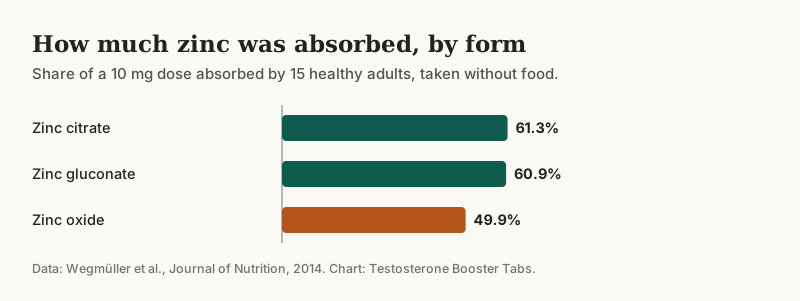
Absorption was 61.3% from citrate and 60.9% from gluconate. Zinc oxide came in significantly lower at 49.9%, and three people absorbed little or none from it.[2]
A 2024 review pulled the human studies together. It concluded that zinc glycinate and zinc gluconate are better absorbed than other forms.[3] Glycinate has its own small study behind it: in 12 women, a single 15 mg dose was 43.4% more available as bisglycinate than as gluconate.[4]
So gluconate sits near the top of the forms tested, with more than one study behind it. Picolinate has one positive trial and little since.
Does the form matter for testosterone?
There is no sign that it does. No study has tested picolinate against gluconate with testosterone as the outcome.
What the research does show is that your zinc status matters far more than the label:
- In four young men, a low-zinc diet cut testosterone from 39.9 to 10.6 nmol/L over 20 weeks.[7]
- In nine older men who were marginally short of zinc, zinc gluconate for three to six months raised testosterone from 8.3 to 16.0 nmol/L.[7]
- In 14 active men already eating enough zinc, a zinc-containing supplement raised blood zinc but did not change total or free testosterone.[8]
A 2023 review of 38 studies reached the same view: the effect depends on your starting zinc and testosterone levels, the form, the dose and the duration.[9] Zinc deficiency is not rare worldwide. One review puts 17 to 20% of people at risk.[3] MedlinePlus lists hypogonadism in males among the signs of deficiency.[5]
This is why zinc earns an “only if deficient” rating in our overview of whether testosterone boosters work.
How much is too much?
More than the form, watch the dose. The NHS says men need about 9.5 mg of zinc a day and women 7 mg, and that you should be able to get it all from food. Good sources include meat, shellfish, dairy foods and bread.[6]


The NHS advises against taking more than 25 mg of zinc supplements a day unless a doctor tells you to. High doses reduce the copper your body can absorb, which can lead to anaemia and weaker bones.[6] The head-to-head trial used 50 mg a day, double that figure.[1]
Our guide to foods and testosterone covers dietary zinc, and booster side effects covers what happens when blends stack minerals.
Which one? Picolinate or gluconate
It probably does not matter much. Both are absorbed. Picolinate won the only direct comparison, on tissue measures in 15 people.[1] Gluconate has the wider evidence base and is the form used in the testosterone study.[2, 3, 7]
Avoid zinc oxide if absorption is your concern. It was the weakest form in the isotope study.[2]
Neither will raise testosterone if you already get enough zinc.[8] If you think you may be short of it, symptoms of low testosterone and a blood test are a better guide than a supplement.
Zinc is often sold with a second mineral. See zinc vs magnesium for that pairing, and magnesium and testosterone for the mineral on its own. For another form-versus-form question, see vitamin D2 vs D3.
The bottom line
Zinc picolinate has one small trial in its favour. Zinc gluconate is well absorbed and better studied. Choose either, keep to 25 mg a day or less unless a doctor says otherwise, and do not expect a rise in testosterone unless you were short of zinc to begin with.
Common questions
Is zinc picolinate better than zinc gluconate?
There is only one head-to-head trial. In 15 volunteers, picolinate raised zinc in hair, urine and red blood cells over four weeks and gluconate did not. It is a small, old study and has not settled the question.[1]
Which form of zinc is best absorbed?
A 2024 review concluded that zinc glycinate and zinc gluconate are better absorbed than other forms. Zinc oxide was absorbed less well than citrate or gluconate in an isotope study.[2, 3]
How much zinc is safe to take?
The NHS says not to take more than 25 mg of zinc supplements a day unless a doctor advises it. High doses reduce the copper your body can absorb, which can lead to anaemia and weaker bones.[6]
Sources
- Comparative absorption of zinc picolinate, zinc citrate and zinc gluconate in humans (Barrie et al., 1987) Agents and Actions
- Zinc absorption by young adults from supplemental zinc citrate is comparable with that from zinc gluconate and higher than from zinc oxide (Wegmüller et al., 2014) The Journal of Nutrition
- Comparative Absorption and Bioavailability of Various Chemical Forms of Zinc in Humans: A Narrative Review (Devarshi et al., 2024) Nutrients
- A bioavailability study comparing two oral formulations containing zinc (Zn bis-glycinate vs. Zn gluconate) after a single administration to twelve healthy female volunteers (Gandia et al., 2007) International Journal for Vitamin and Nutrition Research. Internationale Zeitschrift Fur Vitamin- Und Ernahrungsforschung. Journal International De Vitaminologie Et De Nutrition
- Zinc in diet MedlinePlus, US National Library of Medicine
- Vitamins and minerals: Others NHS
- Zinc status and serum testosterone levels of healthy adults (Prasad et al., 1996) Nutrition
- Serum testosterone and urinary excretion of steroid hormone metabolites after administration of a high-dose zinc supplement (Koehler et al., 2009) European Journal of Clinical Nutrition
- Correlation between serum zinc and testosterone: A systematic review (Te et al., 2023) Journal of Trace Elements in Medicine and Biology
One of our side-by-side comparisons. New here? Start with do testosterone boosters work?