Vitamin D supplements come in two forms. Vitamin D2 is also called ergocalciferol and vitamin D3 is also called cholecalciferol.[6] Labels often list one or the other, and people ask which is worth buying. This page compares them on the thing trials have measured: how much each one raises the vitamin D level in your blood. It also covers what that means for testosterone, which is why vitamin D ends up in so many testosterone boosters.
Vitamin D2 vs D3 at a glance
| Vitamin D2 | Vitamin D3 | |
|---|---|---|
| What it is | Ergocalciferol[6] | Cholecalciferol[6] |
| Effect on blood vitamin D | Raises it, but less than D3 in pooled trials[1, 2] | Raises it more than D2 in pooled trials[1, 2] |
| Evidence for testosterone | Not tested in the testosterone trials cited here | No significant effect in two 12-week trials of D3[8, 9] |
| Doses in the cited trials | 1,000 IU a day; single 50,000 IU dose[3, 4] | 1,000 IU a day; single 50,000 IU dose; 20,000 IU a week[3, 4, 8] |
| Main risks | Too much vitamin D can harm the kidneys[6] | The same. The adult upper limit is 4,000 IU a day[6] |
| Who it suits | People already prescribed it, or who need a daily low dose | Most people choosing a supplement to correct a low level |
What is the difference between vitamin D2 and D3?
They are two forms of the same vitamin. Both raise the blood level of 25-hydroxyvitamin D, written 25(OH)D.[4] This is the form a blood test measures, and it is the best measure of your vitamin D status.[6]
Your skin also makes vitamin D in sunlight. How much it makes varies a lot from person to person. Cloud, shade and darker skin all cut the amount.[6] That is one reason supplements are common, and why the form in the bottle matters.
Which raises blood vitamin D more?
D3, in most studies.
- A 2012 pooled analysis of randomised trials found that D3 raised blood 25(OH)D more than D2. The difference was clear with large single doses. It was lost with daily doses.[1]
- A 2021 pooled analysis covered 24 studies and 1,277 healthy people. D3 raised total 25(OH)D by 15.69 nmol/L more than D2 on average.[2]
- A 2024 analysis covered 20 comparative studies. In 12 daily-dose comparisons measured by mass spectrometry, the rise in total 25(OH)D was 10.39 nmol/L lower with D2, about 40% less. Body weight changed the picture: the gap mostly lost significance in people with a body mass index above 25.[5]
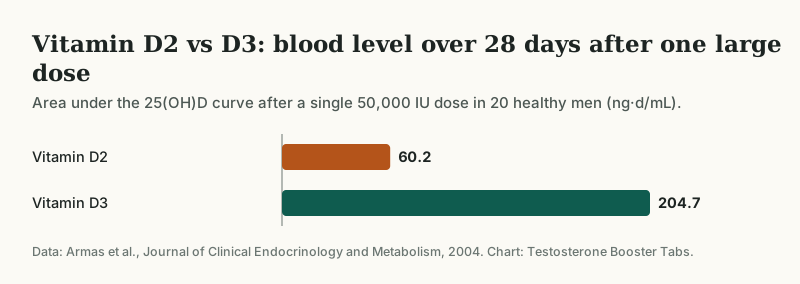
The chart shows the starkest example. Twenty healthy men took a single 50,000 IU dose of D2 or D3. Both raised blood levels equally for the first three days. With D3 the level kept climbing and peaked at day 14. With D2 it fell back, and by day 14 it was no different from the starting level. The authors put the potency of D2 at less than one third that of D3.[3]
Does the dosing schedule matter?
Yes. The big gaps show up with large doses taken once or spaced far apart.[1, 3]
A daily low dose tells a different story. In an 11-week trial, healthy adults took 1,000 IU a day of D2, D3 or a half-and-half mix. Blood levels rose to the same extent in all three groups: from 16.9 to 26.8 ng/mL with D2, and from 19.6 to 28.9 ng/mL with D3.[4]
The same trial has a second lesson. About 60% of the volunteers were short of vitamin D at the start, and 1,000 IU a day of either form did not lift them above 30 ng/mL.[4] The dose and your starting level can matter as much as the form.
Does either form raise testosterone?
This is where the marketing runs ahead of the research. Our vitamin D and testosterone guide covers it in full. In brief:
- One early study found a rise. Men in a weight-loss programme took about 3,332 IU a day for a year, and total testosterone rose from 10.7 to 13.4 nmol/L. It did not change with placebo.[7]
- Two later trials were designed to test the idea. Both gave 20,000 IU of D3 a week for 12 weeks. Neither found an effect on total testosterone, in 98 healthy men or in 100 men with low testosterone.[8, 9]
- A 2026 pooled analysis found no clear effect on total testosterone (0.47 nmol/L, with a range that included zero). The authors rated the certainty as low.[10]
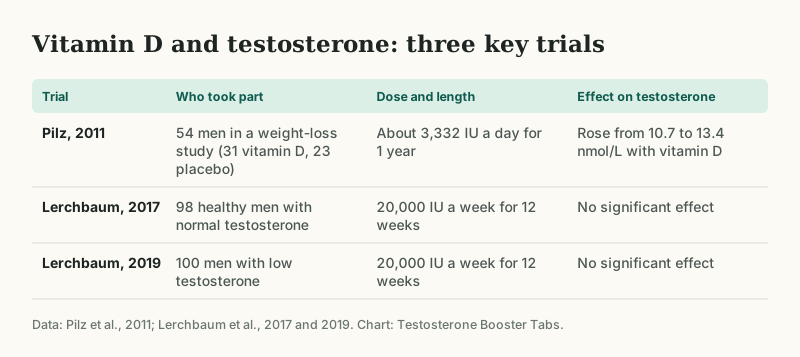
So the choice between D2 and D3 will not change your testosterone. If low testosterone is the worry, a testosterone blood test and a look at the symptoms are better first steps. Our guide to supporting testosterone naturally covers sleep, weight and exercise.
Is one form safer?
The sources we checked do not set separate safety limits for the two forms. MedlinePlus gives one upper limit for adults: 4,000 IU (100 micrograms) a day. Too much vitamin D can cause nausea, vomiting, constipation, poor appetite, weakness, kidney stones and kidney damage.[6]
If a booster blend contains vitamin D and you also take a multivitamin, add the amounts up. Our guide to testosterone booster side effects covers stacking doses.
Which one? D2 or D3
For most people choosing a supplement, D3 is the better-supported pick. It raised blood levels more in two pooled analyses, and the difference was clearest with large, spaced-out doses.[1, 2, 3]
D2 is not useless. At 1,000 IU a day it matched D3 over 11 weeks.[4] If you were prescribed D2, there is no need to switch on the strength of this page.
Neither is worth taking for testosterone. The trials do not support it.[8, 9, 10]
If you are comparing mineral supplements too, see zinc vs magnesium and zinc picolinate vs zinc gluconate. For food sources, see foods and testosterone.
The bottom line
D3 raises blood vitamin D more than D2 in most trials, mainly when doses are large and spaced out. With a small daily dose the two look similar. Take vitamin D to correct a low vitamin D level, in a dose that stays under the upper limit. Do not expect either form to raise testosterone.
Common questions
Is vitamin D3 better than D2?
For raising the blood level, mostly yes. Two pooled analyses found that D3 raised 25-hydroxyvitamin D more than D2. The advantage was strongest with large single or spaced doses and weaker with daily doses.[1, 2]
Can I take vitamin D2 instead of D3?
D2 still raises your vitamin D level. In one trial, 1,000 IU a day of D2 raised blood levels as much as 1,000 IU a day of D3 over 11 weeks. If a doctor has prescribed one form, stay with their advice.[4]
Does vitamin D3 increase testosterone?
The evidence says no clear effect. A 2026 pooled analysis of randomised trials found no clear change in total testosterone with vitamin D supplements, and rated the certainty of that evidence as low.[10]
How much vitamin D is too much?
MedlinePlus gives an upper limit of 4,000 IU (100 micrograms) a day for adults. Too much vitamin D can cause nausea, vomiting, constipation, weakness, kidney stones and kidney damage.[6]
Sources
- Comparison of vitamin D2 and vitamin D3 supplementation in raising serum 25-hydroxyvitamin D status: a systematic review and meta-analysis (Tripkovic et al., 2012) The American Journal of Clinical Nutrition
- Relative Efficacy of Vitamin D(2) and Vitamin D(3) in Improving Vitamin D Status: Systematic Review and Meta-Analysis (Balachandar et al., 2021) Nutrients
- Vitamin D2 is much less effective than vitamin D3 in humans (Armas et al., 2004) The Journal of Clinical Endocrinology and Metabolism
- Vitamin D2 is as effective as vitamin D3 in maintaining circulating concentrations of 25-hydroxyvitamin D (Holick et al., 2008) The Journal of Clinical Endocrinology and Metabolism
- Comparison of the Effect of Daily Vitamin D2 and Vitamin D3 Supplementation on Serum 25-Hydroxyvitamin D Concentration (Total 25(OH)D, 25(OH)D2, and 25(OH)D3) and Importance of Body Mass Index: A Systematic Review and Meta-Analysis (van den Heuvel et al., 2024) Advances in Nutrition
- Vitamin D MedlinePlus, US National Library of Medicine
- Effect of vitamin D supplementation on testosterone levels in men (Pilz et al., 2011) Hormone and Metabolic Research = Hormon- Und Stoffwechselforschung = Hormones Et Metabolisme
- Vitamin D and Testosterone in Healthy Men: A Randomized Controlled Trial (Lerchbaum et al., 2017) The Journal of Clinical Endocrinology and Metabolism
- Effects of vitamin D supplementation on androgens in men with low testosterone levels: a randomized controlled trial (Lerchbaum et al., 2019) European Journal of Nutrition
- Vitamin D Supplementation, Total Testosterone, and Androgen Bioavailability Markers in Adult Men: A Systematic Review and Meta-Analysis of Randomized Controlled Trials (Paez-Allendes et al., 2026) Nutrients
One of our side-by-side comparisons. New here? Start with do testosterone boosters work?