D-aspartic acid is a staple of testosterone booster blends, but the human evidence does not support it. One short early study was positive. Better-controlled trials were not.
D-aspartic acid, often shortened to DAA or D-Asp, is an amino acid found naturally in the pituitary gland and the testes.[1] Those are the two organs that control testosterone production, so it looked like a promising supplement.
Why did people think D-aspartic acid would work?
In rat experiments, D-aspartate increased the release and production of luteinising hormone (LH) in the pituitary gland, and of testosterone in the testes.[1] LH is the signal that tells the testes to make testosterone. A 2017 systematic review found that D-aspartic acid raised testosterone in studies of male animals.[4]
Animal results often fail to carry over to people, which is why human trials matter.
Does D-aspartic acid increase testosterone in men?
The 2009 study that launched it
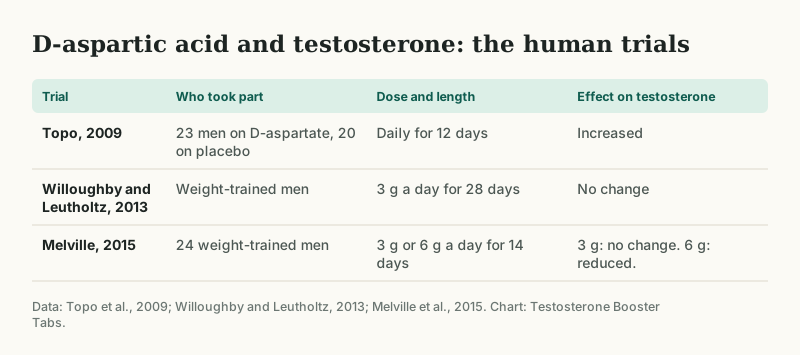
In the first human study, 23 men took a daily dose of sodium D-aspartate for 12 days, and another 20 men took a placebo. The researchers reported that D-aspartate increased the release of LH and testosterone.[1]
This single short study is the basis for most of the claims you will see on a label.
28 days in weight-trained men
A 2013 trial tested D-aspartic acid in men who already lifted weights. They trained four times a week for 28 days and took either 3 g of D-aspartic acid or 3 g of placebo each day.[2]
Both groups got stronger and improved their body composition, with no difference between them. Total testosterone, free testosterone, LH and oestradiol were unchanged. The researchers concluded that, at that dose, D-aspartic acid does not stimulate the hormone system that controls testosterone and has no muscle-building benefit.[2]
Two doses compared
A 2015 trial went a step further. Twenty-four men with at least two years of weight-training experience were randomly given a placebo, 3 g a day, or 6 g a day for 14 days.[3]
- 3 g a day: no significant effect on testosterone.[3]
- 6 g a day: total testosterone and free testosterone were significantly reduced.[3]
The researchers had expected that experienced lifters might need a higher dose to respond. The higher dose pushed testosterone the wrong way. They also checked whether men with lower starting testosterone responded better. They did not.[3]
What the systematic reviews say
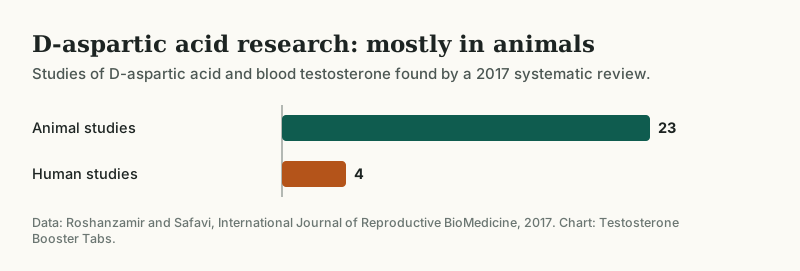
A 2017 systematic review searched for every study of D-aspartic acid and blood testosterone. It found 23 animal studies and only 4 human studies. Its summary:[4]
- In male animals, D-aspartic acid raised testosterone.
- In humans, results were inconsistent.
- The human evidence is sparse, mostly because the studies were few and of poor quality.
A wider 2024 review of testosterone boosters concluded that most fail to raise total testosterone.[5] We go through that review in do testosterone boosters work?
Why might the studies disagree?
The 2009 study and the later trials differ in ways that could matter.
- Who was studied. The later trials were in weight-trained men.[2, 3] The researchers behind the 2015 trial described the earlier positive result as coming from sedentary men.[3]
- Duration. The studies ran for 12, 14 and 28 days.[1, 2, 3] None tells us what happens over months.
- Size. The groups were small. The 2009 study had 23 men taking D-aspartate, and the 2015 trial split 24 men across three groups.[1, 3]
Nobody has shown that D-aspartic acid produces a lasting rise in testosterone, or that it improves strength, muscle or how men feel.
D-aspartic acid and the gym
DAA is marketed mostly to men who lift. In both trials in trained men, the training did the work and the supplement added nothing.[2, 3] Our guide to whether working out increases testosterone explains what exercise does to hormone levels.
Other gym-shelf supplements have been tested the same way. Creatine does not raise testosterone either, though it has good evidence for performance. Tribulus terrestris failed in trained athletes, and boron did nothing for bodybuilders in its one controlled trial. DHEA is a hormone, not an amino acid, and is banned in sport.
What doses of D-aspartic acid were studied?
- 3 g a day for 14 days and for 28 days: no effect on testosterone in trained men.[2, 3]
- 6 g a day for 14 days: lower total and free testosterone.[3]
These are study doses, not recommendations, and the trials give little reason to take it.
Is D-aspartic acid safe?
There is very little safety data. The trials were short and small, and the 2017 review judged the human studies to be of poor quality.[4] Uncommon side effects, and anything that takes months to show up, would not have been detected.
The one clear signal from the trials is itself a caution: the higher dose lowered testosterone.[3] Doubling up in the hope of a bigger effect is a bad idea.
Like all dietary supplements, DAA products are not approved by the US Food and Drug Administration before they are sold.[6] Our guide to testosterone booster side effects covers what that means in practice. If you are trying for a baby or having fertility tests, talk to your doctor before starting any hormone-related supplement.
The bottom line
D-aspartic acid works in rats. In men, one short early study was positive, two better-controlled trials in trained men found nothing at 3 g a day, and 6 g a day reduced testosterone. We rate it “unlikely to work”. If you have symptoms that worry you, read low testosterone symptoms and get tested.
Common questions
Does D-aspartic acid increase testosterone?
Probably not in any lasting way. One 12-day study reported a rise, but two trials in weight-trained men found no change at 3 g a day, and a 2017 systematic review judged the human results inconsistent.[1, 2, 3, 4]
What is D-aspartic acid?
It is an amino acid that occurs naturally in the body, mainly in the pituitary gland and the testes.[1] It is sold as a supplement, often shortened to DAA or D-Asp.
How much D-aspartic acid was used in studies?
Trials in trained men used 3 g a day for 14 or 28 days, with no effect on testosterone. One trial also tested 6 g a day for 14 days, which lowered total and free testosterone.[2, 3]
Does D-aspartic acid build muscle?
A 28-day trial found no difference in muscle strength or body composition between men taking 3 g a day and men taking a placebo. Both groups improved from the training.[2]
Sources
- The role and molecular mechanism of D-aspartic acid in the release and synthesis of LH and testosterone in humans and rats (Topo et al., 2009) Reproductive Biology and Endocrinology
- D-aspartic acid supplementation combined with 28 days of heavy resistance training has no effect on body composition, muscle strength, and serum hormones associated with the hypothalamo-pituitary-gonadal axis in resistance-trained men (Willoughby and Leutholtz, 2013) Nutrition Research
- Three and six grams supplementation of d-aspartic acid in resistance trained men (Melville et al., 2015) Journal of the International Society of Sports Nutrition
- The putative effects of D-Aspartic acid on blood testosterone levels: A systematic review (Roshanzamir and Safavi, 2017) International Journal of Reproductive Biomedicine
- Do "testosterone boosters" really increase serum total testosterone? A systematic review (Morgado et al., 2024) International Journal of Impotence Research
- Questions and Answers on Dietary Supplements US Food and Drug Administration
Part of our testosterone guides. New here? Start with do testosterone boosters work?