The link between boron and testosterone comes down to two small human studies that disagree. That is too little to say boron works.
Boron is a trace mineral. It has a loyal following in fitness circles, where it is said to “free up” testosterone by lowering a protein called sex hormone-binding globulin (SHBG). When you trace that claim back, you arrive at a single study of eight men.[1]

Is boron an essential nutrient?
Not officially. No estimated requirement or dietary reference intake has been set for boron. The only reference value is an upper intake level of 20 mg a day for adults, according to a 2015 review of the boron literature.[4]
That review argued that boron is an important trace mineral with several roles, including in how the body uses testosterone, oestrogen and vitamin D. It suggested that people whose diet lacks fruit and vegetables are the ones most likely to be short of it.[4] The author was making a case for boron, so read it as one side of an unsettled question.
Does boron increase testosterone? The human studies
The study behind the claim
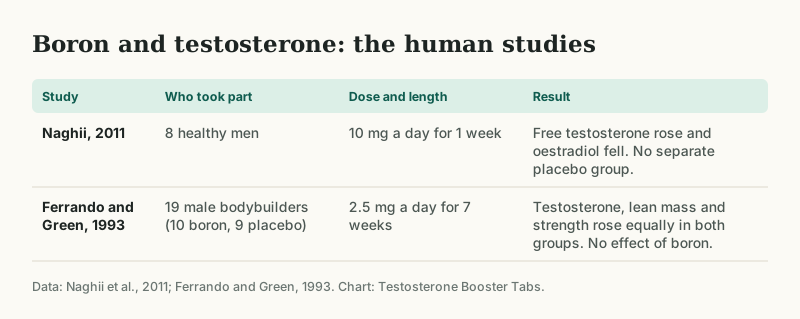
In 2011, researchers gave eight healthy men a 10 mg boron capsule with breakfast every day for a week. They took blood samples at set times on the first day and again after seven days.[1]
They reported that:[1]
- within six hours of the first dose, SHBG fell significantly
- after one week, average free testosterone had risen and oestradiol had fallen
- three markers of inflammation also fell.
The authors described it as the first human study to show a rise in free testosterone after taking boron.[1]
It is an interesting result. It is also about as preliminary as research gets.
- Eight participants. A handful of men is too few to rule out chance.
- No separate placebo group. The men took a placebo on one day, then boron for a week.[1] There was no group taking a placebo for the whole week to compare with.
- One week. Nobody knows whether the change lasts.
- Normal variation. Hormone levels naturally move from one test to the next. In a study of 132 men, two measurements of the same hormone in the same man differed by more than 18 to 28% about half the time, depending on the hormone.[5]
The trial that found nothing
An earlier trial did have a placebo group. Nineteen male bodybuilders aged 20 to 27 were given either 2.5 mg of boron a day or a placebo for 7 weeks. Researchers measured total and free testosterone, lean body mass and strength at the start and the end.[2, 3]
Both groups improved. Total testosterone, lean mass, squat and bench press all rose significantly, in the boron group and the placebo group alike. Boron made no difference to any of them.[2]
The authors’ conclusion was blunt: seven weeks of bodybuilding can raise testosterone, lean mass and strength in less experienced lifters, and boron supplementation did not affect those measures at all.[3] We look at that training effect in does working out increase testosterone?
How do you square the two studies?
The studies differ in dose (10 mg against 2.5 mg), length (1 week against 7 weeks) and design.[1, 2] Fans of boron point to the dose. Sceptics point to the lack of a control group.
Both could be right. A higher dose might do something the lower one does not. But a properly controlled trial of the higher dose, in a reasonable number of men, over a reasonable time, is what is needed to find out. We could not find one.
A 2024 systematic review of testosterone boosters concluded that most fail to raise total testosterone.[6] We cover it in do testosterone boosters work?
What doses of boron were studied?
- 10 mg a day for 1 week: free testosterone rose in eight men, with no separate placebo group.[1]
- 2.5 mg a day for 7 weeks: no effect compared with placebo in bodybuilders.[2]
These are study doses, not recommendations.
Is boron safe?
The published upper intake level for adults is 20 mg a day.[4] That is a ceiling, not a target.
The trials above were short and involved few people, so they tell us little about side effects. If you take a booster blend, a multivitamin and a separate boron capsule, check the combined total against that upper level. Our guide to testosterone booster side effects explains why blends make this hard.
Talk to a doctor or pharmacist before taking boron if you have kidney disease or a hormone-sensitive condition, or if you take regular medicines.
Should you get your SHBG tested instead?
Much of the interest in boron comes from men who have been told their SHBG is high and their free testosterone is low. If that is you, the supplement question comes second. The first question is whether the test was done properly and what the result means.
Our guide to reading a testosterone blood test explains total testosterone, free testosterone and high SHBG, and why one result is not enough.
How does boron compare with other minerals in boosters?
Boron usually shares a label with other minerals. Zinc raises testosterone only in men who are deficient, and magnesium has no placebo-controlled trial showing a rise. Vitamin D has been tested far more thoroughly than any of them and did not work. For the gym crowd, neither D-aspartic acid nor creatine raises testosterone either.
If you would rather get trace minerals from your plate, see foods that boost testosterone.
The bottom line
Boron might affect free testosterone. One week-long study of eight men suggests so. A placebo-controlled trial at a lower dose found nothing. That is not enough to conclude that boron works, and we rate it “too little evidence”. Treat confident claims about boron with caution until better trials exist.
Common questions
Does boron increase testosterone?
It is not known. One study of eight men reported higher free testosterone after a week of 10 mg a day, with no separate placebo group.[1] A placebo-controlled trial of 2.5 mg a day for 7 weeks found no effect.[2]
Does boron lower SHBG?
In the eight-man study, sex hormone-binding globulin (SHBG) fell significantly within six hours of the first 10 mg dose.[1] No larger controlled trial has confirmed it.
How much boron was used in the studies?
The two human studies used 10 mg a day for one week and 2.5 mg a day for seven weeks.[1, 2] A 2015 review gives the upper intake level for adults as 20 mg a day.[4]
Is boron an essential nutrient?
No estimated requirement or dietary reference intake has been set for boron. Only an upper intake level exists.[4]
Sources
- Comparative effects of daily and weekly boron supplementation on plasma steroid hormones and proinflammatory cytokines (Naghii et al., 2011) Journal of Trace Elements in Medicine and Biology
- The effect of boron supplementation on lean body mass, plasma testosterone levels, and strength in male bodybuilders (Ferrando and Green, 1993) International Journal of Sport Nutrition
- Plasma boron and the effects of boron supplementation in males (Green and Ferrando, 1994) Environmental Health Perspectives
- Nothing Boring About Boron (Pizzorno, 2015) Integrative Medicine
- Intraindividual variation in levels of serum testosterone and other reproductive and adrenal hormones in men (Brambilla et al., 2007) Clinical Endocrinology
- Do "testosterone boosters" really increase serum total testosterone? A systematic review (Morgado et al., 2024) International Journal of Impotence Research
Part of our testosterone guides. New here? Start with do testosterone boosters work?