Creatine does not increase testosterone in most studies. A 2021 review by an international team of creatine researchers counted 12 studies that measured testosterone: 10 found no change, and 2 found small rises that were not physiologically meaningful.[1]
Creatine is one of the most studied sports supplements, so this is a question with real data behind it.
What is creatine?
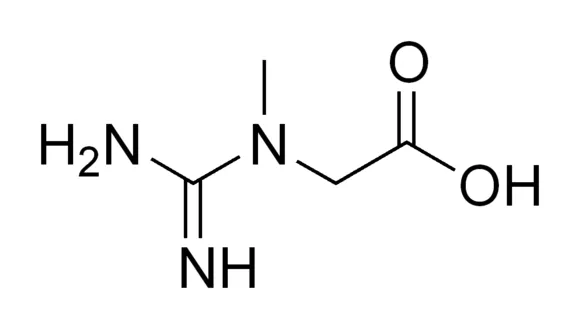
Creatine is a compound the body makes itself, in the kidneys and liver, from three amino acids: arginine, glycine and methionine.[1] In muscle it is converted to phosphocreatine, which muscle cells use to produce ATP, the molecule they run on.[1]

A later review by the same group describes creatine monohydrate as a safe and effective way to improve certain aspects of sport and exercise performance.[6] That benefit does not depend on hormones.
Does creatine increase testosterone?
What the pooled evidence shows
The 2021 review looked at studies using 3 to 25 g of creatine a day, for between 6 days and 12 weeks.[1]
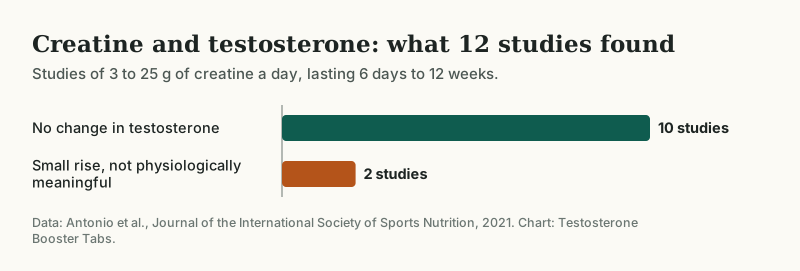
- 10 studies found no change in testosterone.
- 2 studies found small increases in total testosterone after six and seven days. The reviewers described them as physiologically insignificant.
- 5 studies also measured free testosterone. None found an increase.
The reviewers’ conclusion: the evidence does not indicate that creatine increases total testosterone, free testosterone or DHT.[1]
The 2025 trial
The most direct test so far was a randomised controlled trial published in 2025. It enrolled 45 resistance-trained men aged 18 to 40, who took 5 g of creatine a day or a placebo for 12 weeks. Of these, 38 completed the study.[3]
There were no differences between the groups in total testosterone, free testosterone, DHT, or the ratio of DHT to testosterone.[3]
Other trials
- In 17 men doing four weeks of deliberately excessive training, total testosterone fell in both the creatine group and the placebo group. Changes in performance were not related to resting hormone levels.[4]
- A 2024 study of 40 people aged 18 to 25 doing eight weeks of weight training reported a better ratio of testosterone to cortisol with creatine than with placebo.[5] It is one small study, and a ratio can change without testosterone itself rising.
A 2024 systematic review of testosterone boosters included four creatine studies. Creatine was not among the ingredients it judged effective for raising testosterone.[7]
Does creatine raise DHT?
This is where the hair loss story begins.
DHT (dihydrotestosterone) is a hormone the body makes from testosterone, and it is linked to pattern baldness.[1] In 2009, researchers gave 20 college-aged rugby players creatine or a placebo in a double-blind crossover study. The dose was 25 g a day for 7 days, then 5 g a day for 14 days.[2]
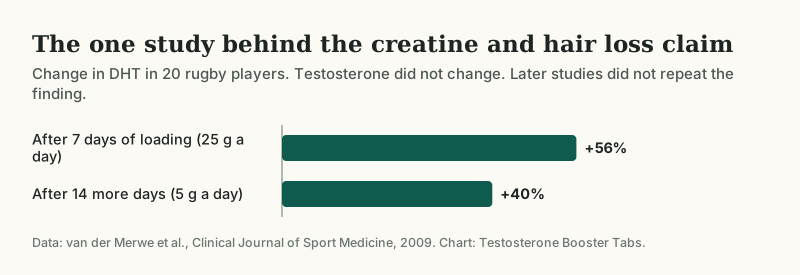
- Testosterone did not change.
- DHT rose by 56% after the loading week and was still 40% above the starting level after the maintenance phase.
- The ratio of DHT to testosterone rose by 36%, then 22%.[2]
Three things limit what this tells us.
- It was a single study of 20 men lasting three weeks.[2]
- Later research has not repeated the result. The 12-week trial in 2025 found no change in DHT.[3]
- No study has reported hair loss in people taking creatine.[1]
Does creatine cause hair loss?
There is no direct evidence that it does.
The 2025 trial is the only one we found that measured hair as well as hormones. It found no differences between the creatine and placebo groups in its hair measures after 12 weeks.[3]
Pattern baldness depends mostly on inherited sensitivity to DHT, which we explain in does testosterone cause hair loss?

Is creatine a steroid?
No. Anabolic steroids are synthetic versions of testosterone. Creatine has a different chemical structure and a different legal status.[1]
The two also work differently. Steroids act through the androgen receptor inside muscle cells. Creatine works through the muscle’s energy system.[1] More on the definitions in is testosterone a steroid?
Does creatine lower testosterone?
There is no good evidence that it does. In the studies above, testosterone either stayed the same or moved equally in the creatine and placebo groups.[1, 4]
How does creatine compare with testosterone boosters?
Creatine and boosters are sold in the same shops, often to the same people, but they are different kinds of product.
- Creatine has good evidence for performance and no meaningful effect on testosterone.[1, 6]
- Boosters are sold to raise testosterone, and most fail to do so.[7] See do testosterone boosters work?
Gym-focused booster ingredients have fared poorly in trained men. See our guides to D-aspartic acid and tribulus terrestris. Ashwagandha and tongkat ali were the two herbs a 2024 systematic review rated as possibly effective in healthy men.[7]
Training itself does not change resting testosterone much either. A meta-analysis of 11 randomised trials found a negligible effect.[8] See does working out increase testosterone?
If your aim is a healthier testosterone level and not a stronger lift, the steps with the best evidence are in how to increase testosterone naturally and foods that boost testosterone. Safety questions about supplements in general are covered in testosterone booster side effects.
The bottom line
Creatine does not raise testosterone. One small study found a rise in DHT, but a longer and more recent trial did not, and no study has shown that creatine causes hair loss. It is not a steroid. Take it, if you do, for its effect on training, not for any effect on hormones.
Common questions
Does creatine boost testosterone?
The evidence says no. A 2021 expert review counted 12 studies: 10 found no change and 2 found small, physiologically insignificant rises after six or seven days.[1]
Does creatine raise DHT?
One 2009 study in 20 rugby players found DHT 56% higher after a week of high-dose creatine.[2] A 12-week randomised trial in 2025 found no change in DHT.[3]
Does creatine cause hair loss?
There is no direct evidence that it does. The 2025 trial measured hair as well as hormones and found no differences between creatine and placebo.[3]
Is creatine a steroid?
No. Sports nutrition researchers state that anabolic steroids have a different chemical structure from creatine and a different legal status.[1]
Does creatine lower testosterone?
There is no good evidence of that either. In one trial of men doing four weeks of very hard training, testosterone fell equally in the creatine and placebo groups.[4]
Sources
- Common questions and misconceptions about creatine supplementation: what does the scientific evidence really show? (Antonio et al., 2021) Journal of the International Society of Sports Nutrition
- Three weeks of creatine monohydrate supplementation affects dihydrotestosterone to testosterone ratio in college-aged rugby players (van der Merwe et al., 2009) Clinical Journal of Sport Medicine
- Does creatine cause hair loss? A 12-week randomized controlled trial (Lak et al., 2025) Journal of the International Society of Sports Nutrition
- The effects of creatine supplementation on muscular performance and body composition responses to short-term resistance training overreaching (Volek et al., 2004) European Journal of Applied Physiology
- Supplementing With Which Form of Creatine (Hydrochloride or Monohydrate) Alongside Resistance Training Can Have More Impacts on Anabolic/Catabolic Hormones, Strength and Body Composition? (Eghbali et al., 2024) Physiological Research
- Part II. Common questions and misconceptions about creatine supplementation: what does the scientific evidence really show? (Antonio et al., 2025) Journal of the International Society of Sports Nutrition
- Do "testosterone boosters" really increase serum total testosterone? A systematic review (Morgado et al., 2024) International Journal of Impotence Research
- Effects of Exercise Training on Resting Testosterone Concentrations in Insufficiently Active Men: A Systematic Review and Meta-Analysis (Potter et al., 2021) Journal of Strength and Conditioning Research
Part of our testosterone guides. New here? Start with do testosterone boosters work?