DHEA can raise testosterone a little, mostly in women, but trials have not shown that the rise brings any benefit. It is also a hormone, which sets it apart from every other ingredient in do testosterone boosters work?
What is DHEA?
Dehydroepiandrosterone (DHEA) is a hormone that your body makes naturally in the adrenal glands. It helps produce other hormones, including testosterone and oestrogen. Natural DHEA levels peak in early adulthood and then slowly fall with age.[4]
A synthetic version is sold as tablets, capsules, powders and creams. People use it as an anti-ageing treatment and to improve physical performance.[4]
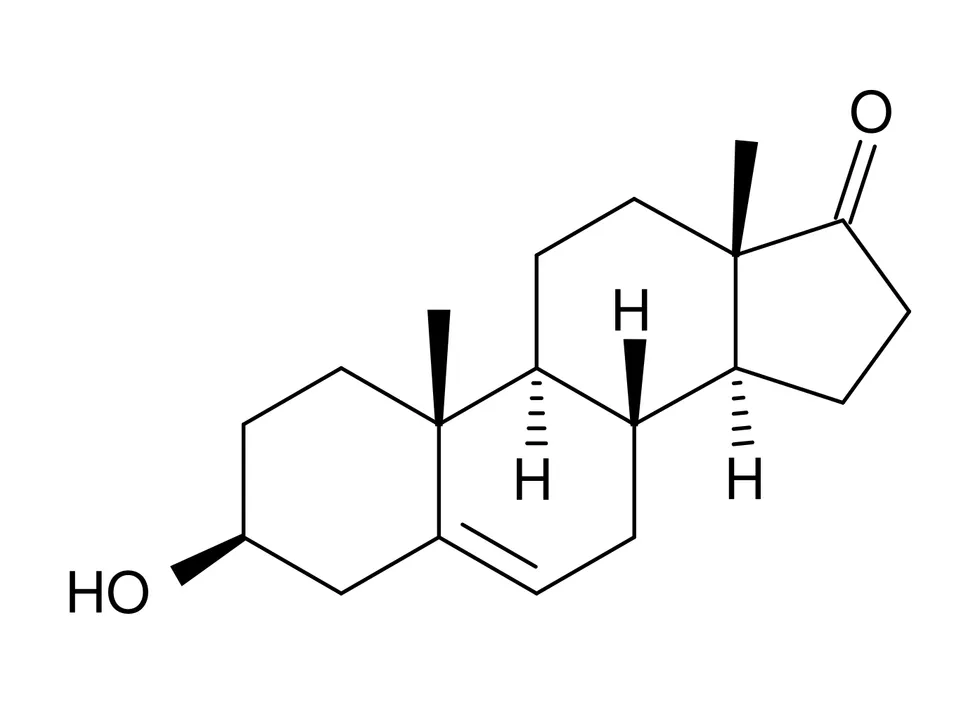

Because the body converts DHEA into sex hormones, taking it is closer to taking a hormone than to taking a vitamin. Our guide to whether testosterone is a steroid explains the family these molecules belong to.
Does DHEA increase testosterone?
The pooled analysis
A 2020 meta-analysis combined 42 publications from randomised controlled trials. Overall, DHEA raised testosterone by an average of 28.02 ng/dL.[1]
The size of the rise varied between groups:[1]
- Sex. Women: 30.98 ng/dL. Men: 21.36 ng/dL.
- Dose. Above 50 mg a day: 57.96 ng/dL. At 50 mg a day or less: 19.43 ng/dL.
- Duration. Trials of 12 weeks or less: 44.64 ng/dL. Longer trials: 19 ng/dL.
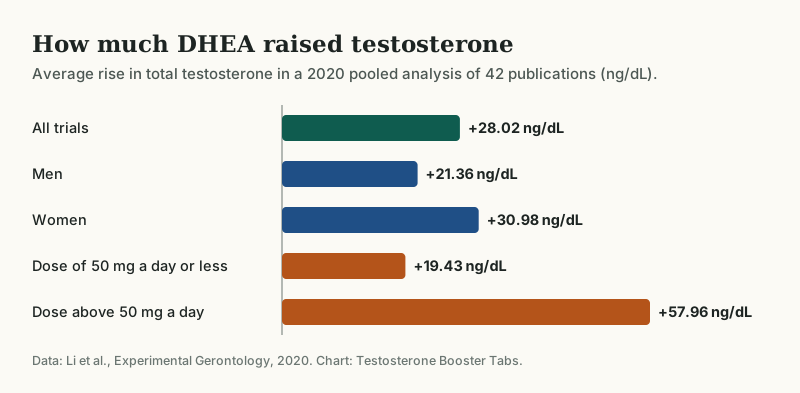
For a man, 21 ng/dL is a small change. For a woman it is a large one, because women’s normal levels are so much lower. We give the ranges in normal testosterone levels by age.
Young men who lift weights
A 1999 study tested DHEA in young men in two ways.[2]
- A single dose. In 10 men, 50 mg of DHEA raised blood androstenedione by 150% within an hour. It did not affect testosterone or oestrogen.
- Eight weeks of training. Nineteen men followed a weight-training programme. Nine took 150 mg of DHEA a day in two-week blocks, and ten took a placebo. Total and free testosterone were unaffected. Strength and lean body mass increased by a similar amount in both groups.
The authors concluded that DHEA does not raise testosterone or improve the results of resistance training in young men.[2] Other gym supplements fare no better, as our guide to D-aspartic acid shows.
Older men and women
The longest trial ran for 2 years. It enrolled 87 older men with low DHEA and low bioavailable testosterone, and 57 older women with low DHEA. Among the men, 29 took DHEA, 27 took testosterone and 31 took a placebo.[3]
DHEA raised blood DHEA levels as expected. But it had no significant effect on body composition, and it did not change muscle strength, aerobic fitness or insulin sensitivity. Quality of life did not improve.[3]
The researchers concluded that neither DHEA nor low-dose testosterone has physiologically relevant benefits for body composition, physical performance, insulin sensitivity or quality of life in older people.[3]
Does a higher number on a blood test mean you feel better?
Not from what the trials show. This is why we rate DHEA “mixed evidence”. It can move a blood result.[1] The studies that looked for benefits people would notice did not find them.[2, 3]
Mayo Clinic’s summary is similar. Research has not shown that DHEA slows ageing, and most studies indicate it has no effect on muscle strength in younger or older adults.[4]
A 2024 review of testosterone boosters concluded that most fail to raise total testosterone.[6]
Is DHEA safe? Side effects and warnings
Mayo Clinic gives DHEA a “red light” and advises avoiding it. According to its guidance:[4]
- DHEA is a hormone. Using it might raise androgen levels and have a steroid effect.
- High doses or long-term use might raise the risk of hormone-sensitive cancers, such as prostate and breast cancer, though more research is needed. People with these cancers should not use it.
- It should not be used during pregnancy or while breastfeeding.
- It might lower HDL (“good”) cholesterol.
- It might worsen mental health conditions and raise the risk of mania in people with mood disorders.
- It might cause oily skin, acne and unwanted male-pattern hair growth in women.
- It should not be combined with testosterone or oestrogen.
- Studies have shown that quality control of DHEA supplements is often poor.
Those effects in women overlap with the signs described in high testosterone in women. Women thinking about DHEA for low energy or low sex drive should read low testosterone in women first. Acne and scalp hair changes are covered in does testosterone cause hair loss?
Is DHEA banned in sport?
Yes. The World Anti-Doping Agency’s Prohibited List includes prasterone, another name for DHEA, under anabolic androgenic steroids. Anabolic agents are prohibited at all times.[5] The US National Collegiate Athletic Association has also banned DHEA use among athletes.[4]
If you compete in a tested sport, check every supplement label for DHEA and its other names.
DHEA or testosterone treatment?
They are different things. DHEA is sold over the counter as a supplement in some countries. Testosterone is a prescription medicine for men with a diagnosed deficiency. In the 2-year trial above, neither helped older adults whose levels were simply low for their age.[3]
If you think your testosterone is low, read testosterone boosters vs TRT and see a doctor. For the wider risks of hormone-related supplements, see testosterone booster side effects.
The bottom line
DHEA is a hormone, and it does nudge testosterone upwards, more in women than in men. But the trials that looked for real benefits found none, and the safety concerns are larger than for any herb or mineral in a booster. Mayo Clinic’s advice is to avoid it. We rate it “mixed evidence”, and we would not treat it as a casual supplement.
Common questions
Does DHEA increase testosterone?
On average, a little. A 2020 meta-analysis of randomised trials found an average rise of 28.02 ng/dL. The rise was larger in women (30.98 ng/dL) than in men (21.36 ng/dL), and larger at doses above 50 mg a day.[1]
Does DHEA raise testosterone in young men?
Not in the trial that tested it. In 19 young men doing 8 weeks of weight training, 150 mg of DHEA a day did not change total or free testosterone, and strength and lean mass rose equally with placebo.[2]
Is DHEA a steroid?
DHEA is a hormone, and Mayo Clinic says using it might raise androgen levels and have a steroid effect.[4] The World Anti-Doping Agency lists it under anabolic androgenic steroids, prohibited at all times.[5]
Is DHEA safe?
Mayo Clinic's advice is to avoid it. It says DHEA can cause serious side effects, and that high doses or long-term use might raise the risk of hormone-sensitive cancers, though more research is needed.[4]
Sources
- A dose-response and meta-analysis of dehydroepiandrosterone (DHEA) supplementation on testosterone levels: perinatal prediction of randomized clinical trials (Li et al., 2020) Experimental Gerontology
- Effect of oral DHEA on serum testosterone and adaptations to resistance training in young men (Brown et al., 1999) Journal of Applied Physiology
- DHEA in elderly women and DHEA or testosterone in elderly men (Nair et al., 2006) The New England Journal of Medicine
- DHEA Mayo Clinic
- The Prohibited List World Anti-Doping Agency
- Do "testosterone boosters" really increase serum total testosterone? A systematic review (Morgado et al., 2024) International Journal of Impotence Research
Part of our testosterone guides. New here? Start with do testosterone boosters work?