The low testosterone symptoms that matter most in men are sexual ones: fewer morning erections, less interest in sex, and trouble getting or keeping an erection.[2] Many other symptoms get blamed on “low T”, but most of them have several possible causes.
This guide covers the signs of low testosterone in men, what causes it, and when a blood test is worth having.
What are the signs and symptoms of low testosterone in men?
Testosterone is a hormone made by the testicles. It helps keep bones and muscles strong, maintain sex drive and erections, make sperm and red blood cells, and support energy and mood.[1]
MedlinePlus, from the US National Library of Medicine, lists these possible symptoms of low testosterone:[1]
- low sex drive
- problems having an erection
- low sperm count
- sleep problems such as insomnia
- decrease in muscle size and strength
- bone loss
- increase in body fat
- depression
- trouble concentrating.
Some men with low testosterone have no symptoms.[1]
Which symptoms point most clearly to low testosterone?
The best evidence comes from the European Male Ageing Study, which surveyed 3,369 men aged 40 to 79 and measured their testosterone in morning blood samples.[2]
Nine symptoms were examined. Six were related to the testosterone level: poor morning erections, low sexual desire, erectile dysfunction, inability to do vigorous activity, depression and fatigue. But only the three sexual symptoms formed a consistent pattern with low testosterone. The more of them a man had, the lower his testosterone tended to be.[2]
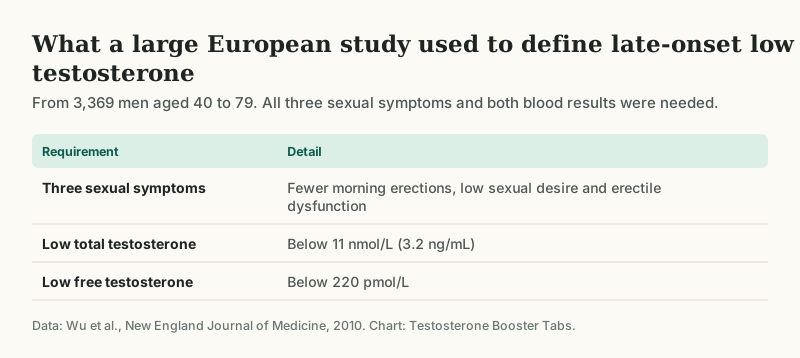
The researchers concluded that age-related low testosterone can be defined by at least three sexual symptoms together with a total testosterone below 11 nmol/L and a free testosterone below 220 pmol/L.[2]
In other words, tiredness alone is a weak clue. Tiredness plus a clear drop in sexual function is a stronger one.
Are these symptoms just part of ageing?
Some are. It is normal to feel less interested in sex as you get older. It is not usually normal to have no interest at all.[1]
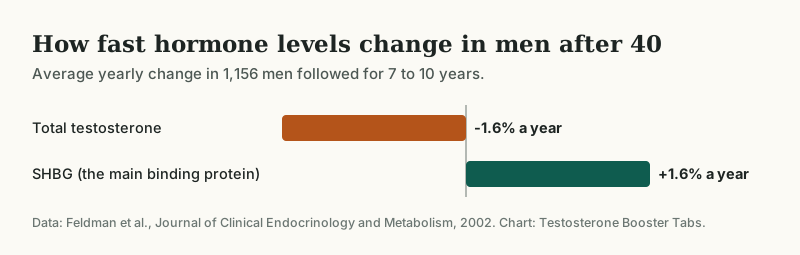
Testosterone does fall with age, but slowly. In the Massachusetts Male Aging Study, 1,156 men aged 40 to 70 were followed for 7 to 10 years. Total testosterone fell by about 1.6% a year. Over the same period SHBG, the main protein that binds testosterone, rose by 1.6% a year.[4]
Health matters as much as birthdays. In the same cohort, gaining 4 to 5 points of body mass index was linked to a fall in testosterone similar to about 10 years of ageing.[5] See normal testosterone levels by age for typical numbers.
What causes low testosterone?
MedlinePlus lists these causes besides ageing:[1]
- medicine side effects, such as from chemotherapy
- injury to, or cancer of, the testicles
- problems with the glands in the brain that control hormone production (the hypothalamus and pituitary)
- low thyroid function
- too much body fat
- other disorders, long-term diseases, treatments or infections.
Research adds detail on some of these.
- Body weight. In 3,200 European men aged 40 to 79, total testosterone was 2.32 nmol/L lower in overweight men and 5.09 nmol/L lower in obese men than in men of normal weight.[10] We cover this in testosterone and weight gain.
- Sleep apnoea. A pooled analysis of 24 studies found significantly lower testosterone in men with obstructive sleep apnoea than in men without it.[6]
- Opioid medicines. A pooled analysis of 17 studies found that testosterone was suppressed in men who used opioids regularly.[7]
One thing that does not cause it: a vasectomy. See does a vasectomy affect testosterone?
How is low testosterone diagnosed?
Symptoms alone are not enough, and neither is a single blood test.
The Endocrine Society’s guideline recommends diagnosing low testosterone (hypogonadism) only in men who have symptoms and signs of testosterone deficiency and blood testosterone that is unequivocally and consistently low. It recommends:[3]
- a fasting, morning total testosterone test as the first step
- a repeat test to confirm a low result
- a free testosterone test for men whose total is near the lower limit, or who have a condition that alters SHBG
- further tests to find the cause in men who are confirmed as deficient.
Timing matters because testosterone changes through the day. In men aged 30 to 40, levels were 20 to 25% lower at 4 pm than at 8 am.[8] Eating matters too. In 74 men, a sugary drink lowered testosterone by an average of 25%.[9]
Our guide to testosterone blood test results explains total testosterone, free testosterone and SHBG.
When should you see a doctor?
MedlinePlus advises contacting a health professional if you have symptoms of low testosterone that are bothering you.[1] It is especially worth going if sexual symptoms have come on together, or if you also have one of the causes listed above.
Your doctor is likely to arrange a blood test and check for other causes of your symptoms, such as medicine side effects, thyroid problems or depression.[1] Symptoms may also be caused by other conditions, such as high blood pressure or diabetes.[1]
What helps if your testosterone is low?
It depends on the cause.
- Prescription treatment. If a deficiency is confirmed, testosterone replacement therapy may help reduce symptoms. It has risks and needs regular check-ups.[1] Read testosterone boosters vs TRT.
- Weight, sleep and activity. These can move testosterone in the right direction, as we explain in how to increase testosterone naturally.
- Supplements. Most do not raise testosterone in controlled trials. One herb, tongkat ali, has been tried in 76 men with late-onset low testosterone, but in a study with no placebo group.[11] See do testosterone boosters work? before spending money.
Do women get low testosterone symptoms?
Women make testosterone too, in much smaller amounts, and the picture is different. We cover it in low testosterone in women.
The bottom line
Low sex drive, fewer morning erections and erection problems are the signs most closely tied to low testosterone in men. Tiredness, low mood and weight gain are less specific. If symptoms are bothering you, a morning blood test, repeated if low, is the only way to know. Treat the cause with a doctor, not with a supplement.
Common questions
What are the signs and symptoms of low testosterone?
MedlinePlus lists low sex drive, problems having an erection, low sperm count, sleep problems, loss of muscle size and strength, bone loss, more body fat, depression and trouble concentrating.[1]
What are the first signs of low testosterone in a man?
In a study of 3,369 European men aged 40 to 79, only three symptoms formed a consistent pattern with low testosterone: poor morning erections, low sexual desire and erectile dysfunction.[2]
Can you have low testosterone with no symptoms?
Yes. Some men with low testosterone do not have any symptoms.[1] A low reading without symptoms is not enough for a diagnosis under the Endocrine Society guideline.[3]
At what age does testosterone start to drop?
Levels may start to decrease slowly from around age 30 to 40.[1] In a US study that followed 1,156 men for 7 to 10 years, total testosterone fell by about 1.6% a year.[4]
How do I know if my testosterone is low?
Only a blood test can tell you. Guidelines recommend a fasting morning total testosterone test, repeated to confirm a low result.[3]
Sources
- Low testosterone MedlinePlus, US National Library of Medicine
- Identification of late-onset hypogonadism in middle-aged and elderly men (Wu et al., 2010) The New England Journal of Medicine
- Testosterone Therapy in Men With Hypogonadism: An Endocrine Society Clinical Practice Guideline (Bhasin et al., 2018) The Journal of Clinical Endocrinology and Metabolism
- Age trends in the level of serum testosterone and other hormones in middle-aged men: longitudinal results from the Massachusetts male aging study (Feldman et al., 2002) The Journal of Clinical Endocrinology and Metabolism
- The relative contributions of aging, health, and lifestyle factors to serum testosterone decline in men (Travison et al., 2007) The Journal of Clinical Endocrinology and Metabolism
- Obstructive sleep apnea and serum total testosterone: a system review and meta-analysis (Wang et al., 2023) Sleep & Breathing = Schlaf & Atmung
- Testosterone suppression in opioid users: a systematic review and meta-analysis (Bawor et al., 2015) Drug and Alcohol Dependence
- The effect of diurnal variation on clinical measurement of serum testosterone and other sex hormone levels in men (Brambilla et al., 2009) The Journal of Clinical Endocrinology and Metabolism
- Abrupt decrease in serum testosterone levels after an oral glucose load in men: implications for screening for hypogonadism (Caronia et al., 2013) Clinical Endocrinology
- Hypothalamic-pituitary-testicular axis disruptions in older men are differentially linked to age and modifiable risk factors: the European Male Aging Study (Wu et al., 2008) The Journal of Clinical Endocrinology and Metabolism
- Standardised water-soluble extract of Eurycoma longifolia, Tongkat ali, as testosterone booster for managing men with late-onset hypogonadism? (Tambi et al., 2012) Andrologia
Part of our testosterone guides. New here? Start with do testosterone boosters work?