Working out does increase testosterone, but only for a short time after a hard session.[3] Regular training makes very little difference to your resting level, which is the number a blood test measures.[1]
That gap between the short-term spike and the long-term level explains most of the confusion on this topic.
Does exercise raise testosterone straight after a workout?
Yes, in men. A 2010 review of the physiology found that testosterone is generally elevated directly after heavy resistance exercise in men.[3]
How big the response is depends on several things.[3, 5]
- The session. High-volume sessions with high metabolic demand produce the largest response.[3]
- Age. Older men show a smaller response than younger men.[3]
- Sex. In women, studies show both increases and no change.[3]
- Timing. Results differ depending on whether blood is taken during exercise, straight after, or hours later.[5]
A 2020 review concluded that this is why studies disagree so much: the type of exercise, its intensity, who is being studied and when the blood is drawn all change the answer.[5]
Does working out increase testosterone in the long run?
This is the question that matters for most people, and the answer is: not by much.
In healthy men
A 2021 meta-analysis pooled 11 randomised controlled trials with 421 healthy but inactive men aged 19 to 75. They did aerobic training, resistance training or both, typically for 12 weeks.[1]
The effect on resting total testosterone was negligible. It made no difference what type of training the men did, how old they were, or how much they weighed.[1]
In men over 60
A 2018 meta-analysis looked at 22 studies of men aged 60 and over.[2]
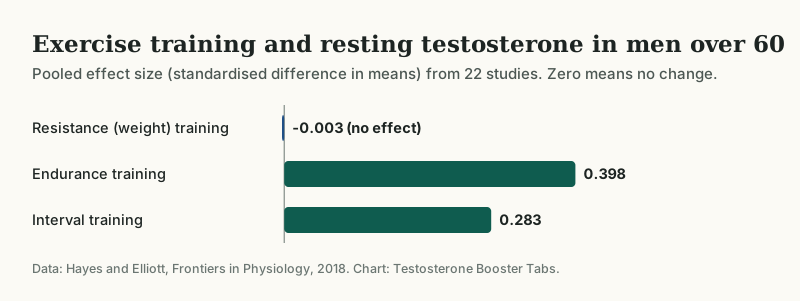
- Resistance training did not significantly change resting testosterone.
- Endurance training produced a small, significant rise.
- Interval training produced a small, significant rise.
The authors described the effects as small and the results as inconsistent.[2]
In the general population
Large studies give a mixed picture. Among 208,677 UK men, higher physical activity was linked to higher testosterone.[10] But in a European study that followed 2,395 men for about four years, changes in physical activity were not associated with significant changes in hormone levels.[12]
Will lifting weights increase testosterone enough to build more muscle?
Many training plans are built around “maximising the hormone response”. The evidence does not support the idea.
In a 12-week trial, 49 men with weight-training experience followed a whole-body programme using either lighter weights for 20 to 25 repetitions or heavier weights for 8 to 12. Both groups gained muscle and strength. The researchers found no significant link between the rise in testosterone after a session and the gains in muscle size or strength.[4]

In other words, weight lifting works, but not because of a testosterone spike. Lift for strength, muscle and health. Do not choose exercises for their supposed hormone effect.
This is also why training is nothing like taking steroids, which supply far more hormone than the body makes. See is testosterone a steroid?
When does exercise help testosterone most?
When it helps you lose excess weight.
- In 41 overweight and obese men on a 12-week programme of aerobic exercise and calorie restriction, testosterone rose. Men who increased their activity the most saw larger rises.[8]
- In a pooled analysis of 24 studies, a low-calorie diet raised testosterone by an average of 2.87 nmol/L, and more weight loss meant a bigger rise.[9]
So for a man carrying extra weight, exercise is part of the best-supported way to raise testosterone. We explain the link in testosterone and weight gain, and the other steps in how to increase testosterone naturally.
Can too much exercise lower testosterone?
It can, in a specific group.
Men who do heavy endurance training for years can develop persistently low resting testosterone. Researchers call this the “exercise-hypogonadal male condition”. Current evidence suggests it is limited to men with a long history of chronic endurance training, and is not common.[6]
Under-eating appears to be part of it. A 2023 review found that low energy availability, which means not eating enough to cover the demands of training, occurs in male endurance athletes and goes with lower testosterone and lower bone density.[7]
MedlinePlus also lists overtraining syndrome among the possible causes of a low testosterone result.[11]
If you train hard and have symptoms, see low testosterone symptoms and eat enough to match your training. Our guide to foods that boost testosterone covers diet.
Do gym supplements add to the effect of training?
Several booster ingredients have been tested in men doing weight training. The results are mostly disappointing.
- D-aspartic acid and tribulus terrestris did not raise testosterone in trained men.
- Ashwagandha and fenugreek have some positive trials in men who train.
- Creatine helps performance but does not raise testosterone in most studies.
The full picture is in do testosterone boosters work?
The bottom line
Exercise raises testosterone briefly after a session, and regular training has little effect on resting levels in men who are already healthy. Its real value for testosterone is indirect: helping to lose excess weight. Train for strength, fitness and health, eat enough to support it, and do not expect a workout plan to act like a hormone treatment.
Common questions
Does exercise increase testosterone?
Briefly, yes. Testosterone is generally higher straight after heavy resistance exercise in men.[3] Over weeks of training, resting levels change very little: a meta-analysis of 11 randomised trials found a negligible effect.[1]
Will lifting weights increase testosterone?
For a short time after the session.[3] In men over 60, a pooled analysis of 22 studies found that weight training did not significantly change resting testosterone.[2]
What is the best weight lifting for testosterone?
Sessions with a high volume of work and high metabolic demand produce the largest short-term response.[3] But that spike was not related to gains in muscle or strength in a 12-week trial of 49 trained men.[4]
Does cardio lower testosterone?
Ordinary amounts do not. Persistently low testosterone has been described in men who do endurance training heavily for years, and it appears to be uncommon.[6]
Does exercise raise testosterone in women?
The findings are mixed. Studies of a single heavy resistance session in women have shown both increases and no change.[3]
Sources
- Effects of Exercise Training on Resting Testosterone Concentrations in Insufficiently Active Men: A Systematic Review and Meta-Analysis (Potter et al., 2021) Journal of Strength and Conditioning Research
- Short-Term Exercise Training Inconsistently Influences Basal Testosterone in Older Men: A Systematic Review and Meta-Analysis (Hayes and Elliott, 2018) Frontiers in Physiology
- Testosterone physiology in resistance exercise and training: the up-stream regulatory elements (Vingren et al., 2010) Sports Medicine
- Neither load nor systemic hormones determine resistance training-mediated hypertrophy or strength gains in resistance-trained young men (Morton et al., 2016) Journal of Applied Physiology
- Various Factors May Modulate the Effect of Exercise on Testosterone Levels in Men (Riachy et al., 2020) Journal of Functional Morphology and Kinesiology
- Reproductive Dysfunction from Exercise Training: The "Exercise-Hypogonadal Male Condition" (Lane et al., 2019) Archivos De Medicina Del Deporte
- Hungry runners - low energy availability in male endurance athletes and its impact on performance and testosterone: mini-review (Cupka and Sedliak, 2023) European Journal of Translational Myology
- Increased physical activity has a greater effect than reduced energy intake on lifestyle modification-induced increases in testosterone (Kumagai et al., 2016) Journal of Clinical Biochemistry and Nutrition
- Body weight loss reverts obesity-associated hypogonadotropic hypogonadism: a systematic review and meta-analysis (Corona et al., 2013) European Journal of Endocrinology
- Sociodemographic, lifestyle and medical influences on serum testosterone and sex hormone-binding globulin in men from UK Biobank (Yeap et al., 2021) Clinical Endocrinology
- Testosterone test MedlinePlus, US National Library of Medicine
- Age-associated changes in hypothalamic-pituitary-testicular function in middle-aged and older men are modified by weight change and lifestyle factors: longitudinal results from the European Male Ageing Study (Camacho et al., 2013) European Journal of Endocrinology
Part of our testosterone guides. New here? Start with do testosterone boosters work?