Testosterone boosters and TRT are often mentioned together, but they are very different things. A booster is a supplement that claims to help your body make more testosterone. TRT, short for testosterone replacement therapy, is the hormone itself, prescribed by a doctor.
What is a testosterone booster?
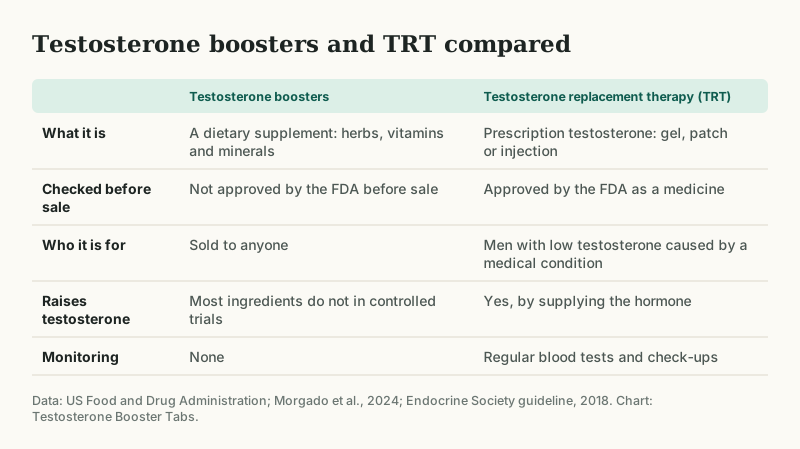
A testosterone booster is a dietary supplement, usually a blend of herbs, vitamins and minerals. In the United States, the Food and Drug Administration (FDA) does not approve dietary supplements before they are sold.[10]
The evidence that they work is thin. A 2024 systematic review of 52 studies covering 27 ingredients concluded that most boosters fail to raise total testosterone. It rated a handful as “possibly effective” in men with late-onset low testosterone, among them tongkat ali.[9] We go through the ingredients in do testosterone boosters work?
What is TRT?
TRT is prescription testosterone. FDA-approved forms include a gel, a skin patch, a system applied to the gum or inner cheek, and injections.[3]
In the US, testosterone products are approved for men who have low testosterone together with an associated medical condition. Examples include testicles that fail to make testosterone because of a genetic problem or chemotherapy, and problems with the hypothalamus or pituitary gland in the brain.[3]
Testosterone belongs to the steroid family of hormones, which is why it is tightly regulated. See is testosterone a steroid?
Who is TRT for?
The Endocrine Society’s guideline recommends diagnosing low testosterone only in men who have symptoms and signs of deficiency and blood testosterone that is unequivocally and consistently low. It recommends testosterone therapy for men with symptomatic deficiency, after a discussion of the benefits, the risks and the monitoring involved.[1]
So two things come first:
- Symptoms that fit. See low testosterone symptoms.
- A fasting morning blood test, repeated to confirm. See how to test for testosterone levels.
MedlinePlus notes that TRT seems to be more effective in young men with very low testosterone levels.[2]
What about testosterone that is low because of age?
This is where opinion has shifted. In June 2026 the FDA asked manufacturers to update testosterone labels. One change removed the statement that the safety and effectiveness of TRT had not been established in men with age-related low testosterone.[3]
That does not make TRT a treatment for normal ageing. The best trial in older men found real but modest benefits, as the next section shows.
How well does TRT work?
The Testosterone Trials enrolled 790 men aged 65 and over with testosterone below 275 ng/dL and symptoms. They used testosterone gel or placebo gel for a year.[5]
- Testosterone rose to the mid-normal range for young men.
- Sexual activity, desire and erectile function improved significantly.
- Mood was slightly better.
- There was no significant benefit for vitality or walking distance.
The researchers described this as a moderate benefit for sexual function and some benefit for mood.[5]
In men whose levels are only a little low for their age, the gains may be smaller still. In a 2-year trial that gave low-dose testosterone to 27 older men, there were no meaningful benefits for physical performance or quality of life.[12] The same trial tested DHEA, covered in DHEA and testosterone.
MedlinePlus advises that if symptoms have not changed after 3 months of treatment, it is less likely that TRT will help.[2]
What are the risks of TRT?
Heart and circulation
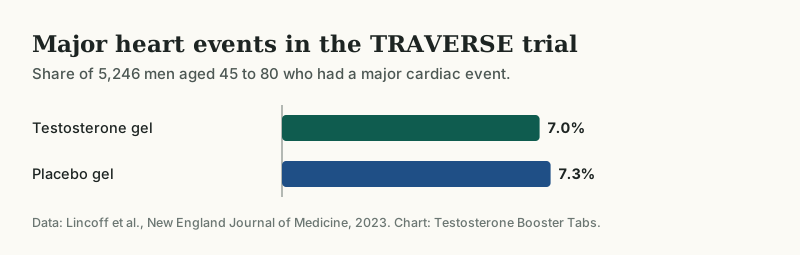
For years the heart safety of TRT was uncertain. The TRAVERSE trial was designed to settle it. It enrolled 5,246 men aged 45 to 80 who had low testosterone, symptoms, and existing heart disease or a high risk of it.[4]
A major cardiac event occurred in 7.0% of men using testosterone gel and 7.3% of men using placebo. But atrial fibrillation, acute kidney injury and pulmonary embolism (a blood clot in the lung) were more common in the testosterone group.[4]
Thicker blood
Testosterone raises the red blood cell count. A meta-analysis of 51 studies found a significant increase in haemoglobin and haematocrit with treatment.[6] A later analysis of 29 placebo-controlled trials in 3,393 men found that every form of testosterone raised haematocrit.[7]
In one 2-year trial of 1,007 men, haematocrit rose above the safety limit of 54% in 22% of men given testosterone injections and 1% given placebo.[11] This is one reason treatment is monitored. We explain more in high testosterone in men.
Fertility
Testosterone from outside the body switches off the signals that drive sperm production. A 2013 review described it as a preventable cause of male infertility, and noted that most men recover normal sperm production within a year of stopping.[8]
The guideline advises against starting TRT in men who plan to have children in the near future.[1] This is unrelated to vasectomy, which does not change hormone levels: see does a vasectomy affect testosterone?
Other effects
MedlinePlus lists these possible risks: infertility, an enlarged prostate leading to difficulty urinating, blood clots, worsening of heart disease, sleep problems and cholesterol problems.[2] Changes in body weight and scalp hair are covered in testosterone and weight gain and does testosterone cause hair loss?
Who should not start TRT?
The Endocrine Society recommends against starting testosterone therapy in men who:[1]
- plan to have children in the near term
- have breast or prostate cancer
- have a raised PSA or a prostate lump that has not been assessed by a urologist
- have a raised haematocrit
- have untreated severe obstructive sleep apnoea
- have severe lower urinary tract symptoms
- have uncontrolled heart failure
- have had a heart attack or stroke in the last 6 months
- have a tendency to form blood clots.
What monitoring does TRT need?
The guideline calls for a standard plan: checking symptoms and side effects, and measuring blood testosterone and haematocrit. It suggests aiming for a testosterone level in the mid-normal range.[1] MedlinePlus says regular check-ups are needed.[2]
A supplement comes with none of this. Nobody checks whether a booster has changed your testosterone, or anything else.
Are boosters a safer alternative to TRT?
They are a different thing, not a milder version of the same thing.
- A booster cannot treat a real deficiency, because most do not raise testosterone.[9]
- Boosters are not risk-free. See testosterone booster side effects.
- Taking a booster for months can delay the diagnosis of a condition that needs treatment.
If your testosterone is low because of excess weight, poor sleep or heavy drinking, addressing those has better evidence than any supplement. See how to increase testosterone naturally.
The bottom line
Testosterone boosters are supplements with little evidence behind them. TRT is a prescription medicine that works, but only for men with a confirmed deficiency, and it brings risks that need monitoring. If you have symptoms, get tested before spending money on either.
Common questions
Are testosterone boosters the same as TRT?
No. Boosters are dietary supplements, which the US Food and Drug Administration does not approve before sale.[10] TRT is prescription testosterone, approved for men with low testosterone linked to a medical condition.[3]
Do testosterone boosters work as well as TRT?
No. TRT supplies the hormone itself and reliably raises blood levels.[5] A 2024 systematic review of 52 studies found that most boosters fail to raise total testosterone.[9]
Is TRT safe for the heart?
In the TRAVERSE trial of 5,246 men aged 45 to 80, major cardiac events occurred in 7.0% of men on testosterone gel and 7.3% on placebo. Atrial fibrillation, acute kidney injury and pulmonary embolism were more common with testosterone.[4]
Does TRT affect fertility?
Yes. Testosterone from outside the body reduces sperm production. Most men recover normal sperm production within a year of stopping, according to a 2013 review.[8] Guidelines advise against starting TRT in men planning to have children soon.[1]
Who should not have TRT?
The Endocrine Society advises against starting it in men with breast or prostate cancer, a raised red blood cell level, untreated severe sleep apnoea, uncontrolled heart failure, or a heart attack or stroke in the last 6 months, among other conditions.[1]
Sources
- Testosterone Therapy in Men With Hypogonadism: An Endocrine Society Clinical Practice Guideline (Bhasin et al., 2018) The Journal of Clinical Endocrinology and Metabolism
- Low testosterone MedlinePlus, US National Library of Medicine
- Testosterone Information US Food and Drug Administration
- Cardiovascular Safety of Testosterone-Replacement Therapy (Lincoff et al., 2023) The New England Journal of Medicine
- Effects of Testosterone Treatment in Older Men (Snyder et al., 2016) The New England Journal of Medicine
- Clinical review 1: Adverse effects of testosterone therapy in adult men: a systematic review and meta-analysis (Fernández-Balsells et al., 2010) The Journal of Clinical Endocrinology and Metabolism
- The Effect of Route of Testosterone on Changes in Hematocrit: A Systematic Review and Bayesian Network Meta-Analysis of Randomized Trials (Nackeeran et al., 2022) The Journal of Urology
- Exogenous testosterone: a preventable cause of male infertility (Crosnoe et al., 2013) Translational Andrology and Urology
- Do "testosterone boosters" really increase serum total testosterone? A systematic review (Morgado et al., 2024) International Journal of Impotence Research
- Questions and Answers on Dietary Supplements US Food and Drug Administration
- Testosterone treatment to prevent or revert type 2 diabetes in men enrolled in a lifestyle programme (T4DM): a randomised, double-blind, placebo-controlled, 2-year, phase 3b trial (Wittert et al., 2021) The Lancet. Diabetes & Endocrinology
- DHEA in elderly women and DHEA or testosterone in elderly men (Nair et al., 2006) The New England Journal of Medicine
Part of our testosterone guides. New here? Start with do testosterone boosters work?