Does ashwagandha increase testosterone? In men, several small trials say yes, by a modest amount. Whether you would feel the difference is less clear.
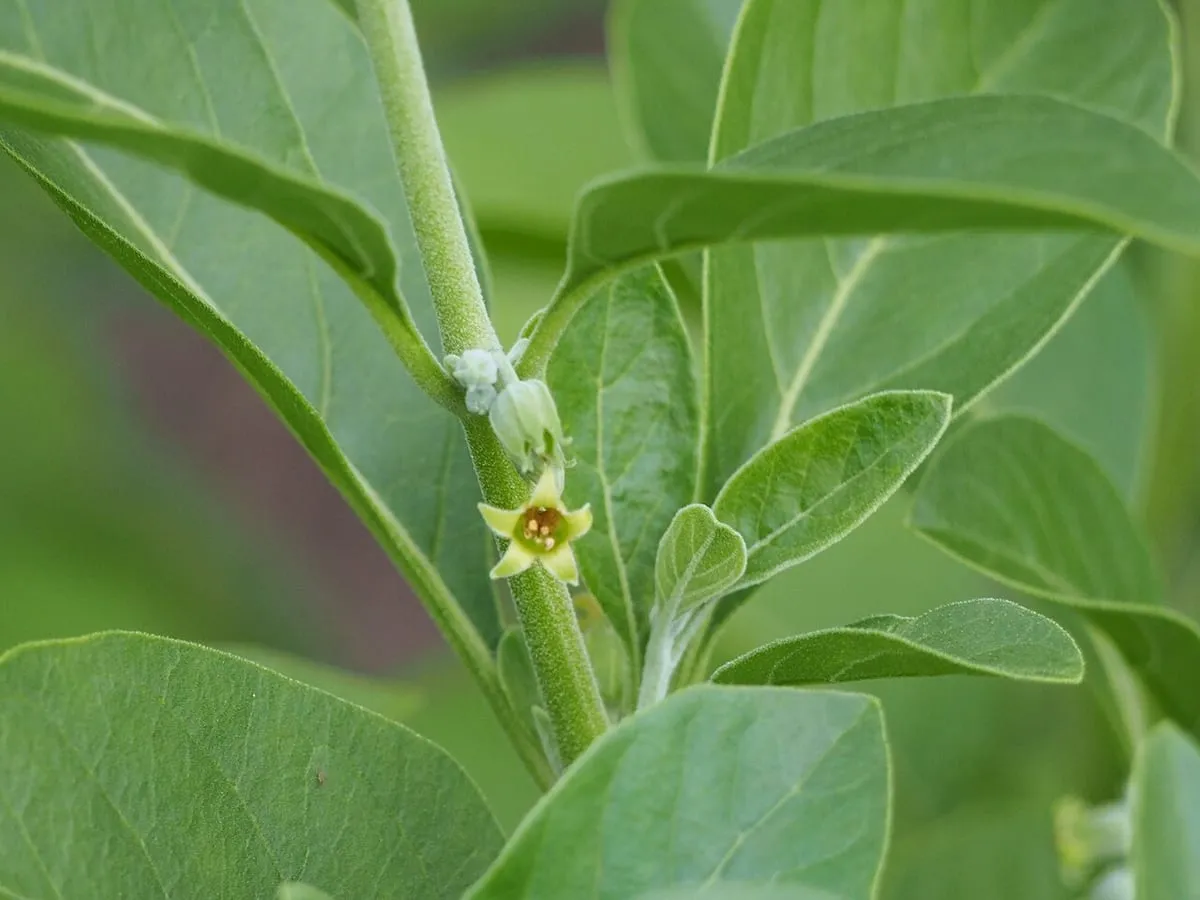
Ashwagandha (Withania somnifera) is a herb with a long history in Ayurvedic medicine. It is sold mostly for stress and sleep, and it turns up in many booster blends. Of the ingredients we cover in do testosterone boosters work?, it is one of the better studied.

Does ashwagandha increase testosterone? The human trials
Overweight men aged 40 to 70
A 2019 crossover trial enrolled 57 overweight men aged 40 to 70 who had mild fatigue. For 8 weeks they took either a placebo or an ashwagandha extract that delivered 21 mg of withanolide glycosides a day. Then they swapped.[1]
Testosterone, measured in saliva, rose 14.7% more with ashwagandha than with placebo.[1]
The catch: there were no significant differences between ashwagandha and placebo for fatigue, vigour, or sexual and psychological wellbeing.[1]
Young men starting weight training
A 2015 trial followed 57 men aged 18 to 50 with little weight-training experience. All of them trained for 8 weeks. Half took 300 mg of ashwagandha root extract twice a day, and half took a placebo.[2]
Testosterone rose by 96.2 ng/dL in the ashwagandha group and 18.0 ng/dL in the placebo group. The ashwagandha group also gained more strength.[2]
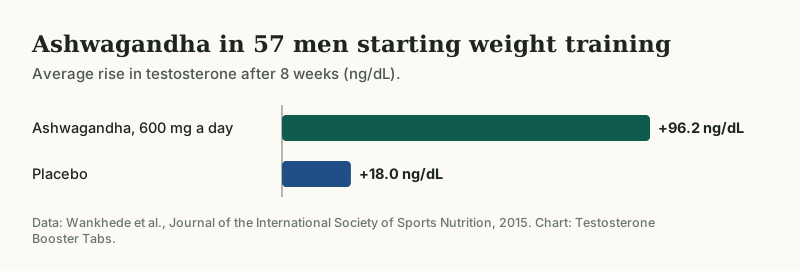
This is one trial in beginners, who gain quickly whatever they take. Training itself has only a small effect on resting hormone levels, as we explain in does working out increase testosterone?
Men with low sexual desire
A 2022 trial gave 50 men with lower sexual desire either 300 mg of root extract twice a day or a placebo for 8 weeks. The ashwagandha group reported better scores on a sexual function questionnaire and had a significantly greater rise in serum testosterone.[3]
What the pooled results show
A 2026 meta-analysis combined 23 randomised, placebo-controlled trials of ashwagandha and hormone levels, covering 1,706 adults. In men, ashwagandha raised testosterone by an average of 57 ng/dL. The authors warned that results varied a lot between studies.[4]
Two wider reviews agree in direction. A 2021 systematic review of herbs named ashwagandha as one of two herbal extracts with positive effects on testosterone in men.[5] A 2024 review of boosters rated it “possibly effective” for healthy men.[6]
The other herb the 2021 review singled out was fenugreek.[5] Tongkat ali has a similar, thin evidence base, while tribulus terrestris has failed in controlled trials.
How big is the effect of ashwagandha on testosterone?
For scale, a study that standardised testosterone measurements across four cohorts put the range for healthy, non-obese men aged 19 to 39 at 264 to 916 ng/dL, with a midpoint of 531 ng/dL.[9]
Against that, an average rise of 57 ng/dL is real but modest.[4] It could move a man within the normal range. It is unlikely to move a man with clearly low testosterone into it. For more on the numbers, see normal testosterone levels by age.
Does ashwagandha affect testosterone in women?
The 2026 meta-analysis found no meaningful effect on testosterone in women.[4] If you are a woman with symptoms you think are hormonal, our guides to high testosterone in women and low testosterone in women are better starting points than a supplement.
What doses of ashwagandha were used in studies?
- 300 mg of root extract twice a day (600 mg a day) for 8 weeks, in the weight-training and sexual-desire trials.[2, 3]
- An extract providing 21 mg of withanolide glycosides a day for 8 weeks, in the trial of older overweight men.[1]
The trials used specific standardised extracts. A label that says “ashwagandha 600 mg” is not necessarily equivalent. These are the doses researchers used, not recommendations.

Limits of the evidence
- Small trials. The three trials above included 50 to 57 men each.[1, 2, 3]
- Short trials. Eight weeks is typical. We do not know whether the effect lasts, grows or fades.
- Mixed measurement. One trial measured testosterone in saliva and others in blood.[1, 2]
- Blood test versus benefit. Higher testosterone did not reliably come with better energy or wellbeing.[1]
Is ashwagandha safe? Side effects and warnings
According to the US National Center for Complementary and Integrative Health:[7]
- Ashwagandha may be safe when taken for up to 3 months. There is not enough information to judge long-term safety.
- It can cause drowsiness, stomach upset, diarrhoea and vomiting in some people.
- Although rare, there have been a number of cases linking liver injury to ashwagandha supplements.
A case series from Iceland and the United States described five people with liver injury attributed to ashwagandha supplements. They developed jaundice 2 to 12 weeks after starting. None developed liver failure.[8]
The same NIH centre advises that ashwagandha:[7]
- should be avoided during pregnancy and while breastfeeding
- is not recommended for people with autoimmune or thyroid disorders, or people about to have surgery
- should be avoided by people with hormone-sensitive prostate cancer, because it may raise testosterone
- may interact with medicines for diabetes and high blood pressure, immunosuppressants, sedatives, anti-seizure medicines and thyroid hormone medicines.
Our guide to testosterone booster side effects covers the wider risks of supplement blends.
The bottom line
Ashwagandha has more human evidence than most booster ingredients, and the direction is consistent: a modest rise in testosterone over about 8 weeks. The trials are small and short, and a higher reading has not reliably meant feeling better. It has known interactions and a rare but real liver risk, so talk to a doctor or pharmacist first. If you have symptoms, start with low testosterone symptoms.
Common questions
Does ashwagandha increase testosterone?
In men, on average, yes, by a modest amount. A 2026 meta-analysis of 23 placebo-controlled trials covering 1,706 adults found an average rise of 57 ng/dL in men, with results that varied a lot between studies.[4]
Is ashwagandha a testosterone booster?
It is one of the few ingredients with human trials behind it. A 2024 review of testosterone boosters rated it possibly effective for healthy men, and a 2021 review of herbs named it as one of two extracts with positive effects.[5, 6]
Is Withania somnifera the same as ashwagandha?
Yes. Withania somnifera is the botanical name of the plant sold as ashwagandha. Studies of Withania somnifera and testosterone are studies of ashwagandha.[7]
Sources
- A Randomized, Double-Blind, Placebo-Controlled, Crossover Study Examining the Hormonal and Vitality Effects of Ashwagandha ( Withania somnifera) in Aging, Overweight Males (Lopresti et al., 2019) American Journal of Men's Health
- Examining the effect of Withania somnifera supplementation on muscle strength and recovery: a randomized controlled trial (Wankhede et al., 2015) Journal of the International Society of Sports Nutrition
- Effect of standardized root extract of ashwagandha (Withania somnifera) on well-being and sexual performance in adult males: A randomized controlled trial (Chauhan et al., 2022) Health Science Reports
- Hormonal Modulation with Withania somnifera: Systematic Review and Meta-Analysis of Randomized-controlled Trials (Fornalik et al., 2026) Planta Medica
- Examining the Effects of Herbs on Testosterone Concentrations in Men: A Systematic Review (Smith et al., 2021) Advances in Nutrition
- Do "testosterone boosters" really increase serum total testosterone? A systematic review (Morgado et al., 2024) International Journal of Impotence Research
- Ashwagandha: Usefulness and Safety National Center for Complementary and Integrative Health (NIH)
- Ashwagandha-induced liver injury: A case series from Iceland and the US Drug-Induced Liver Injury Network (Björnsson et al., 2020) Liver International
- Harmonized Reference Ranges for Circulating Testosterone Levels in Men of Four Cohort Studies in the United States and Europe (Travison et al., 2017) The Journal of Clinical Endocrinology and Metabolism
Part of our testosterone guides. New here? Start with do testosterone boosters work?