A testosterone result can come back as “total”, “free” or both. They measure different things, and one can look fine while the other does not. This page compares the two tests. For a walk through a full lab report, see our guide to testosterone blood test results.
Free vs total testosterone at a glance
| Total testosterone | Free testosterone | |
|---|---|---|
| What it is | All the testosterone in your blood, bound and free[1] | Only the testosterone not attached to proteins[1] |
| How often it is used | The most common test[1] | Less common[1] |
| Role in diagnosis | The first test, taken in the morning while fasting, then repeated[3] | Added when total is near the lower limit, or SHBG is abnormal[3] |
| How it is measured | Directly from a blood sample[1] | By equilibrium dialysis, or estimated with a formula[3] |
| Main weakness | Cannot show how much is free for the body to use[2] | Some direct tests are unreliable[4] |
| Who it suits | Everyone being checked for low or high testosterone | People with borderline totals, obesity, diabetes or thyroid problems[2, 3] |
What is total testosterone?
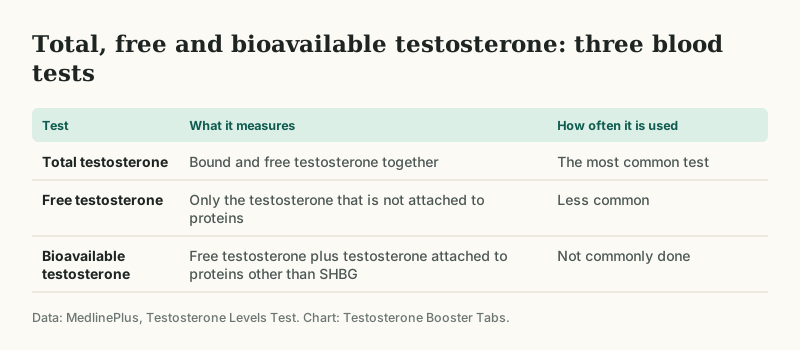
All the testosterone in your blood is either bound to proteins or unbound. Most of it is bound, mainly to two proteins: sex hormone binding globulin (SHBG) and albumin. A total testosterone test measures the bound and the free hormone together. It is the most common testosterone test.[1]
Reference ranges are written for total testosterone. One large project pooled 9,054 men from four studies in the United States and Europe. In healthy men aged 19 to 39 who were not obese, the middle 95% of results ran from 264 to 916 ng/dL.[7] Our guide to normal testosterone levels by age has the detail.
What is free testosterone?
Free testosterone is the small share that is not attached to any protein. It is more available for your body to use.[1] The idea that only the free part acts on your tissues is called the free hormone hypothesis. It has been debated for years, and a 2017 review argued that the standard models of how testosterone binds to SHBG and albumin are probably inaccurate.[5]
There is a third measure too. Bioavailable testosterone is the free hormone plus the part attached to proteins other than SHBG.[1]
Why SHBG decides the gap between them
SHBG is a protein made mostly in your liver. It binds testosterone and estrogen, and helps control how much of each is active.[2] The two hormones are compared in testosterone vs estrogen.
If your SHBG is low, more of your total testosterone is likely to be free.[2] So two men with the same total can have different free levels.
SHBG is not fixed. In a study of 1,786 men, SHBG was higher in older men. It was lower in men with more abdominal fat and higher triglycerides. The authors called low SHBG a marker of abdominal obesity.[6] This is one reason body weight and testosterone are so closely tied. MedlinePlus also links low SHBG to type 2 diabetes, an underactive thyroid and anabolic steroid use.[2]
Which test do doctors use first?
Total testosterone. The Endocrine Society guideline tells doctors to:
- Diagnose low testosterone only in men who have symptoms and results that are clearly and repeatedly low.
- Measure total testosterone in the morning, fasting, as the first test.
- Repeat it to confirm.
- Get a free testosterone level when the total is near the lower limit of normal, or when a condition is altering SHBG.[3]
Timing matters for both tests. In men aged 30 to 40, testosterone was 20 to 25% lower at 4 pm than at 8 am. The gap narrowed to about 10% at age 70. SHBG changed far less through the day.[8]

How accurate is a free testosterone test?
Less than you might hope. It depends on the method.
A 1999 study compared several methods in a large set of blood samples. A free level calculated from total testosterone and SHBG was almost identical to the reference method, equilibrium dialysis, except in pregnancy. A quick direct test called an analog immunoassay gave values that were only a fraction of the true figure, and the error changed with SHBG. The authors judged it unreliable.[4]
The guideline reflects this. It asks for free testosterone by equilibrium dialysis or by an accurate formula.[3] If your report shows a free result, it is fair to ask how it was measured.
Which one? Free or total
Start with total. It is the standard first test and the one reference ranges are built on.[3, 7]
Add free when total does not fit the picture. That means a total near the bottom of the range, or symptoms of low testosterone alongside a condition that shifts SHBG, such as obesity or diabetes.[2, 3]
Neither number works alone. A diagnosis needs symptoms as well as repeated low results.[3] The same goes for a high result. See high testosterone in men and high testosterone in women.
Free testosterone is not the only “active” form people ask about. The body also converts testosterone into a stronger androgen, covered in testosterone vs DHT.
The bottom line
Total testosterone is the headline number. Free testosterone is a follow-up test for borderline or puzzling results, and it is only as good as the method behind it. Get both read by a doctor who knows your symptoms, and test in the morning.
Common questions
Which is more important, free or total testosterone?
Total testosterone is the test guidelines start with. Free testosterone becomes important when the total is near the bottom of the normal range, or when a condition is changing your SHBG level.[3]
Can total testosterone be normal while free testosterone is low?
Yes. A total test cannot tell bound and free testosterone apart, so MedlinePlus notes you could have symptoms from too little free testosterone even when your total level is normal.[2]
What is bioavailable testosterone?
It is free testosterone plus the testosterone attached to proteins other than SHBG. The test is not commonly done.[1]
What lowers SHBG?
Low SHBG may be linked to obesity, type 2 diabetes or insulin resistance, an underactive thyroid, Cushing syndrome and overuse of steroid medicines or anabolic steroids.[2]
Sources
- Testosterone Levels Test MedlinePlus, US National Library of Medicine
- SHBG Blood Test MedlinePlus, US National Library of Medicine
- Testosterone Therapy in Men With Hypogonadism: An Endocrine Society Clinical Practice Guideline (Bhasin et al., 2018) The Journal of Clinical Endocrinology and Metabolism
- A critical evaluation of simple methods for the estimation of free testosterone in serum (Vermeulen et al., 1999) The Journal of Clinical Endocrinology and Metabolism
- A Reappraisal of Testosterone's Binding in Circulation: Physiological and Clinical Implications (Goldman et al., 2017) Endocrine Reviews
- Cross-sectional and longitudinal determinants of serum sex hormone binding globulin (SHBG) in a cohort of community-dwelling men (Gyawali et al., 2018) PloS One
- Harmonized Reference Ranges for Circulating Testosterone Levels in Men of Four Cohort Studies in the United States and Europe (Travison et al., 2017) The Journal of Clinical Endocrinology and Metabolism
- The effect of diurnal variation on clinical measurement of serum testosterone and other sex hormone levels in men (Brambilla et al., 2009) The Journal of Clinical Endocrinology and Metabolism
One of our side-by-side comparisons. New here? Start with do testosterone boosters work?