DHT stands for dihydrotestosterone. It is not a rival to testosterone. It is made from it. Both are androgens, and the body responds to them through the androgen receptor.[4] Yet they do different jobs and raise different worries, hair loss most of all. This page compares them.
Testosterone vs DHT at a glance
| Testosterone | DHT | |
|---|---|---|
| What it is | The hormone DHT is made from[3] | The most potent natural androgen in humans[2] |
| How it is made | By the testes, in larger amounts from puberty[3] | From testosterone, by the enzyme 5-alpha reductase[3] |
| Main jobs | Muscle mass, deeper voice, pubic hair and the growth spurt at puberty[3] | Forming the male external sex organs before birth; facial and body hair[3] |
| Can it become estrogen? | Yes[8] | No[7] |
| Dose in the cited trial | Not tested | 70 mg of DHT gel a day for two years[7] |
| Main concerns | See our guides on low and high testosterone | Male pattern hair loss in men with the genes for it[4] |
| Who needs it measured | Men with symptoms of low testosterone | Almost no one outside rare developmental conditions[2] |
How is DHT made from testosterone?
An enzyme called 5-alpha reductase converts testosterone into DHT.[3] The drug finasteride blocks one type of that enzyme, which lowers DHT in the blood and the scalp.[5]
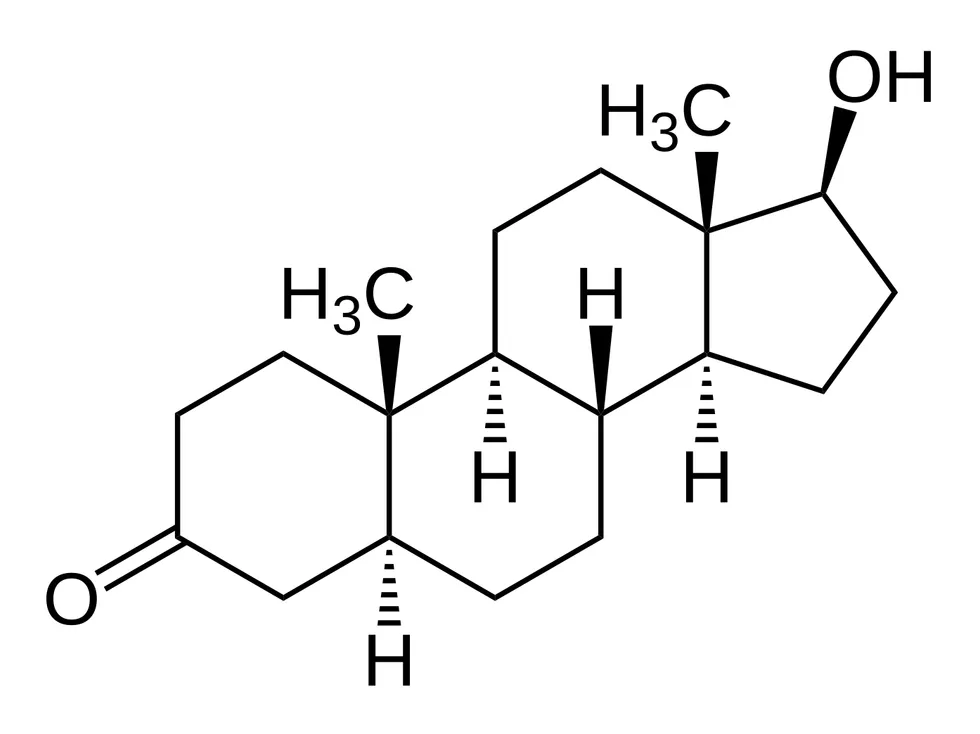

Testosterone has a second fate that DHT does not. The body can turn testosterone into estradiol, an estrogen. DHT cannot be converted in that way.[7, 8] That route is covered in testosterone vs estrogen.
What does each hormone do?
A rare genetic condition shows the split. People with 5-alpha reductase deficiency are genetically male and have testes, but make too little DHT.[3]
- Before birth, the shortage of DHT disrupts the formation of the external sex organs.[3]
- At puberty, rising testosterone still brings more muscle, a deeper voice, pubic hair and a growth spurt.[3]
- Later, they do not develop much facial or body hair.[3]
So testosterone can do much of the work of puberty by itself. DHT is needed for early genital development and for facial and body hair.[3]
Which one causes hair loss?
DHT is the androgen most closely tied to male pattern hair loss.[4] In two one-year trials in 1,553 men, finasteride slowed hair loss and increased hair counts compared with placebo.[5]
Genes decide who is vulnerable. The one confirmed genetic factor is the androgen receptor gene, which makes the receptor that responds to DHT and other androgens.[4] In a pooled analysis of 2,074 men with hair loss and 1,115 without, one variant of that gene was linked to about 2.7 times the odds.[10]
Our guide to testosterone and hair loss goes through this in detail.
Does more testosterone mean more DHT?
Blood levels of the two do move apart. In men given finasteride, blood DHT fell by 78.7% within a month, while testosterone rose by about 18%.[6]
It works the other way with testosterone treatment, which modestly raises blood DHT. A 2017 review judged that this should not be a concern in practice. Raised DHT had not been linked to a higher risk of prostate disease, and androgen levels inside tissues were essentially independent of blood levels.[1] The review also noted the lack of large, long trials.[1]
One supplement study gets quoted often. In 20 rugby players, three weeks of creatine left testosterone unchanged but raised DHT by 56% after the first week.[9] Hair was not among the outcomes the study reported. See creatine and testosterone.
What happens if men take DHT directly?
One trial tested it. For two years, 114 healthy men over 50 used a DHT gel or a placebo gel every day.[7]
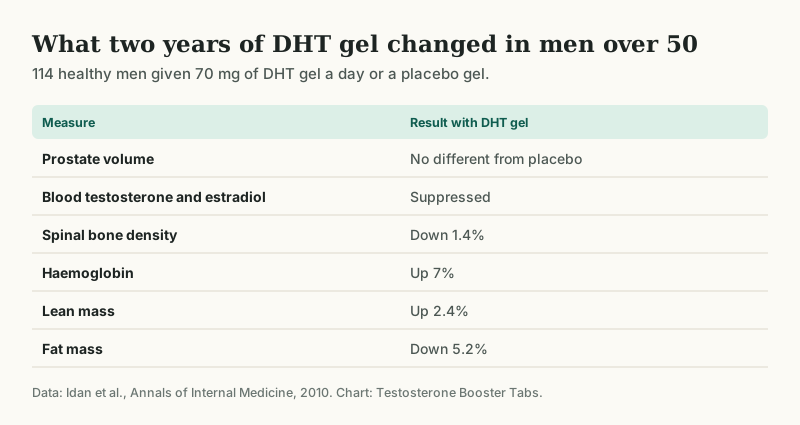
- Prostate. Prostate volume grew with age in both groups. DHT made no difference.[7]
- Other hormones. DHT suppressed the men’s own testosterone and estradiol.[7]
- Bone. Spinal bone density fell by 1.4%. Hip density did not change.[7]
- Body composition and blood. Lean mass rose 2.4%, fat mass fell 5.2% and haemoglobin rose 7%. Eight men stopped because their haematocrit, a measure of red blood cells, rose too high.[7]
- Sexual function. It was maintained on 33 measures, apart from a mild, reversible fall in overall desire.[8]
The bone result points back to estrogen. With testosterone suppressed and no conversion to estradiol, the spine lost density.[7, 8]
Should you test DHT?
For most people, no. A clinical biochemistry review found little evidence for measuring blood DHT in managing disease. The accepted uses are narrow: suspected 5-alpha reductase deficiency in infants, some cases of delayed puberty or undescended testes, and confirming that testicular tissue is active.[2]
The standard starting point is total testosterone. See free vs total testosterone and our guide to testosterone blood test results.
Which one matters more?
For symptoms of low testosterone, testosterone is the hormone to measure and, if needed, treat. DHT is not part of that work-up.[2]
For hair loss, DHT is the hormone that matters, alongside your genes.[4, 10]
For safety on testosterone treatment, the modest rise in DHT has not been tied to prostate disease so far, though long trials are lacking.[1] Treatment itself is compared in TRT vs steroids and testosterone vs HGH. For what excess androgens do, see high testosterone in men.
The bottom line
DHT is testosterone’s more potent offspring. It builds male anatomy before birth and drives beard growth and male pattern hair loss. Testosterone does most of the rest, and can also become estrogen, which DHT cannot. Blood DHT is rarely worth testing.
Common questions
Is DHT stronger than testosterone?
Yes. A clinical biochemistry review describes DHT as the most potent natural androgen in humans.[2]
Does high testosterone mean high DHT?
Not in a simple way. Testosterone therapy modestly raises blood DHT, but androgen levels inside tissues are largely independent of blood levels. Blocking the conversion with finasteride cut blood DHT by about 79% while testosterone rose.[1, 6]
Does DHT cause hair loss?
DHT is the androgen most linked to male pattern hair loss, but genes decide who is affected. Variations in the androgen receptor gene are the confirmed genetic factor.[4, 10]
Should I get my DHT level tested?
Usually not. A review found little evidence for measuring blood DHT in managing disease. The main uses are investigating rare developmental conditions.[2]
Sources
- Dihydrotestosterone: Biochemistry, Physiology, and Clinical Implications of Elevated Blood Levels (Swerdloff et al., 2017) Endocrine Reviews
- Clinical biochemistry of dihydrotestosterone (Marchetti and Barth, 2013) Annals of Clinical Biochemistry
- 5-alpha reductase deficiency MedlinePlus Genetics, US National Library of Medicine
- Androgenetic alopecia MedlinePlus Genetics, US National Library of Medicine
- Finasteride in the treatment of men with androgenetic alopecia. Finasteride Male Pattern Hair Loss Study Group (Kaufman et al., 1998) Journal of the American Academy of Dermatology
- Effect of finasteride on serum levels of androstenedione, testosterone and their 5α-reduced metabolites in men at risk for prostate cancer (Stanczyk et al., 2013) The Journal of Steroid Biochemistry and Molecular Biology
- Long-term effects of dihydrotestosterone treatment on prostate growth in healthy, middle-aged men without prostate disease: a randomized, placebo-controlled trial (Idan et al., 2010) Annals of Internal Medicine
- Male sexual function can be maintained without aromatization: randomized placebo-controlled trial of dihydrotestosterone (DHT) in healthy, older men for 24 months (Sartorius et al., 2014) The Journal of Sexual Medicine
- Three weeks of creatine monohydrate supplementation affects dihydrotestosterone to testosterone ratio in college-aged rugby players (van der Merwe et al., 2009) Clinical Journal of Sport Medicine
- Androgen receptor gene polymorphisms and risk for androgenetic alopecia: a meta-analysis (Zhuo et al., 2012) Clinical and Experimental Dermatology
One of our side-by-side comparisons. New here? Start with do testosterone boosters work?