Normal testosterone levels for adult men span a wide range: roughly 264 to 916 ng/dL in healthy young men when measured to a common standard.[3] Levels shift with age, but less than most people expect, and the range of normal is wide at every age.
This guide gives a testosterone levels by age chart for men, ranges for women, and the caveats you need to read any of them.
Read this first: ranges differ between laboratories
There is no single universal “normal”. Different laboratories use different methods and print different reference ranges.[2] Always compare your result with the range on your own report.
One research group tackled this by re-measuring samples from four large studies, covering 9,054 men, against a reference method at the US Centers for Disease Control and Prevention. They found that a substantial share of the differences between studies was caused by the tests themselves, not the men.[3]
Testosterone levels by age chart for men
The most complete picture comes from a 2014 model built from 13 studies and 10,098 healthy males.[1]
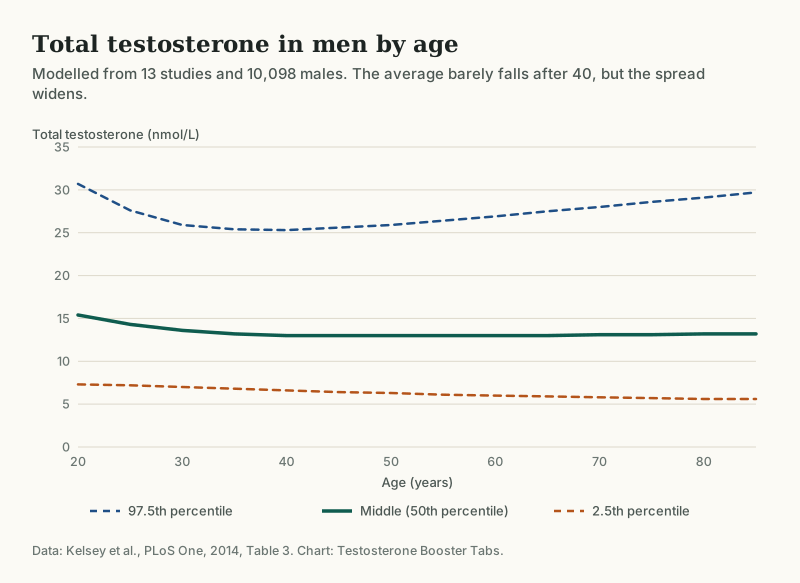
The same data as a table. The middle column is the typical value. The outer columns mark the range that covers 95% of healthy men.[1]
| Age | Low end (2.5th percentile) | Middle | High end (97.5th percentile) |
|---|---|---|---|
| 20 | 7.3 nmol/L | 15.4 nmol/L | 30.7 nmol/L |
| 30 | 7.0 nmol/L | 13.6 nmol/L | 25.9 nmol/L |
| 40 | 6.6 nmol/L | 13.0 nmol/L | 25.3 nmol/L |
| 50 | 6.3 nmol/L | 13.0 nmol/L | 25.9 nmol/L |
| 60 | 6.0 nmol/L | 13.0 nmol/L | 26.9 nmol/L |
| 70 | 5.8 nmol/L | 13.1 nmol/L | 28.0 nmol/L |
| 80 | 5.6 nmol/L | 13.2 nmol/L | 29.1 nmol/L |
To convert, 300 ng/dL is 10.4 nmol/L.[10] So 13.0 nmol/L is roughly 375 ng/dL by our calculation.
Three things stand out.[1]
- The peak is early. Average total testosterone peaks at about age 19.
- The fall is modest. The average drops from 15.4 to 13.0 nmol/L by age 40, with no evidence of a further fall in the average after that.
- The spread widens. After 40, the gap between the lowest and highest men grows.
Age explained only about 41% of the variation in testosterone across the male lifespan. The rest came from other factors, such as lifestyle, body size and health.[1]
What is a normal testosterone level for young men?
A US study used national survey data from 1,486 men aged 20 to 44. It reported the middle third of results for each age group.[4]
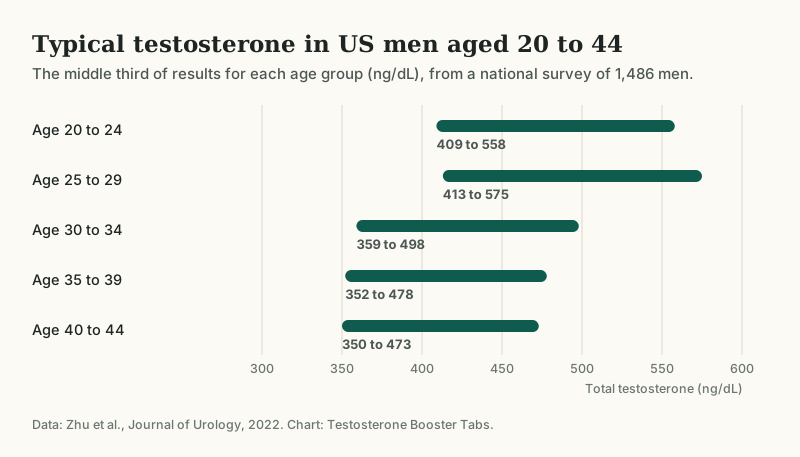
The authors argued that young men have different reference ranges from older men, and that age-specific values should be used when assessing them.[4] That is one study’s view. It has not replaced the laboratory range in everyday practice.
Does testosterone really fall with age?
It does, but studies disagree on how much, because they measure different things.
- Following the same men over time shows a steeper fall. In the Massachusetts Male Aging Study, 1,156 men aged 40 to 70 were followed for 7 to 10 years. Total testosterone fell by about 1.6% a year.[5]
- Comparing healthy men of different ages shows much less, as in the chart above.[1]
The difference is probably health. In the Massachusetts study, men in apparent good health had androgen levels 10 to 15% higher, and the authors suggested that new illness speeds up the age-related decline.[5] A later analysis of the same men found that a 4 to 5 point rise in body mass index was linked to a fall in testosterone similar to about 10 years of ageing.[6]
Free testosterone falls faster than total, because SHBG, the protein that binds testosterone, rises with age.[5] Our testosterone blood test guide explains the difference.
What else moves the number?
- Body weight. In 3,200 European men aged 40 to 79, total testosterone was 5.09 nmol/L lower in obese men than in men of normal weight.[12] See testosterone and weight gain.
- Time of day. In men aged 30 to 40, levels were 20 to 25% lower at 4 pm than at 8 am.[10]
- Lifestyle. In 208,677 UK men aged 40 to 69, the median total testosterone was 11.6 nmol/L, and it varied with weight, activity and diet.[11] See how to increase testosterone naturally.
A vasectomy is not on the list: see does a vasectomy affect testosterone?
Normal testosterone levels for men and women
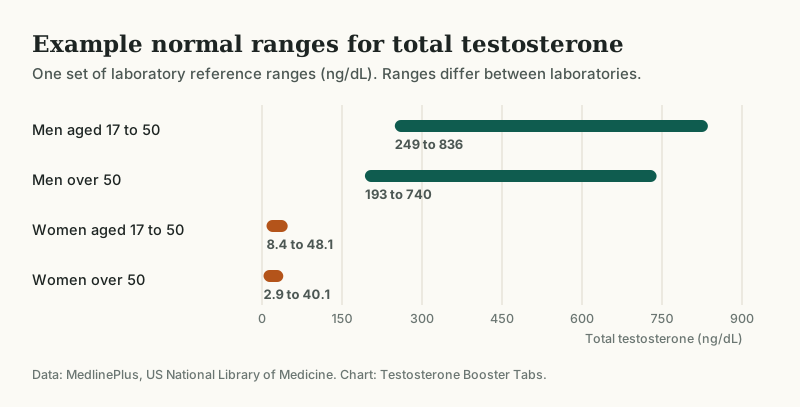
MedlinePlus, from the US National Library of Medicine, gives these example normal ranges for total testosterone:[2]
- men aged 17 to 50: 249 to 836 ng/dL (8.6 to 29.0 nmol/L)
- men over 50: 193 to 740 ng/dL (6.7 to 25.7 nmol/L)
- women aged 17 to 50: 8.4 to 48.1 ng/dL (0.3 to 1.7 nmol/L)
- women over 50: 2.9 to 40.1 ng/dL (0.1 to 1.4 nmol/L).
What is normal for women?
Women have much lower levels than men, which makes them harder to measure accurately.
A study of 161 healthy women aged 18 to 49 with regular cycles found that total testosterone declined with age. For a typical 30-year-old, the 5th to 95th percentile range was 15 to 46 ng/dL.[7]
A 2026 report from a meeting of experts and the US Centers for Disease Control and Prevention noted that reference ranges for women and girls remain highly variable across laboratories, which limits how accurately conditions can be diagnosed.[8]
For what high and low results can mean, see high testosterone in women and low testosterone in women.
What counts as low, and what counts as high?
Low. A number below the range is not a diagnosis. The Endocrine Society recommends diagnosing low testosterone only in men with symptoms and blood levels that are unequivocally and consistently low on fasting morning tests.[9] See low testosterone symptoms.
High. A result above the top of your laboratory’s range counts as high. In men this is uncommon without an outside source of testosterone. See high testosterone in men.
In between. A result in the lower part of the normal range is still normal. Supplements sold to “optimise” a normal level have little evidence behind them, as we explain in do testosterone boosters work?
The bottom line
A normal testosterone level is a range, not a number. For healthy young men it runs from about 264 to 916 ng/dL. Average levels dip a little between 20 and 40 and then hold fairly steady in healthy men, while weight and illness pull individual results down. Read your result against your own laboratory’s range, and judge it together with how you feel.
Common questions
What is a normal testosterone level?
For healthy, non-obese men aged 19 to 39, a study that standardised results across four large cohorts put the normal range at 264 to 916 ng/dL, with a middle value of 531 ng/dL.[3] Ranges vary between laboratories.[2]
What is a normal testosterone level for a 40-year-old man?
In a model built from 13 studies, the average at age 40 was 13.0 nmol/L, with 95% of healthy men between 6.6 and 25.3 nmol/L.[1]
Does testosterone drop with age?
Yes, but slowly, and health matters as much as age. In 1,156 men followed for 7 to 10 years, total testosterone fell by about 1.6% a year.[5] Men in good health had levels 10 to 15% higher.[5]
What is a normal testosterone level for a woman?
One example laboratory range is 8.4 to 48.1 ng/dL for women aged 17 to 50 and 2.9 to 40.1 ng/dL over 50.[2] Reference ranges for women remain highly variable between laboratories.[8]
What level counts as low testosterone?
There is no single number. Guidelines require symptoms plus a result that is clearly and repeatedly below the laboratory's range on fasting morning tests.[9]
Sources
- A validated age-related normative model for male total testosterone shows increasing variance but no decline after age 40 years (Kelsey et al., 2014) PloS One
- Testosterone test MedlinePlus, US National Library of Medicine
- Harmonized Reference Ranges for Circulating Testosterone Levels in Men of Four Cohort Studies in the United States and Europe (Travison et al., 2017) The Journal of Clinical Endocrinology and Metabolism
- What Is a Normal Testosterone Level for Young Men? Rethinking the 300 ng/dL Cutoff for Testosterone Deficiency in Men 20-44 Years Old (Zhu et al., 2022) The Journal of Urology
- Age trends in the level of serum testosterone and other hormones in middle-aged men: longitudinal results from the Massachusetts male aging study (Feldman et al., 2002) The Journal of Clinical Endocrinology and Metabolism
- The relative contributions of aging, health, and lifestyle factors to serum testosterone decline in men (Travison et al., 2007) The Journal of Clinical Endocrinology and Metabolism
- Testosterone reference ranges in normally cycling healthy premenopausal women (Braunstein et al., 2011) The Journal of Sexual Medicine
- Testosterone reference ranges in women, adolescent girls, and children: the 2024 PCOS Challenge-CDC stakeholder meeting (Ottey et al., 2026) The Journal of Clinical Endocrinology and Metabolism
- Testosterone Therapy in Men With Hypogonadism: An Endocrine Society Clinical Practice Guideline (Bhasin et al., 2018) The Journal of Clinical Endocrinology and Metabolism
- The effect of diurnal variation on clinical measurement of serum testosterone and other sex hormone levels in men (Brambilla et al., 2009) The Journal of Clinical Endocrinology and Metabolism
- Sociodemographic, lifestyle and medical influences on serum testosterone and sex hormone-binding globulin in men from UK Biobank (Yeap et al., 2021) Clinical Endocrinology
- Hypothalamic-pituitary-testicular axis disruptions in older men are differentially linked to age and modifiable risk factors: the European Male Aging Study (Wu et al., 2008) The Journal of Clinical Endocrinology and Metabolism
Part of our testosterone guides. New here? Start with do testosterone boosters work?