High testosterone in women most often shows up as unwanted hair on the face or body, acne, and irregular periods.[2] The most common cause is polycystic ovary syndrome (PCOS).[4]
Women make testosterone naturally, in the ovaries and the adrenal glands, but in much smaller amounts than men.[5] Problems start when the level climbs above the normal female range, or when the body becomes more sensitive to these hormones.[4]
What are the symptoms of high testosterone in women?
MedlinePlus groups the signs by how high the level is.[2]
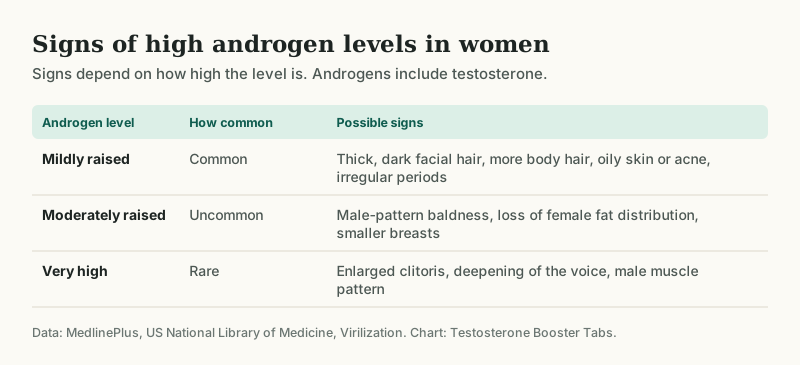
Mildly raised (common):
- thick, dark facial hair in the beard or moustache area
- an increase in body hair
- oily skin or acne
- irregular periods.
Moderately raised (uncommon):
- male-pattern baldness
- loss of female fat distribution
- decreased breast size.
Very high (rare):
- enlargement of the clitoris
- deepening of the voice
- a male muscle pattern.
The medical name for the rarer, more marked changes is virilisation.[2]
When is it urgent?
The NHS advises asking for an urgent GP appointment if new thick, dark hair suddenly starts growing on your face and body, your voice is getting lower, or your muscles are getting bigger.[4] Sudden, marked changes like these can point to one of the rarer causes below.
What causes high testosterone in females?
Polycystic ovary syndrome (PCOS)
PCOS is a hormone condition that can affect hair growth, periods, fertility and mood. The NHS now calls it polyendocrine metabolic ovarian syndrome (PMOS).[3] It is the most common cause of hirsutism, the medical term for excess thick, dark hair.[4]
The main symptoms the NHS lists are:[3]
- irregular periods or long gaps between periods
- excessive hair growth, or hair loss
- weight gain or difficulty losing weight
- difficulty getting pregnant
- oily skin and acne
- mental health problems such as depression or anxiety.
The cause is unknown, but it may be to do with hormones such as insulin and testosterone not working properly. It is more likely if a close relative has it.[3]
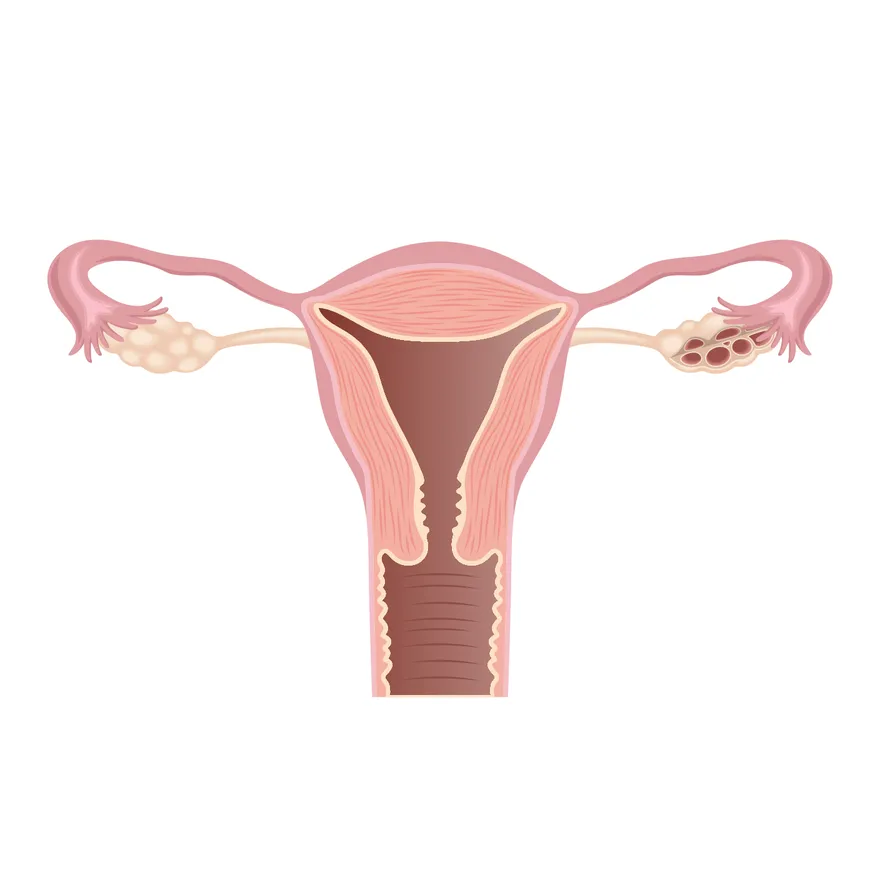

PCOS is also linked to low levels of SHBG, the protein that binds testosterone. When SHBG is low, more testosterone is likely to be free to act.[8] Our testosterone blood test guide explains SHBG and free testosterone.
Rarer causes
MedlinePlus lists these other causes of high testosterone in females:[1]
- ovarian cancer or other problems with the ovaries
- an adrenal gland disorder, such as congenital adrenal hyperplasia
- a pituitary gland disorder.
The NHS adds some medicines, other hormonal conditions such as Cushing’s syndrome, and tumours that affect hormone levels. Sometimes no cause is found.[4]
Steroids and supplements
Anabolic steroids can cause all of these changes. In women, the NHS lists excess facial and body hair, decreased breast size, swelling of the clitoris, a deepened voice, problems with periods, hair loss and severe acne.[12] See is testosterone a steroid?
The hormone supplement DHEA can act the same way on a smaller scale. Mayo Clinic says it might cause oily skin, acne and unwanted male-pattern hair growth in women.[11] We cover it in DHEA and testosterone. Other supplements carry different risks, set out in testosterone booster side effects.
What is a high testosterone level for a woman?
There is no single cut-off. MedlinePlus gives these example normal ranges for total testosterone:[5]
- women aged 17 to 50: 8.4 to 48.1 ng/dL (0.3 to 1.7 nmol/L)
- women over 50: 2.9 to 40.1 ng/dL (0.1 to 1.4 nmol/L).
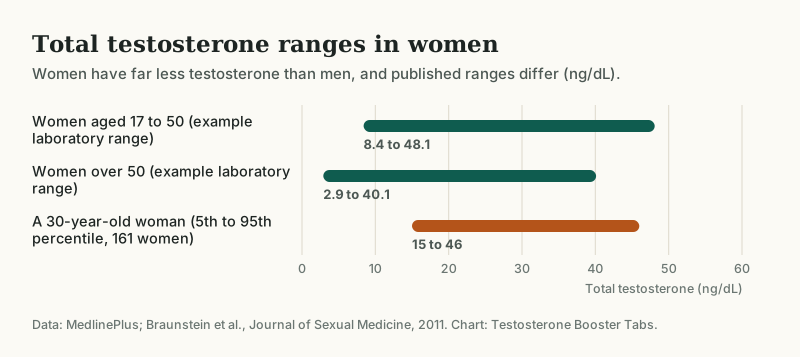
Ranges vary between laboratories.[5] A 2026 expert report noted that reference ranges for women remain highly variable across laboratories, which limits how accurately conditions such as PCOS can be diagnosed.[9] So a result needs to be read against your own laboratory’s range and alongside your symptoms. Compare the male and female figures in normal testosterone levels by age.
How is high testosterone in women diagnosed?
A doctor will check what is causing the symptoms. You may have a blood test to measure your hormone levels.[4]
The Endocrine Society’s guideline on hirsutism suggests testing for raised androgen levels in all women with an abnormal hirsutism score. It suggests against testing women who have regular periods and only some unwanted local hair.[7]
If a tumour is suspected, scans of the ovaries and adrenal glands may follow.[2]
How is high testosterone in women treated?
Treatment depends on the cause and on which symptoms bother you most.
For PCOS, the NHS lists:[3]
- the contraceptive pill or a hormonal coil, to help with irregular periods
- medicines to reduce hair growth on the face and body
- creams or tablets for acne
- metformin, and weight-loss medicines if you are overweight.
Losing weight if you are overweight can help control hormone levels.[4] The two-way link between weight and hormones is covered in testosterone and weight gain.
For excess hair, the Endocrine Society suggests combined oestrogen-progestin contraceptive pills for most women, adding an anti-androgen after 6 months if the response is not good enough. It also suggests laser or light-based hair removal for women who choose that route.[7]
An international PCOS guideline was updated in 2023. It notes that the evidence behind PCOS care has improved but remains of low to moderate quality.[6]
Will the changes reverse?
When the cause is exposure to androgens, many of the symptoms go away once the hormones are stopped. A deepened voice is the exception: it is permanent.[2]
Does high testosterone cause hair loss in women?
It can. Male-pattern baldness is one of the less common signs.[2] Female pattern hair loss is also associated with a higher risk of PCOS.[10] See does testosterone cause hair loss?
What about the opposite problem?
Low levels get far less attention and are harder to define. We cover them in low testosterone in women. For men, see high testosterone in men.
The bottom line
In women, high testosterone usually means unwanted hair, acne and irregular periods, and the usual cause is PCOS. It is common and treatable. A sudden change, a deepening voice or rapid muscle gain is different: see a doctor promptly, because those signs point to rarer causes that need to be ruled out.
Common questions
What are the symptoms of high testosterone in women?
At mildly raised levels: thick, dark hair on the face, more body hair, oily skin or acne, and irregular periods. Less commonly: male-pattern baldness and smaller breasts. Rarely: an enlarged clitoris, a deeper voice and a male muscle pattern.[2]
What causes high testosterone in females?
MedlinePlus lists polycystic ovary syndrome, ovarian cancer or other ovary problems, adrenal gland disorders such as congenital adrenal hyperplasia, and pituitary disorders.[1] Anabolic steroids and certain medicines can also cause it.[2]
What is a high testosterone level for a woman?
It depends on the laboratory. One example normal range is 8.4 to 48.1 ng/dL for women aged 17 to 50, so a result above the top of your own laboratory's range counts as high.[5]
Can high testosterone in women be treated?
Yes. Treatment depends on the cause. For excess hair growth, the Endocrine Society suggests combined contraceptive pills for most women, with an anti-androgen added after 6 months if needed.[7]
Do the signs of high testosterone go away?
When they are caused by taking androgens, many symptoms go away once the hormones are stopped. Deepening of the voice is permanent.[2]
Sources
- Testosterone Levels Test MedlinePlus, US National Library of Medicine
- Virilization MedlinePlus, US National Library of Medicine
- Polyendocrine metabolic ovarian syndrome (PMOS) NHS
- Excessive hair growth (hirsutism) NHS
- Testosterone test MedlinePlus, US National Library of Medicine
- Recommendations From the 2023 International Evidence-based Guideline for the Assessment and Management of Polycystic Ovary Syndrome (Teede et al., 2023) The Journal of Clinical Endocrinology and Metabolism
- Evaluation and Treatment of Hirsutism in Premenopausal Women: An Endocrine Society Clinical Practice Guideline (Martin et al., 2018) The Journal of Clinical Endocrinology and Metabolism
- SHBG Blood Test MedlinePlus, US National Library of Medicine
- Testosterone reference ranges in women, adolescent girls, and children: the 2024 PCOS Challenge-CDC stakeholder meeting (Ottey et al., 2026) The Journal of Clinical Endocrinology and Metabolism
- Androgenetic alopecia MedlinePlus Genetics, US National Library of Medicine
- DHEA Mayo Clinic
- Anabolic steroid misuse NHS
- Testosterone reference ranges in normally cycling healthy premenopausal women (Braunstein et al., 2011) The Journal of Sexual Medicine
Part of our testosterone guides. New here? Start with do testosterone boosters work?