High testosterone in men is much less common than low testosterone, and it is rarely something the body does by itself. When a man’s level is truly elevated, the usual explanation is testosterone or anabolic steroids from outside the body.[1]
This guide covers what counts as high, the signs of high testosterone in a man, the causes, and when it matters.
What counts as high testosterone in men?
A result is high when it sits above the top of your laboratory’s reference range. That top end differs between laboratories.[2]
- MedlinePlus gives an example range of 249 to 836 ng/dL for men aged 17 to 50, and 193 to 740 ng/dL for men over 50.[2]
- A study that standardised results from four large cohorts put the range for healthy, non-obese men aged 19 to 39 at 264 to 916 ng/dL.[3]
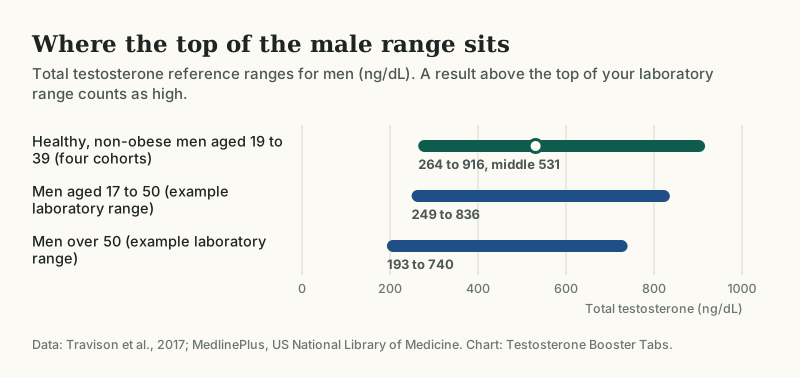
A level near the top of the range is not “high testosterone”. It is normal. Our guide to normal testosterone levels by age shows how wide the healthy spread is.
A single reading can also mislead. Levels are higher in the morning and vary from day to day, as we explain in how to test for testosterone levels.
What causes elevated testosterone in men?
MedlinePlus lists these possible causes of high testosterone in males:[1]
- use of steroids
- a tumour in the testicles
- a disorder of the adrenal glands, such as congenital adrenal hyperplasia.
Its entry on the testosterone test adds:[2]
- resistance to the action of male hormones (androgen resistance)
- medicines or drugs that raise testosterone, including some supplements.
Testosterone treatment
Prescription testosterone is meant to bring a low level into the normal range. The Endocrine Society suggests aiming for the mid-normal range during treatment and monitoring blood levels.[12] A dose that is too high can overshoot. See testosterone boosters vs TRT.
Anabolic steroids
Anabolic steroids are man-made versions of testosterone.[5] People who misuse them often take doses far above anything the body would make.[6] Our guide is testosterone a steroid? explains how the two relate.
Supplements
Most testosterone boosters do not raise testosterone.[14] But some supplements contain undeclared drugs. Of 92 adulterated muscle-building supplements named in US FDA warnings from 2007 to 2016, 89.1% contained synthetic steroids or steroid-like ingredients.[11] An unexpectedly high result in a man taking supplements is a reason to look hard at what he is taking. See testosterone booster side effects. The hormone supplement DHEA is a separate case, because the body converts it into sex hormones.
What are the signs of high testosterone in a man?
Most of what is known comes from men who take anabolic steroids, so the signs below reflect very high levels, usually of synthetic hormones.
The NHS lists these physical effects of regular anabolic steroid use in men:[4]
- reduced sperm count and infertility
- shrunken testicles
- erectile dysfunction
- hair loss
- breast development
- severe acne.
It also lists psychological effects: aggressive behaviour, mood swings, paranoia and manic behaviour.[4]
MedlinePlus adds high blood pressure, changes in cholesterol, heart problems, liver disease and kidney damage to the list of problems linked with long-term misuse.[5]
Some of these seem backwards. Why would extra testosterone shrink the testicles? Because the body senses the surplus and shuts down its own production, and sperm production with it.[9]
Hair is a common worry. We cover it in does testosterone cause hair loss?
Is high testosterone dangerous?
Thicker blood
Testosterone stimulates red blood cell production. A pooled analysis of 29 placebo-controlled trials in 3,393 men found that every form of prescription testosterone raised haematocrit, the share of blood made up of red cells.[8]
In a 2-year Australian trial of 1,007 men, haematocrit went above the safety threshold of 54% in 22% of men given testosterone injections, compared with 1% given placebo.[7]
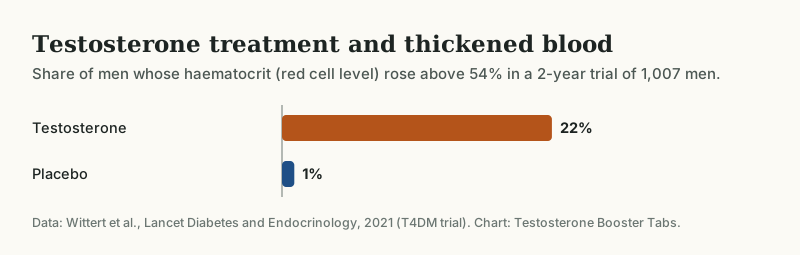
A raised haematocrit is one of the conditions in which guidelines advise against starting testosterone.[12]
Fertility
Testosterone from outside the body reduces sperm production. Most men recover normal sperm production within a year of stopping, according to a 2013 review.[9]
After stopping steroids
Coming off anabolic steroids can leave a man with low testosterone and symptoms to match. A 2014 review found that this may depend on the dose, the duration and the type of steroid used, and that it can be managed with specialist treatment.[10]
Wider health
An Endocrine Society scientific statement concluded that the use of performance-enhancing drugs has been linked to an increased risk of death and to a wide range of cardiovascular, psychiatric, metabolic, endocrine, liver and kidney disorders.[6]
Can you get high testosterone naturally?
Not above the normal range, as far as the evidence shows.
- Lifestyle can lift a level that is being held down. Weight loss on a low-calorie diet raised testosterone by an average of 2.87 nmol/L in a pooled analysis of 24 studies.[13] See how to increase testosterone naturally.
- Supplements mostly fail to raise it at all, according to a 2024 systematic review of 52 studies.[14]
Are there high testosterone foods?
No food has been shown to push testosterone above normal. The diet effects that have been measured are small. For example, a meta-analysis of six studies in 206 men found slightly lower testosterone on low-fat diets than on higher-fat diets.[15] Our guide to foods that boost testosterone has the details.
What should you do about a high result?
- Repeat the test in the morning, and check the range on your report.[2]
- Tell your doctor everything you take, including gym supplements, prescription testosterone and anything bought online.
- Expect further tests if no outside source is found, to look for the rarer causes listed above.[1]
Women with high testosterone have a different set of causes and signs. See high testosterone in women.
The bottom line
A truly high testosterone level in a man usually points to testosterone or steroids from outside the body, and sometimes to a hidden ingredient in a supplement. Rarely, a tumour or an adrenal disorder is responsible. A level at the upper end of normal is not a problem, and nothing natural will push it past the top of the range.
Common questions
What are the signs of high testosterone in a man?
Most of what is known comes from men who misuse anabolic steroids. The NHS lists reduced sperm count, infertility, shrunken testicles, erection problems, hair loss, breast development and severe acne, along with mood swings and aggressive behaviour.[4]
What causes elevated testosterone in men?
MedlinePlus lists steroid use, a tumour in the testicles and adrenal gland disorders such as congenital adrenal hyperplasia.[1] Medicines or drugs that raise testosterone, including some supplements, can also do it.[2]
Is high testosterone in men dangerous?
It can be when it comes from steroid misuse. An Endocrine Society statement links the use of performance-enhancing drugs to a higher risk of death and to heart, psychiatric, liver, kidney and hormone disorders.[6]
How do you get high testosterone naturally?
You cannot raise it above the normal range by natural means. Weight loss can lift a low level: a pooled analysis of 24 studies found an average rise of 2.87 nmol/L with a low-calorie diet.[13] Most supplements fail to raise it at all.[14]
Are there high testosterone foods?
No food has been shown to produce high testosterone. Diet studies show small shifts, such as slightly lower testosterone on low-fat diets in a meta-analysis of 206 men.[15]
Sources
- Testosterone Levels Test MedlinePlus, US National Library of Medicine
- Testosterone test MedlinePlus, US National Library of Medicine
- Harmonized Reference Ranges for Circulating Testosterone Levels in Men of Four Cohort Studies in the United States and Europe (Travison et al., 2017) The Journal of Clinical Endocrinology and Metabolism
- Anabolic steroid misuse NHS
- Anabolic Steroids MedlinePlus, US National Library of Medicine
- Adverse health consequences of performance-enhancing drugs: an Endocrine Society scientific statement (Pope HG et al., 2014) Endocrine Reviews
- Testosterone treatment to prevent or revert type 2 diabetes in men enrolled in a lifestyle programme (T4DM): a randomised, double-blind, placebo-controlled, 2-year, phase 3b trial (Wittert et al., 2021) The Lancet. Diabetes & Endocrinology
- The Effect of Route of Testosterone on Changes in Hematocrit: A Systematic Review and Bayesian Network Meta-Analysis of Randomized Trials (Nackeeran et al., 2022) The Journal of Urology
- Exogenous testosterone: a preventable cause of male infertility (Crosnoe et al., 2013) Translational Andrology and Urology
- Anabolic steroid-induced hypogonadism: diagnosis and treatment (Rahnema et al., 2014) Fertility and Sterility
- Unapproved Pharmaceutical Ingredients Included in Dietary Supplements Associated With US Food and Drug Administration Warnings (Tucker et al., 2018) JAMA Network Open
- Testosterone Therapy in Men With Hypogonadism: An Endocrine Society Clinical Practice Guideline (Bhasin et al., 2018) The Journal of Clinical Endocrinology and Metabolism
- Body weight loss reverts obesity-associated hypogonadotropic hypogonadism: a systematic review and meta-analysis (Corona et al., 2013) European Journal of Endocrinology
- Do "testosterone boosters" really increase serum total testosterone? A systematic review (Morgado et al., 2024) International Journal of Impotence Research
- Low-fat diets and testosterone in men: Systematic review and meta-analysis of intervention studies (Whittaker and Wu, 2021) The Journal of Steroid Biochemistry and Molecular Biology
Part of our testosterone guides. New here? Start with do testosterone boosters work?