Testosterone and weight gain are linked in both directions. Carrying excess fat lowers testosterone, and low testosterone goes with more body fat and less muscle.[1, 2] Researchers describe this as a two-way relationship, sometimes called the hypogonadal-obesity cycle.[2]
This guide looks at each direction in turn, and then at what testosterone treatment does to weight.
Does weight gain lower testosterone?
Yes. This is the better-established half of the story.
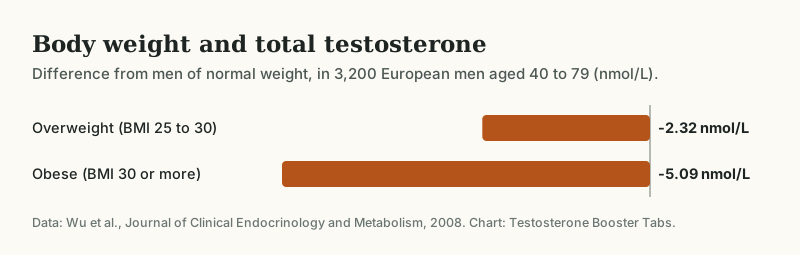
The European Male Ageing Study measured hormones in 3,200 men aged 40 to 79. Compared with men of normal weight:[1]
- overweight men had total testosterone 2.32 nmol/L lower
- obese men had total testosterone 5.09 nmol/L lower.
Other large studies agree.
- In 208,677 UK men aged 40 to 69, testosterone was about 1.5 nmol/L lower at a body mass index (BMI) of 30 than at 25.[11]
- In a US study of 1,667 men aged 40 to 70, a rise in BMI of 4 to 5 points was linked to a fall in testosterone similar to about 10 years of ageing.[3]
Following the same men over time shows that testosterone tracks weight. In 2,395 European men followed for about four years, weight gain was associated with a proportional fall in testosterone, and weight loss with a proportional rise.[4]
Can low testosterone cause weight gain?
It can add to it. The clearest evidence comes from men whose testosterone is deliberately switched off.
Androgen deprivation therapy is a prostate cancer treatment that suppresses testosterone. A meta-analysis of 16 studies found that it increased body fat by an average of 7.7% and reduced lean body mass by 2.8%. Body weight rose by about 2.1%.[6]
That shows that a large, sudden loss of testosterone changes body composition. MedlinePlus lists an increase in body fat and a decrease in muscle size among the possible symptoms of low testosterone.[12]
For most men, though, the fall in testosterone is gradual and modest, and weight gain has many more common causes. If you have gained weight and also have a low sex drive or erection problems, see low testosterone symptoms and consider a testosterone blood test. Weight gain alone is a weak reason to suspect a hormone problem.
Which comes first?
The evidence is stronger for weight driving testosterone than for the reverse. Three findings point that way.
- Weight gain went with a fall in testosterone in the European study above.[4]
- Weight loss reverses it. The same researchers concluded that obesity-related hormone changes are reversible with weight reduction.[4]
- The hormone pattern in obese men suggests the signal from the brain is turned down, not that the testicles have failed.[1]
Once testosterone is low, it may make fat easier to gain and muscle harder to keep, which is why the relationship is described as a cycle.[2]
Does losing weight raise testosterone?
Yes, and the effect scales with how much you lose.
A meta-analysis of 24 studies found that a low-calorie diet raised total testosterone by an average of 2.87 nmol/L, and weight-loss surgery by 8.73 nmol/L. The rise was greater in men who lost more weight, in younger men and in men without diabetes.[5]
Free testosterone is slower to respond. In the European study it changed significantly only in men who gained or lost at least 15% of their weight.[4]
This is the best-supported natural way to raise a low testosterone level. See how to increase testosterone naturally, and for the role of activity, does working out increase testosterone? Diet is covered in foods that boost testosterone.
Does testosterone treatment make you gain weight?
In men
Generally not. It changes what the weight is made of.
A meta-analysis of 29 randomised controlled trials, covering 1,083 middle-aged and older men, found that testosterone treatment:[7]
- reduced body fat by 1.6 kg
- increased fat-free (lean) mass by 1.6 kg
- did not change body weight.
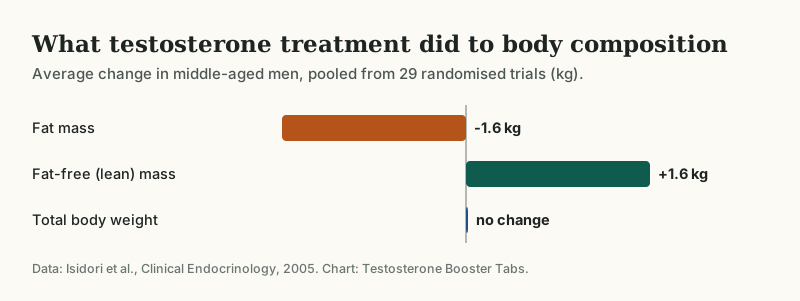
So the number on the scales may not move, or may rise slightly if muscle increases, while the waistline shrinks.
A trial in 100 obese men with total testosterone of 12 nmol/L or below tested treatment alongside a very low energy diet. The men given testosterone lost 2.9 kg more fat than the placebo group. They also regained most of the lean mass they had lost while dieting, which the placebo group did not.[8]
In women
A meta-analysis of 36 randomised trials of testosterone treatment in women recorded an overall increase in weight, with no effect on body composition.[10] The amount is not given in the published summary. See low testosterone in women.
In women, weight gain is more often linked with high androgen levels. Weight gain or difficulty losing weight is one of the main symptoms of polycystic ovary syndrome.[13] See high testosterone in women.
Is testosterone a weight-loss treatment?
No. Guidelines recommend testosterone for men with symptoms and confirmed, consistently low blood levels.[14] Being overweight with a low-normal reading is not the same thing.
Observational studies make testosterone look promising for weight. A 2016 meta-analysis of 32 such studies, with 4,513 patients, estimated a weight loss of 3.5 kg and a 6.2 cm smaller waist after 24 months. But the authors noted that results from placebo-controlled trials are more conflicting, and said the finding should be confirmed in a specifically designed randomised trial.[9]
A 2015 review suggested testosterone might be a useful add-on for weight management in obese men who also have confirmed testosterone deficiency.[2] That is a narrower group than “men who want to lose weight”. Treatment also carries risks, covered in testosterone boosters vs TRT.
Supplements are not a shortcut either. Most do not raise testosterone, as we explain in do testosterone boosters work? For typical levels at different ages, see normal testosterone levels by age.
The bottom line
Excess weight lowers testosterone, and very low testosterone promotes fat gain and muscle loss. For most men the stronger effect is weight on testosterone, and losing excess weight brings testosterone back up. Testosterone treatment in men shifts fat to muscle without much change on the scales. It is a treatment for confirmed deficiency, not a diet aid.
Common questions
Can low testosterone cause weight gain?
It can contribute. Men whose testosterone is switched off by prostate cancer treatment gain body fat (about 7.7% on average) and lose lean mass.[6] But in everyday life the stronger effect usually runs the other way: weight gain lowers testosterone.[4]
Does testosterone make you gain weight?
In men, generally not. A meta-analysis of 29 randomised trials found that testosterone treatment reduced body fat by 1.6 kg and increased fat-free mass by 1.6 kg, with no change in body weight.[7]
Does testosterone make women gain weight?
A meta-analysis of 36 randomised trials of testosterone treatment in women recorded an overall increase in weight.[10]
Sources
- Hypothalamic-pituitary-testicular axis disruptions in older men are differentially linked to age and modifiable risk factors: the European Male Aging Study (Wu et al., 2008) The Journal of Clinical Endocrinology and Metabolism
- Testosterone and obesity (Kelly and Jones, 2015) Obesity Reviews
- The relative contributions of aging, health, and lifestyle factors to serum testosterone decline in men (Travison et al., 2007) The Journal of Clinical Endocrinology and Metabolism
- Age-associated changes in hypothalamic-pituitary-testicular function in middle-aged and older men are modified by weight change and lifestyle factors: longitudinal results from the European Male Ageing Study (Camacho et al., 2013) European Journal of Endocrinology
- Body weight loss reverts obesity-associated hypogonadotropic hypogonadism: a systematic review and meta-analysis (Corona et al., 2013) European Journal of Endocrinology
- The effect of androgen deprivation therapy on body composition in men with prostate cancer: systematic review and meta-analysis (Haseen et al., 2010) Journal of Cancer Survivorship
- Effects of testosterone on body composition, bone metabolism and serum lipid profile in middle-aged men: a meta-analysis (Isidori et al., 2005) Clinical Endocrinology
- Effects of testosterone treatment on body fat and lean mass in obese men on a hypocaloric diet: a randomised controlled trial (Ng Tang Fui et al., 2016) BMC Medicine
- Testosterone supplementation and body composition: results from a meta-analysis of observational studies (Corona et al., 2016) Journal of Endocrinological Investigation
- Safety and efficacy of testosterone for women: a systematic review and meta-analysis of randomised controlled trial data (Islam et al., 2019) The Lancet. Diabetes & Endocrinology
- Sociodemographic, lifestyle and medical influences on serum testosterone and sex hormone-binding globulin in men from UK Biobank (Yeap et al., 2021) Clinical Endocrinology
- Low testosterone MedlinePlus, US National Library of Medicine
- Polyendocrine metabolic ovarian syndrome (PMOS) NHS
- Testosterone Therapy in Men With Hypogonadism: An Endocrine Society Clinical Practice Guideline (Bhasin et al., 2018) The Journal of Clinical Endocrinology and Metabolism
Part of our testosterone guides. New here? Start with do testosterone boosters work?