Testosterone replacement therapy (TRT) and “steroids” get mixed up because they draw on the same family of drugs. The difference is in why they are taken, how much is taken, and whether anyone is checking. This page compares medical testosterone replacement with non-medical anabolic steroid use. It gives no dosing or cycle advice.
For the chemistry question, see is testosterone a steroid?
TRT vs steroids at a glance
| TRT | Non-medical steroid use | |
|---|---|---|
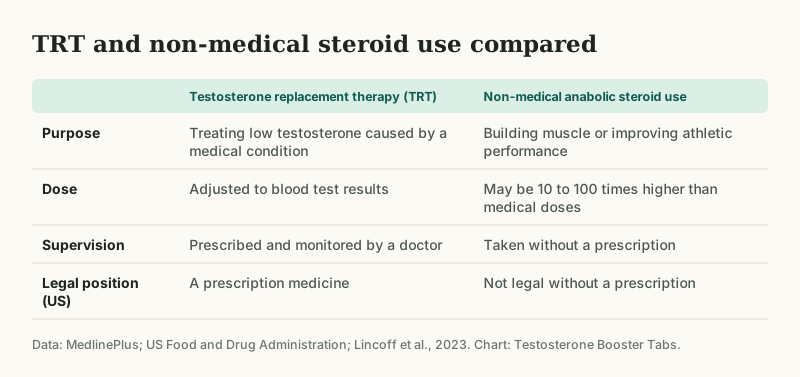
| What it is | Prescribed testosterone as a gel, patch or injection[2] | Testosterone or related drugs taken without a prescription[1, 5] |
| Purpose | Treating low testosterone caused by a medical condition[2] | Building muscle or improving performance[1] |
| Dose, in general terms | Adjusted to keep blood levels in a set range[4] | May be 10 to 100 times higher than medical doses[1, 5] |
| Evidence on testosterone and muscle | Corrects a diagnosed shortage[3] | Very high doses add muscle and strength in healthy men[7] |
| Main risks | Thicker blood, lower sperm production; some heart rhythm and clot signals[4, 9, 10] | Heart, liver, hormone and psychiatric harm; higher risk of death[6, 11] |
| Who it suits | Men with symptoms and repeatedly low blood tests[3] | No one. It is not legal or safe without a prescription[1] |
What is TRT?
TRT replaces testosterone in men who do not make enough. In the United States, testosterone products are approved only for men who have low levels together with a medical condition, such as testicles damaged by chemotherapy or a problem with the brain areas that control them. They are not approved for low testosterone with no such cause.[2]
A diagnosis comes first. The Endocrine Society tells doctors to diagnose only men who have symptoms of low testosterone and morning blood tests that are clearly and repeatedly low.[3]
The dose is then set by results. In the largest safety trial, the gel dose was adjusted to hold each man’s level between 350 and 750 ng/dL.[4] Our guide to normal testosterone levels shows how that compares with the usual range.
What counts as steroid use?
Anabolic steroids are man-made versions of testosterone. Doctors do prescribe them for some hormone problems, delayed puberty and muscle loss from disease.[1] The US National Institute on Drug Abuse uses the term for the non-prescribed use of testosterone and testosterone-like substances.[5]
Some bodybuilders and athletes take them as tablets, injections or gels to build muscle. Those doses may be 10 to 100 times higher than medical ones.[1] Most users are not competitive athletes. They are recreational weightlifters.[6]
Users often follow set patterns of taking and combining the drugs. The US National Institute on Drug Abuse says the claimed benefits of those patterns have not been shown scientifically.[5]
Do steroids work better than TRT for muscle?
At high doses they build muscle. That explains the appeal. In a 1996 trial, 43 healthy men were given a weekly testosterone injection at a dose far above replacement, or a placebo, for 10 weeks. Those who also lifted weights gained 6.1 kg of fat-free mass.[7]
TRT is not meant to do that. Its aim is a normal level, not a high one.[4] Training mattered in that trial too: the men who lifted gained more than the men who did not.[7] See our guide to working out and testosterone.
The muscle gain is where the good news about high doses ends.
How do the risks compare?
TRT
- Blood. Across 51 studies, testosterone treatment raised haemoglobin and haematocrit, two measures of red blood cells. It caused a small drop in HDL cholesterol.[10]
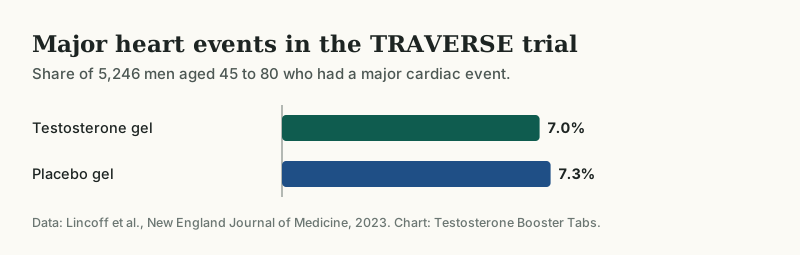
- Heart. In a trial of 5,246 men with or at high risk of heart disease, major cardiac events occurred in 7.0% of men on testosterone gel and 7.3% on placebo. Atrial fibrillation, acute kidney injury and blood clots in the lung were more common with testosterone.[4]
- Fertility. Testosterone from outside the body switches off the testosterone made inside the testicles, and sperm production falls. Most men recover normal sperm production within a year of stopping.[9]
Non-medical steroid use
- Heart and blood. High-dose use raises haematocrit and clotting. Reviews link it to clots, stroke, heart rhythm problems, heart muscle disease and possibly sudden death.[11]
- Liver. One class of steroids, the 17-alpha-alkylated drugs, is toxic to the liver.[11]
- Mind. Reported effects include aggression, reckless behaviour and psychotic symptoms. Stopping can bring depression.[11] The NHS describes anabolic steroids as addictive.[12]
- Hormones. Use can leave a man with low testosterone of his own, depending on dose, duration and drug.[8]
- Overall. An Endocrine Society statement links performance-enhancing drug use to a higher risk of death. It also notes that trials cannot ethically copy the doses people really take, so the true risks are under-studied.[6]
The same hormone at a much higher dose is a different proposition. See high testosterone in men for what excess does.
What does the law say?
In the United States, using anabolic steroids without a prescription is not legal.[1] In the UK they are prescription-only class C drugs. Having them for personal use is legal there, but supplying them is not.[12]
Which one? TRT or steroids
This is not a choice between two versions of the same thing.
TRT is a treatment. It fits men with symptoms and confirmed low testosterone, under a doctor who monitors treatment and adjusts the dose.[3, 4] It has known risks, and it is the wrong choice for a man hoping to father a child soon.[3]
Non-medical steroid use is not a treatment. It trades short-term muscle for risks that grow with dose, and nobody is monitoring them.[6, 11]
If neither fits, the options are narrower than adverts suggest. Our comparison of boosters vs TRT covers supplements. Related pages compare testosterone vs HGH, testosterone vs estrogen and testosterone vs DHT.
The bottom line
TRT and steroid use can involve the same molecule. What separates them is diagnosis, dose and supervision. TRT restores a normal level in men who need it. Steroid misuse pushes far past normal, and the harms follow the dose.
Common questions
Is TRT the same as taking steroids?
No. Testosterone belongs to the anabolic steroid family, but TRT treats a diagnosed shortage with a dose adjusted to blood tests. Steroid misuse takes the drugs without a prescription, at doses that may be 10 to 100 times higher.[1, 4]
Is TRT legal?
Yes, with a prescription. In the United States, testosterone products are approved for men with low testosterone caused by a medical condition. Using anabolic steroids without a prescription is not legal there.[1, 2]
Does TRT affect fertility?
It can. Testosterone from outside the body suppresses the testosterone made inside the testicles, which sperm production depends on. Guidelines advise against starting it in men planning a pregnancy soon.[3, 9]
Can steroid use cause low testosterone?
Yes. Symptomatic low testosterone is a recognised result of anabolic steroid use, and it may depend on the dose, the duration and the drugs used.[8]
Sources
- Anabolic Steroids MedlinePlus, US National Library of Medicine
- Testosterone Information US Food and Drug Administration
- Testosterone Therapy in Men With Hypogonadism: An Endocrine Society Clinical Practice Guideline (Bhasin et al., 2018) The Journal of Clinical Endocrinology and Metabolism
- Cardiovascular Safety of Testosterone-Replacement Therapy (Lincoff et al., 2023) The New England Journal of Medicine
- Anabolic Steroids and Other Appearance and Performance Enhancing Drugs (APEDs) National Institute on Drug Abuse (NIH)
- Adverse health consequences of performance-enhancing drugs: an Endocrine Society scientific statement (Pope HG et al., 2014) Endocrine Reviews
- The effects of supraphysiologic doses of testosterone on muscle size and strength in normal men (Bhasin et al., 1996) The New England Journal of Medicine
- Anabolic steroid-induced hypogonadism: diagnosis and treatment (Rahnema et al., 2014) Fertility and Sterility
- Exogenous testosterone: a preventable cause of male infertility (Crosnoe et al., 2013) Translational Andrology and Urology
- Clinical review 1: Adverse effects of testosterone therapy in adult men: a systematic review and meta-analysis (Fernández-Balsells et al., 2010) The Journal of Clinical Endocrinology and Metabolism
- Doping with anabolic androgenic steroids (AAS): Adverse effects on non-reproductive organs and functions (Nieschlag and Vorona, 2015) Reviews in Endocrine & Metabolic Disorders
- Anabolic steroid misuse NHS
One of our side-by-side comparisons. New here? Start with do testosterone boosters work?