Testosterone does not cause hair loss directly. Pattern baldness is related to dihydrotestosterone (DHT), a hormone the body makes from testosterone, and to how sensitive your hair follicles are to it.[1, 3] That sensitivity is largely inherited.[1]
So two men with the same testosterone level can have very different hairlines. This guide explains why.
How are testosterone, DHT and hair loss connected?
Testosterone and DHT both belong to a group of hormones called androgens. DHT is a metabolite of testosterone: an enzyme called 5-alpha-reductase converts one into the other.[3]
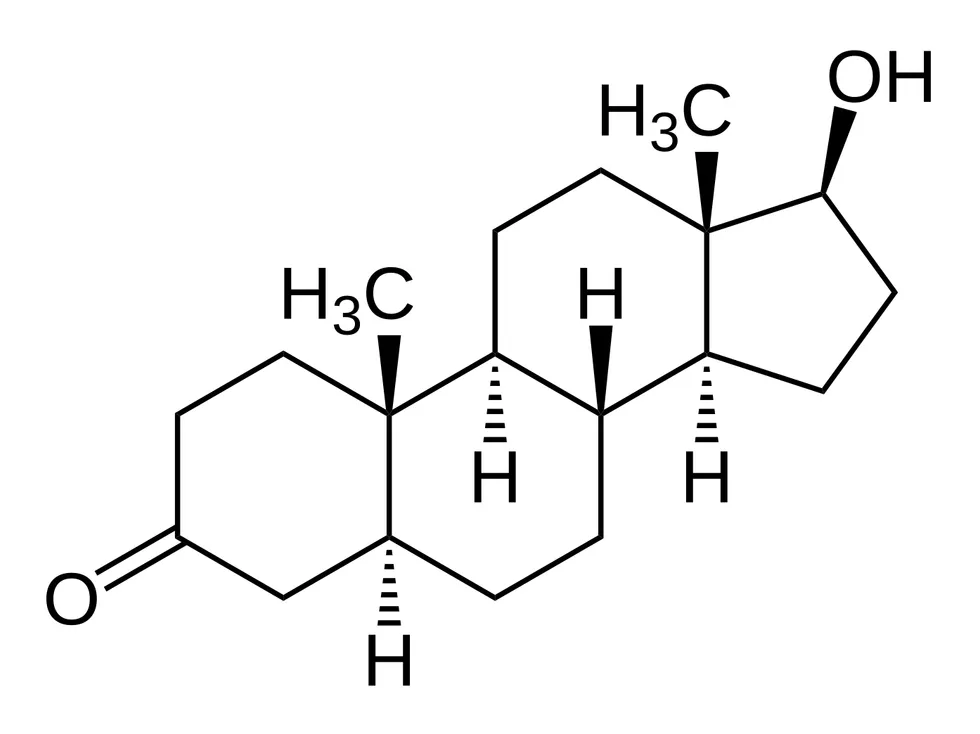

Researchers have determined that androgenetic alopecia, the medical name for pattern hair loss, is related to androgens, and specifically to DHT. This is clearest in men.[1]
Here is how MedlinePlus describes the process.[1]
- Each hair normally grows for 2 to 6 years, rests for several months, then falls out.
- Androgens help control this cycle.
- Too much stimulation of the follicles by androgens may shorten the growth period, giving shorter and thinner hairs.
- New hairs are also slower to replace the ones that are shed.
Why does it only affect some people?
Because the follicles differ, not just the hormones.
Only one gene has been confirmed to be involved in pattern hair loss: the AR gene, which carries the instructions for the androgen receptor. Studies suggest that variations in this gene produce receptors that are more easily stimulated by androgens.[1]
A meta-analysis of 8 studies, with 2,074 patients and 1,115 controls, found that one variant of the AR gene was linked to a much higher risk of androgenetic alopecia.[4]
Pattern hair loss tends to cluster in families, and having a close relative with it appears to be a risk factor.[1]
How common is it?
Androgenetic alopecia affects an estimated 50 million men and 30 million women in the United States. It can start as early as the teens. More than half of men over 50 have some degree of hair loss.[1]
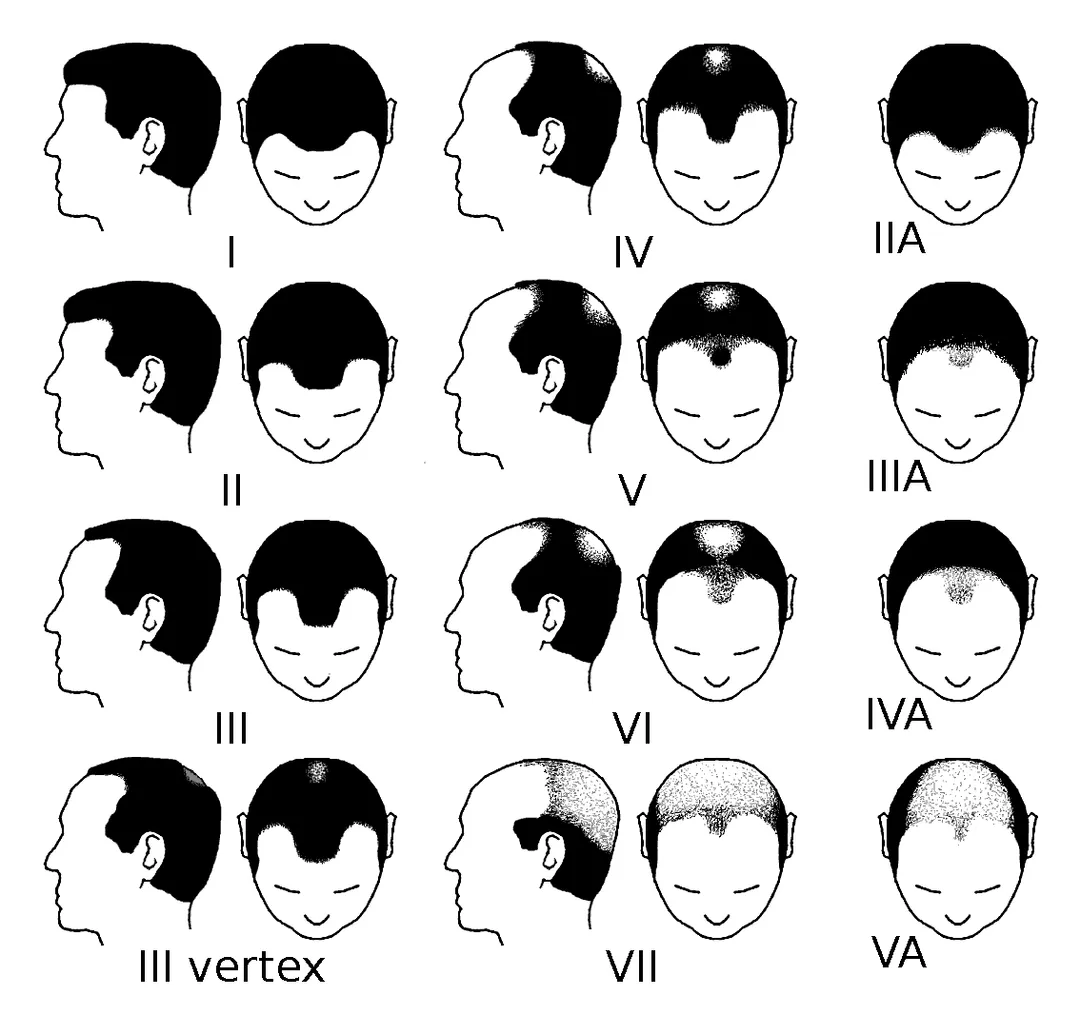

In men, hair is lost in a well-defined pattern. It starts above both temples, and the hairline moves back to form an “M” shape. Hair also thins at the crown.[1]
In women the pattern is different. Hair becomes thinner at the top of the head and the parting widens. The hairline does not usually recede, and total baldness is rare.[1]
Does low testosterone cause hair loss?
There is no good evidence that it causes scalp hair loss.
MedlinePlus lists the possible symptoms of low testosterone in men, including a low sex drive, erection problems, sleep problems and loss of muscle size and strength. Scalp hair loss is not on the list.[7] We go through those signs in low testosterone symptoms.
If your hair is thinning, other causes are worth considering. The NHS notes that temporary hair loss can be caused by illness, stress, cancer treatment, weight loss and iron deficiency.[2]
Does high testosterone cause hair loss?
At very high levels, it can.
In men. Baldness is one of the effects MedlinePlus lists for anabolic steroid misuse in men.[8] The NHS lists hair loss among the physical effects in both men and women.[9] See is testosterone a steroid? and high testosterone in men.
In women. Male-pattern baldness is one of the signs of moderately raised androgen levels in women.[10] Female pattern hair loss is also associated with an increased risk of polycystic ovary syndrome.[1] Our guide to high testosterone in women covers the other signs.
For ordinary pattern baldness, the evidence points to how follicles respond and not only to the hormone level: the one confirmed genetic link is in the androgen receptor.[1]
Does testosterone treatment cause hair loss?
This is less well studied than you might expect.
In women, an international consensus statement reviewed the trials. It concluded that testosterone at doses that keep levels in the normal female range is not associated with scalp hair loss.[11]
In men, we did not find good trial data that measured scalp hair loss on testosterone replacement therapy (TRT). In theory, more testosterone means more raw material for DHT. Whether that speeds up hair loss in a man who is already prone to it has not been settled by the sources we reviewed. If this worries you, raise it with the prescriber before starting. The known risks of treatment are covered in testosterone boosters vs TRT.
Does finasteride lower testosterone?
No. It lowers DHT.
Finasteride blocks the type II form of 5-alpha-reductase, the enzyme that turns testosterone into DHT. This lowers DHT in both the blood and the scalp.[5]
A study of 53 men aged 57 to 79 measured what happens to both hormones. The men took 5 mg a day, five times the 1 mg dose tested for hair loss.[5, 6]
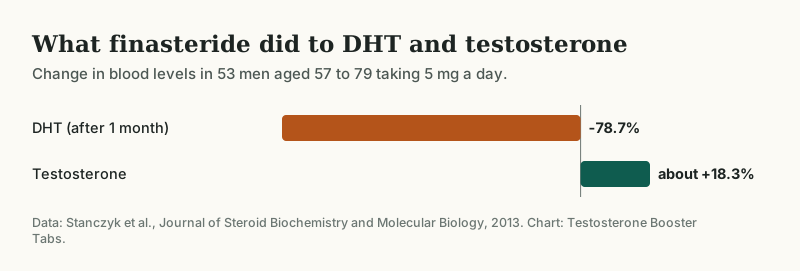
- DHT fell by 78.7% after one month.
- Testosterone rose by about 18%.[6]
Does finasteride work for hair loss?
In trials, yes. Two one-year trials tested 1 mg a day against a placebo in 1,553 men aged 18 to 41 with male pattern hair loss.[5]
- Men taking finasteride had 107 more hairs than the placebo group in a 1-inch circle of scalp after one year, and 138 more after two years. The starting count was 876 hairs.
- Men on placebo progressively lost hair.
The NHS names finasteride and minoxidil as the main treatments for male pattern baldness. It adds that women should not use finasteride, that no treatment is 100% effective, and that these treatments only work for as long as they are used.[2]
Finasteride is a prescription medicine with its own side effects. Talk to a doctor or pharmacist before using it.
Do testosterone boosters cause hair loss?
There is no trial evidence that they do, and little reason to expect it. Most boosters do not raise testosterone at all, as we explain in do testosterone boosters work?
Two things are worth knowing.
- DHEA is a hormone, not a herb. It helps the body produce other hormones, including testosterone.[15] See DHEA and testosterone.
- Hidden steroids. Some muscle-building supplements have been found to contain undeclared steroids, and steroid misuse can cause baldness.[8, 14] See testosterone booster side effects.
What about creatine?
The idea that creatine causes hair loss comes from a single 2009 study. In 20 rugby players, DHT rose by 56% after a week of high-dose creatine, while testosterone did not change.[13] No study has reported hair loss in people taking creatine.[3]
A 2025 randomised trial tested this directly. Resistance-trained men took 5 g of creatine a day or a placebo for 12 weeks. There were no differences between the groups in DHT, testosterone or measures of hair.[12] The details are in does creatine increase testosterone?
Do other things linked to testosterone affect hair?
People often ask about vasectomy. A 2021 review concluded that vasectomy does not affect reproductive hormones in the long term, so there is no obvious hormonal route for it to affect hair.[16] See does a vasectomy affect testosterone?
When should you see a doctor about hair loss?
Losing 50 to 100 hairs a day is normal. Hair loss is not usually anything to worry about, but occasionally it can be a sign of a medical condition. Male and female pattern baldness are permanent and usually run in the family.[2]
The NHS advises seeing a GP if you are worried about your hair loss, and doing so before going to a commercial hair clinic.[2] In women, hair thinning together with irregular periods, acne or new facial hair can point to raised androgens, which a blood test can check.[10]
The bottom line
Testosterone itself is not the culprit. Pattern baldness depends on DHT, which is made from testosterone, and on inherited sensitivity in the hair follicles. Low testosterone is not a recognised cause of scalp hair loss. Very high androgen levels, as with steroid misuse, can cause it. Finasteride treats male pattern hair loss by lowering DHT, and it does not lower testosterone.
Common questions
Does testosterone cause baldness?
Not on its own. Male pattern baldness is related to DHT, a hormone made from testosterone, and to inherited differences in how hair follicles respond to it.[1, 3]
Does low testosterone cause hair loss?
Scalp hair loss is not among the symptoms of low testosterone that MedlinePlus lists.[7] Hair loss has many other causes, including illness, stress, weight loss and iron deficiency.[2]
Does high testosterone cause hair loss?
It can at very high levels. Baldness is a listed effect of anabolic steroid misuse in men.[8] In women, male-pattern baldness is a sign of moderately raised androgen levels.[10]
Does finasteride lower testosterone?
No. It blocks the conversion of testosterone to DHT. In a study of 53 older men taking 5 mg a day, DHT fell by 78.7% after a month and testosterone rose by about 18%.[6]
Sources
- Androgenetic alopecia MedlinePlus Genetics, US National Library of Medicine
- Hair loss NHS
- Common questions and misconceptions about creatine supplementation: what does the scientific evidence really show? (Antonio et al., 2021) Journal of the International Society of Sports Nutrition
- Androgen receptor gene polymorphisms and risk for androgenetic alopecia: a meta-analysis (Zhuo et al., 2012) Clinical and Experimental Dermatology
- Finasteride in the treatment of men with androgenetic alopecia. Finasteride Male Pattern Hair Loss Study Group (Kaufman et al., 1998) Journal of the American Academy of Dermatology
- Effect of finasteride on serum levels of androstenedione, testosterone and their 5α-reduced metabolites in men at risk for prostate cancer (Stanczyk et al., 2013) The Journal of Steroid Biochemistry and Molecular Biology
- Low testosterone MedlinePlus, US National Library of Medicine
- Anabolic Steroids MedlinePlus, US National Library of Medicine
- Anabolic steroid misuse NHS
- Virilization MedlinePlus, US National Library of Medicine
- Global Consensus Position Statement on the Use of Testosterone Therapy for Women (Davis et al., 2019) The Journal of Clinical Endocrinology and Metabolism
- Does creatine cause hair loss? A 12-week randomized controlled trial (Lak et al., 2025) Journal of the International Society of Sports Nutrition
- Three weeks of creatine monohydrate supplementation affects dihydrotestosterone to testosterone ratio in college-aged rugby players (van der Merwe et al., 2009) Clinical Journal of Sport Medicine
- Unapproved Pharmaceutical Ingredients Included in Dietary Supplements Associated With US Food and Drug Administration Warnings (Tucker et al., 2018) JAMA Network Open
- DHEA Mayo Clinic
- Review of Vasectomy Complications and Safety Concerns (Yang et al., 2021) The World Journal of Men's Health
Part of our testosterone guides. New here? Start with do testosterone boosters work?