Testosterone and human growth hormone (HGH) are often mentioned together, because both are sold with promises of muscle, energy and youth. They are different hormones that do different jobs. This page compares them, using trials that tested each one, and a few that tested both.
Testosterone vs HGH at a glance
| Testosterone | Human growth hormone (HGH) | |
|---|---|---|
| What it is | A sex hormone produced by the testicles[9] | A hormone made in the pituitary gland[1] |
| Main job | Male development and characteristics[9] | Controls growth; helps control metabolism[1] |
| What trials show for body composition | Low levels cost lean mass and strength[11] | Adds lean mass and cuts fat, without a gain in strength[3, 5] |
| Dose in the cited trials | 5 or 10 g of gel a day for 16 weeks in one trial[6] | Dosed by body weight each day in the same trial[6] |
| Main risks | See TRT risks. Not for men planning fertility soon[8] | Swelling, joint pain, carpal tunnel syndrome, raised blood sugar[2, 3] |
| Who it suits | Men with symptoms and confirmed low testosterone[8] | Adults with growth hormone deficiency confirmed by testing[7] |
What does each hormone do?
Testosterone is essential to male growth and male characteristics. It is produced by the testicles, under the control of the hypothalamus and pituitary in the brain.[9] When researchers switched it off in healthy men, the men lost lean mass, muscle size and strength.[11]
Growth hormone is made in the pituitary gland, a small organ at the base of the brain. It controls the body’s growth and helps control metabolism. In children it drives bone growth, muscle mass and height. In adults it affects bone and muscle health.[1]
One practical difference: growth hormone levels swing through the day, so a single blood sample tells a doctor little. It is usually checked with tests taken over a few hours.[1] Testosterone is measured with a morning sample, as our guide to testosterone blood test results explains.
What happens when you are short of each?
Adults with too little growth hormone can have low bone density and reduced muscle mass, with symptoms such as fatigue. Testing for it is uncommon in adults, because other disorders are much more likely to cause those symptoms.[1] For people with a proven deficiency, an Endocrine Society guideline says treatment benefits body composition, exercise capacity, bone and quality of life. The diagnosis usually needs a stimulation test.[7]
Low testosterone has its own pattern. See low testosterone symptoms. Diagnosis needs symptoms plus clearly and repeatedly low blood results.[8]
Testosterone vs HGH for muscle and fat
One trial tested both hormones in the same people. Healthy adults aged 65 to 88 took growth hormone, a sex hormone, both or placebo for 26 weeks. The men’s sex hormone was testosterone.[2]
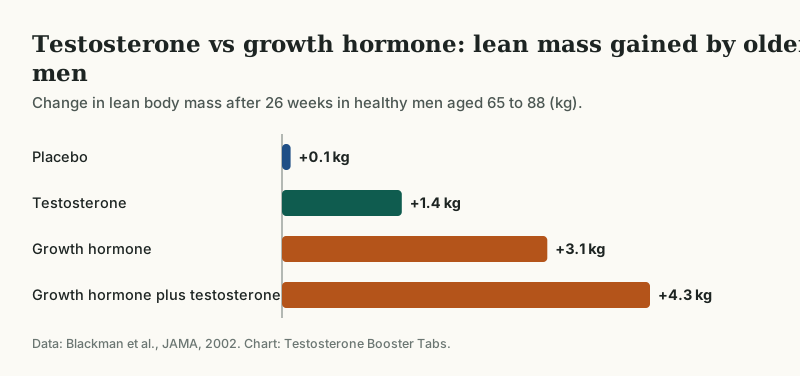
Lean mass rose by 0.1 kg with placebo, 1.4 kg with testosterone, 3.1 kg with growth hormone and 4.3 kg with both. Strength told a different story. It did not increase significantly, except marginally in the men who took both.[2]
A second trial gave 122 men aged about 71 testosterone gel with or without growth hormone for 16 weeks. Lean mass rose by 1.0 to 3.0 kg and strength by 14 to 35%, and the results appeared better when growth hormone was added. Blood pressure also rose.[6]
Does HGH work in healthy adults?
It changes body composition. It has not been shown to improve performance.
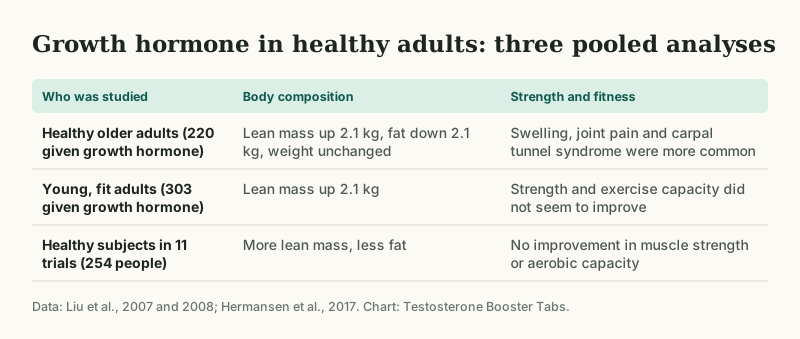
- Healthy older adults. Across 220 people given growth hormone, with an average age of 69, fat mass fell by 2.1 kg and lean mass rose by 2.1 kg. Weight did not change.[3]
- Young, fit adults. Across 303 people, lean mass rose by 2.1 kg. Strength and exercise capacity did not seem to improve, and the reviewers found that claims of better physical performance were not supported.[4]
- A 2017 analysis of 11 trials found more lean mass and less fat, with no improvement in muscle strength or aerobic capacity.[5]
For what training does to hormone levels, see does working out increase testosterone?
How do the side effects compare?
Growth hormone caused clear side effects in healthy older people. Pooled trials found more soft tissue swelling, joint pain, carpal tunnel syndrome and breast enlargement, and somewhat more diabetes and raised fasting glucose.[3] In the 26-week trial, carpal tunnel symptoms affected 32% of men on both hormones and none on placebo. Joint pain affected 41% of men on growth hormone and none on placebo. Diabetes or glucose intolerance developed in 18 men treated with growth hormone and 7 who were not.[2]
Too much growth hormone over time causes acromegaly: thicker bones and enlarged hands, feet and facial features.[1]
The risks of prescribed testosterone are different. They are set out in TRT vs steroids and boosters vs TRT. Guidelines advise against testosterone for men planning a pregnancy soon.[8]
Are they legal, and are they steroids?
Testosterone belongs to the anabolic steroid family.[10] See is testosterone a steroid? Growth hormone does not. The US National Institute on Drug Abuse classes it as a non-steroidal anabolic.[10]
Both are prescription medicines. Testosterone is approved in the United States only for men with low levels caused by a medical condition.[9] Growth hormone is not approved there as an anti-ageing treatment, and distributing it for that purpose is illegal.[3]
In sport, both anabolic steroids and growth hormone are on the World Anti-Doping Agency’s Prohibited List at all times.[12]
Which one? Testosterone or HGH
Neither is a lifestyle supplement. Each treats a specific, tested deficiency.[7, 8]
If the worry is low testosterone, the route is symptoms, blood tests and a doctor. Growth hormone is not a substitute.
If the draw is muscle or anti-ageing, the trials are discouraging for growth hormone: more lean mass on a scan, no gain in strength, and frequent side effects.[3, 5] The authors of the 26-week trial concluded that growth hormone in older people should stay within controlled studies.[2]
Related comparisons: testosterone vs estrogen and testosterone vs DHT.
The bottom line
Testosterone and growth hormone are separate hormones with separate medical uses. Growth hormone reshapes body composition in healthy adults without making them stronger, and it brings side effects. Testosterone treatment is for men with a confirmed shortage. Neither is a shortcut worth taking without a diagnosis.
Common questions
Is HGH the same as testosterone?
No. Growth hormone is made in the pituitary gland and controls growth and metabolism. Testosterone is a sex hormone produced by the testicles.[1, 9]
Is HGH better than testosterone for building muscle?
Growth hormone added more lean mass than testosterone in one 26-week trial in older men, but strength did not improve significantly with either alone. Pooled trials in healthy adults also found no gain in strength.[2, 5]
Is HGH a steroid?
No. The US National Institute on Drug Abuse lists human growth hormone among the non-steroidal anabolics, separate from anabolic steroids.[10]
Can you take HGH for anti-ageing?
It is not recommended. A review of trials in healthy older people concluded that growth hormone cannot be recommended as an anti-ageing therapy, and noted it is not approved for that use in the United States.[3]
Sources
- Growth Hormone Tests MedlinePlus, US National Library of Medicine
- Growth hormone and sex steroid administration in healthy aged women and men: a randomized controlled trial (Blackman et al., 2002) JAMA
- Systematic review: the safety and efficacy of growth hormone in the healthy elderly (Liu et al., 2007) Annals of Internal Medicine
- Systematic review: the effects of growth hormone on athletic performance (Liu et al., 2008) Annals of Internal Medicine
- Impact of GH administration on athletic performance in healthy young adults: A systematic review and meta-analysis of placebo-controlled trials (Hermansen et al., 2017) Growth Hormone & IGF Research
- Testosterone and growth hormone improve body composition and muscle performance in older men (Sattler et al., 2009) The Journal of Clinical Endocrinology and Metabolism
- Evaluation and treatment of adult growth hormone deficiency: an Endocrine Society clinical practice guideline (Molitch et al., 2011) The Journal of Clinical Endocrinology and Metabolism
- Testosterone Therapy in Men With Hypogonadism: An Endocrine Society Clinical Practice Guideline (Bhasin et al., 2018) The Journal of Clinical Endocrinology and Metabolism
- Testosterone Information US Food and Drug Administration
- Anabolic Steroids and Other Appearance and Performance Enhancing Drugs (APEDs) National Institute on Drug Abuse (NIH)
- Gonadal steroids and body composition, strength, and sexual function in men (Finkelstein et al., 2013) The New England Journal of Medicine
- The Prohibited List World Anti-Doping Agency
One of our side-by-side comparisons. New here? Start with do testosterone boosters work?