Low testosterone symptoms in women are much harder to define than in men. Women’s levels do fall with age, but experts have not been able to tie a particular level to a particular set of symptoms.[1]
That makes this an area with a lot of confident claims and not much evidence. Here is what the research supports.
What does testosterone do in women?
Testosterone is often called a male hormone, but it is an essential hormone for women too. It acts throughout the body, both directly and after being converted into oestrogen.[5]
Women make it in the ovaries and the adrenal glands, in much smaller amounts than men.[8] The use with the most research behind it is sexual desire.[3]
How do women’s testosterone levels change with age?
A study of 1,423 women aged 18 to 75, recruited from the community, measured this directly. Among the 595 women with no conditions that might distort the results:[4]
- total and free testosterone declined steeply with age
- the decline was greater in the earlier decades than the later ones
- natural menopause had no independent effect on levels
- women aged 55 or over who had had both ovaries removed had significantly lower testosterone than other women their age.
So the common idea that testosterone “crashes” at menopause is not what this study found. The fall happens gradually, and much of it comes earlier. An international consensus statement adds that levels appear to be maintained in women beyond the age of 65.[2]
What are the signs of low testosterone in a woman?
This is where honesty matters. Many websites list tiredness, low mood, weight gain, thinning hair and weak muscles as signs of testosterone deficiency in females. The evidence does not support a list like that.
The Endocrine Society’s guideline, written with four other medical societies, recommends against diagnosing an androgen deficiency syndrome in healthy women. Its reasons: there is no well-defined syndrome, and there are no data linking androgen levels to specific signs or symptoms.[1]
The trials point the same way. An international consensus statement, endorsed by eleven medical organisations, reviewed the randomised trials and concluded:[2]
- testosterone treatment showed no effect on general wellbeing
- it did not show an effect on depressed mood
- it showed no significant effect on lean body mass, body fat or muscle strength
- it did not improve bone density at 12 months.
If low testosterone caused those problems, giving testosterone should improve them. It did not.
The exception: low sexual desire
The symptom with real evidence behind it is a loss of sexual desire that causes distress, known medically as hypoactive sexual desire disorder (HSDD).
Even here, a blood test does not make the diagnosis. No cut-off level can separate women with and without sexual dysfunction.[2] In the Endocrine Society’s review, a woman’s own testosterone level did not predict whether she would respond to treatment.[1]
Low desire also has many other causes. The NHS mentions relationship difficulties, how you feel about yourself, and physical discomfort around the menopause.[6]
What causes very low testosterone in women?
Low levels are normal in women. MedlinePlus notes that an extremely low level may be a sign of a disorder of the adrenal glands, the pituitary gland or the ovaries.[7] Removal of both ovaries lowers testosterone too.[4]
Even in these situations, the Endocrine Society recommends against routinely prescribing testosterone, because data showing that it improves symptoms are limited and there are no long-term safety studies.[1]
Can a blood test help?
Less than you might hope.
- Measurement is difficult at female levels. The consensus statement says commonly used direct tests for total and free testosterone are highly unreliable in the female range.[2]
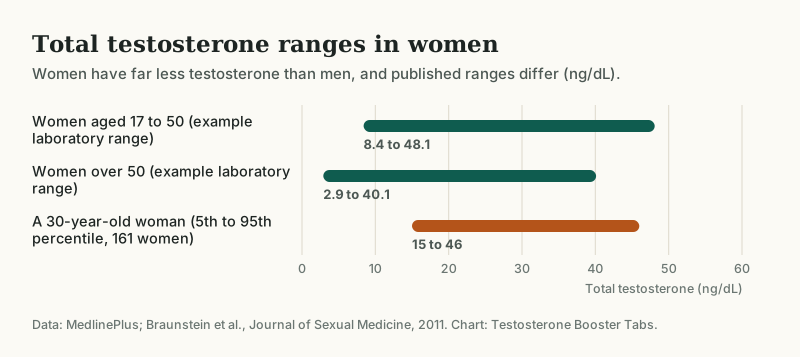
- Ranges are not standardised. A 2026 expert report noted that female reference ranges remain highly variable across laboratories.[10]
A test is mainly useful for ruling out a high level before treatment and for monitoring during it.[2] Our guide to how to test for testosterone levels explains the tests, and normal testosterone levels by age gives example ranges.
Does testosterone treatment help women?
For one group, yes.
A 2019 meta-analysis pooled 36 randomised controlled trials with 8,480 participants. In postmenopausal women, testosterone significantly improved sexual desire, arousal, pleasure and the number of satisfying sexual events, and reduced sexual distress.[3] The consensus statement puts the average gain at about one extra satisfying sexual event a month over placebo.[2]
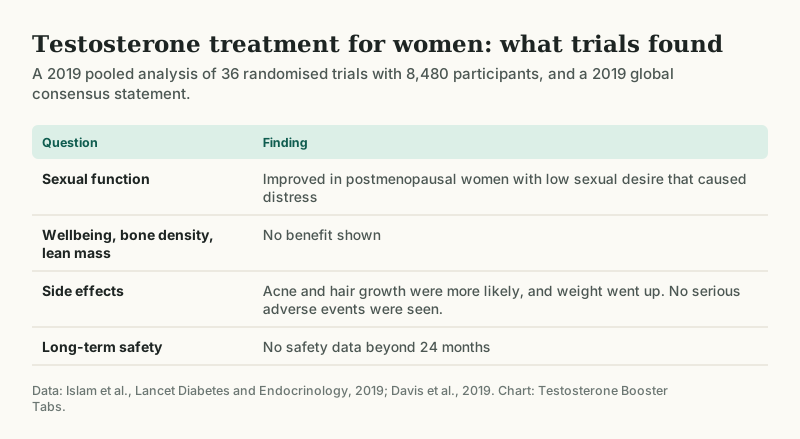
The consensus conclusion was clear. The only evidence-based use of testosterone in women is for postmenopausal women diagnosed with HSDD after a full assessment. There are not enough data to recommend it for premenopausal women, or for any other symptom.[2]
What are the side effects for women?
In the pooled trials, women taking testosterone were more likely to report acne and hair growth, and weight went up overall. No serious adverse events were recorded. Testosterone taken by mouth worsened cholesterol levels. Skin patches and creams did not.[3]
At doses that keep levels in the normal female range, treatment was not associated with scalp hair loss, clitoral enlargement or voice change.[2] Higher doses are another matter: see the signs in high testosterone in women.
Safety data do not extend beyond 24 months of treatment.[2]
What forms are used?
There are few products made for women. The consensus statement says that where no approved female product exists, a male formulation can be prescribed in a female dose, with blood levels monitored. It recommends against compounded testosterone, and against pellets and injections that push levels above the normal female range.[2]
In the UK, the NHS says testosterone gel or cream may be available on prescription from a menopause specialist.[6] How treatment works for men is covered in testosterone boosters vs TRT.
Do supplements help women with low testosterone?
There is little to go on.
- DHEA. The Endocrine Society recommends against its routine use in women, citing limited data on effectiveness and safety.[1] See DHEA and testosterone.
- Herbal boosters. A 2021 systematic review of herbs and testosterone covered trials in men only.[11] We note what is known for women in our guides to ashwagandha and fenugreek.
For the overall picture, see do testosterone boosters work?
How is this different from low testosterone in men?
In men there is a recognised condition, with defined symptoms and blood test thresholds. We cover it in low testosterone symptoms. For women, no equivalent has been established.[1]
The bottom line
Women’s testosterone falls gradually with age, but there is no agreed syndrome of “low testosterone” in women and no blood level that defines one. The symptom with good evidence is distressing low sexual desire after menopause, where prescribed testosterone gives a moderate benefit. If that sounds like you, talk to a doctor or a menopause specialist before buying a supplement.
Common questions
What are the signs of low testosterone in a woman?
There is no agreed list. The Endocrine Society says there is no well-defined syndrome, and no data linking testosterone levels to specific signs or symptoms in women.[1] Low sexual desire is the symptom with the most research behind it.[2]
What does testosterone do to a woman?
Testosterone is an essential hormone for women. It acts throughout the body, directly and after being converted to oestrogen.[5] Its best-studied role is in sexual desire.[3]
Can a blood test show testosterone deficiency in women?
Not reliably. An international consensus statement says no cut-off blood level can distinguish women with and without sexual dysfunction, and that a total testosterone level should not be used to diagnose low sexual desire.[2]
Can women take testosterone?
Sometimes. In the UK, the NHS says testosterone gel or cream can help improve low sex drive for some women around the menopause, and may be prescribed by a menopause specialist.[6]
Does DHEA help women with low testosterone?
The Endocrine Society recommends against the routine use of DHEA in women, because of limited data on its effectiveness and safety.[1]
Sources
- Androgen therapy in women: a reappraisal: an Endocrine Society clinical practice guideline (Wierman et al., 2014) The Journal of Clinical Endocrinology and Metabolism
- Global Consensus Position Statement on the Use of Testosterone Therapy for Women (Davis et al., 2019) The Journal of Clinical Endocrinology and Metabolism
- Safety and efficacy of testosterone for women: a systematic review and meta-analysis of randomised controlled trial data (Islam et al., 2019) The Lancet. Diabetes & Endocrinology
- Androgen levels in adult females: changes with age, menopause, and oophorectomy (Davison et al., 2005) The Journal of Clinical Endocrinology and Metabolism
- Testosterone in women--the clinical significance (Davis and Wahlin-Jacobsen, 2015) The Lancet. Diabetes & Endocrinology
- Treatment for menopause and perimenopause NHS
- Testosterone Levels Test MedlinePlus, US National Library of Medicine
- Testosterone test MedlinePlus, US National Library of Medicine
- Testosterone reference ranges in normally cycling healthy premenopausal women (Braunstein et al., 2011) The Journal of Sexual Medicine
- Testosterone reference ranges in women, adolescent girls, and children: the 2024 PCOS Challenge-CDC stakeholder meeting (Ottey et al., 2026) The Journal of Clinical Endocrinology and Metabolism
- Examining the Effects of Herbs on Testosterone Concentrations in Men: A Systematic Review (Smith et al., 2021) Advances in Nutrition
Part of our testosterone guides. New here? Start with do testosterone boosters work?