A vasectomy does not affect testosterone in any lasting way. Studies that measured hormones in men before and after the operation, and compared men with and without a vasectomy, have found no meaningful difference.[2, 3, 4]
It is one of the most common worries about the procedure, so here is the evidence in detail.
What does a vasectomy actually change?
A vasectomy is a minor operation in which a surgeon cuts and seals the tubes that carry sperm. It stops sperm from getting into the semen. It is usually done under local anaesthetic, and most men go home the same day.[1]
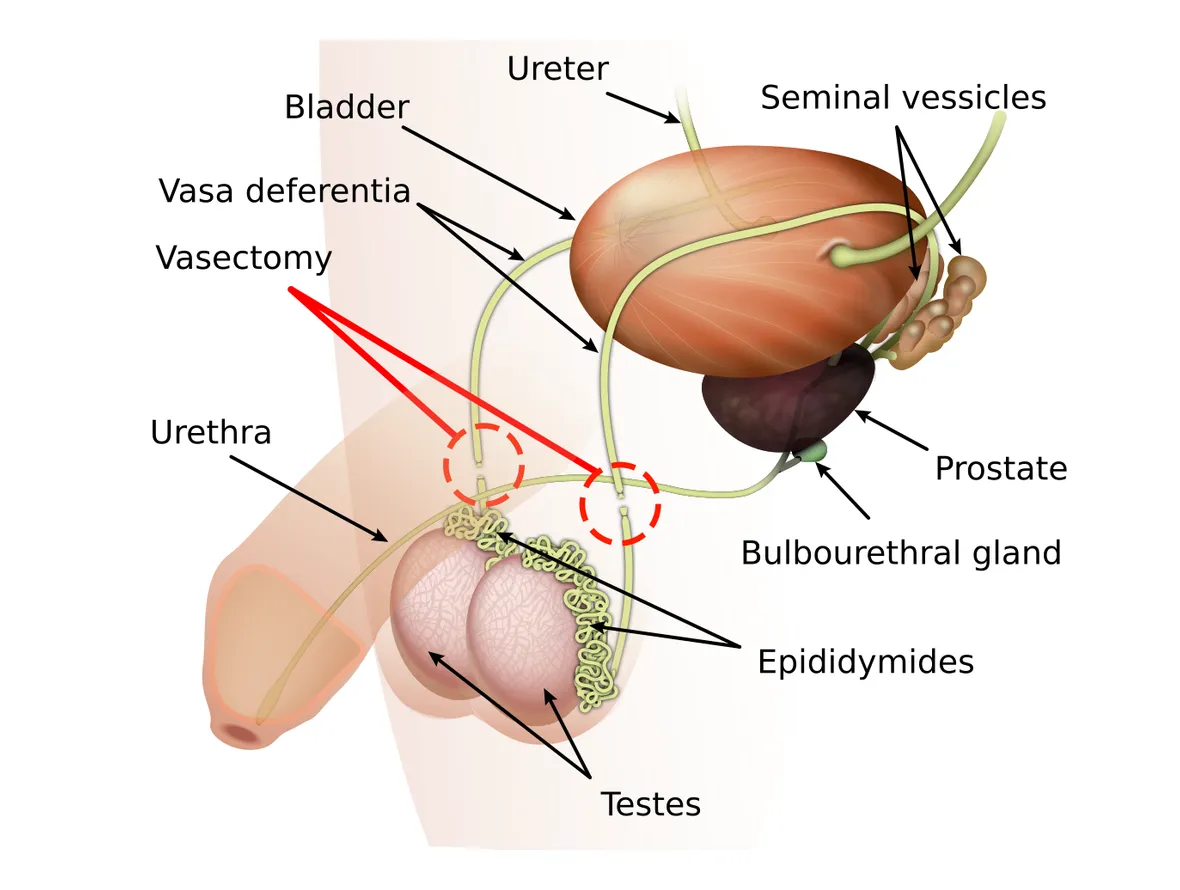

The testicles themselves are not removed, and in men they produce most of the body’s testosterone.[1, 7] Testosterone is carried in the blood, which is where a test measures it.[7]
Does a vasectomy affect testosterone levels?
Studies before and after surgery
Researchers looked at this question as vasectomy became widespread in the 1970s.
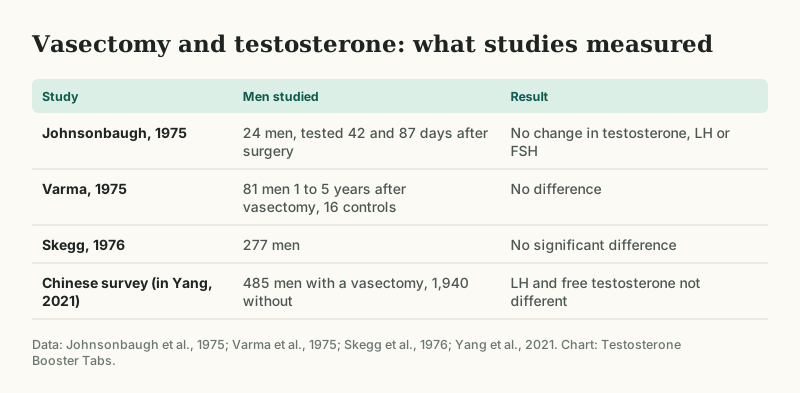
- 24 healthy men had testosterone, LH and FSH measured before a vasectomy and again 42 and 87 days afterwards. None of the hormones had changed significantly.[2]
- 277 men who had either had a vasectomy up to six years earlier or were about to have one were compared. Average testosterone seemed slightly higher in the men who had had the operation, but the difference was not statistically significant. LH, FSH, prolactin and oestradiol did not differ.[4]
The researchers behind the first study took the unchanged hormones to mean that normal testicular function persisted.[2]
Studies years later
- 81 men who had a vasectomy 1 to 5 years earlier were compared with 16 fertile men who had not. There were no significant differences in testosterone, LH, FSH or the share of testosterone bound to blood proteins.[3]
What a recent review concluded
A 2021 review of vasectomy complications and safety summed up the research.[5]
- Early animal experiments showed a temporary dip in testosterone for about three months after vasectomy.
- Long-term evidence from both animals and humans suggests that vasectomy does not affect reproductive hormones.
- The authors concluded that vasectomy does not increase the risk of late-onset low testosterone.
The review also describes a Chinese survey of 485 men who had had a vasectomy and 1,940 who had not. LH, free testosterone and a testosterone secretion index were not significantly different. Total testosterone did differ between the groups, though the review does not say in which direction or by how much.[5]
So the overall picture is consistent, with one caveat: most of the direct hormone studies are old and fairly small.
Does a vasectomy increase testosterone?
No. Some men hope it might, and one study did find a slightly higher average after vasectomy. That difference was not statistically significant, which means it could easily be chance.[4]
Does a vasectomy affect sex drive or erections?
Mayo Clinic’s answer is direct: a vasectomy does not affect sex drive, erections or masculinity. It only prevents you from starting a pregnancy.[1]
A 2025 systematic review gathered 20 studies on sexual function after vasectomy.[6]
- Sexual desire was assessed in 13 papers covering 2,611 men. Ten found no change and three found an improvement.
- Erectile function was assessed in 9 papers covering 1,800 men. Six found no change and three found an improvement.
- Ejaculation was assessed in 4 papers and did not change.
The reviewers concluded that most areas of sexual function are unaffected or improved after vasectomy.[6]
Why might you feel different after a vasectomy?
If your energy or sex drive drops in the months or years after the operation, the vasectomy is an unlikely cause. Other explanations are more common.
- Age. MedlinePlus lists ageing among the causes of low testosterone.[8] That happens whether or not you have had a vasectomy. See normal testosterone levels by age.
- Weight. In a study of 3,200 European men, obese men had total testosterone 5.09 nmol/L lower than men of normal weight.[10] We explain the link in testosterone and weight gain.
- Other health conditions and medicines. MedlinePlus also lists medicine side effects, low thyroid function and long-term diseases.[8]
The signs to look for are in low testosterone symptoms.
Should you get tested?
If symptoms bother you, yes. Guidelines advise diagnosing low testosterone only in men who have symptoms together with blood levels that are consistently low on fasting morning tests.[9] Our guide to testosterone blood test results explains what the numbers mean.
If a level does come back low, the options are set out in how to increase testosterone naturally and testosterone boosters vs TRT.
Do you need a testosterone booster after a vasectomy?
No. There is no hormone shortfall to make up, and most boosters do not raise testosterone in any case. See do testosterone boosters work?
The same goes for hair. Because hormone levels do not change, there is no obvious route for a vasectomy to affect it. We cover the causes in does testosterone cause hair loss?
What are the real risks of a vasectomy?
Vasectomy is a low-risk operation, but it is not risk-free. Mayo Clinic lists short-term effects such as bruising, swelling, mild pain and infection. Ongoing pain affects 1% to 2% of people who have the procedure.[1]
Mayo Clinic also says there is no proven link between vasectomy and cancer of the testicles or prostate.[1] The 2021 review describes these questions as still debated.[5]
A vasectomy is meant to be permanent. Reversal is possible but is not guaranteed to work.[1]
The bottom line
A vasectomy blocks sperm, not hormones. Studies that measured testosterone before and after the operation, and years later, found no lasting change, and sex drive and erections are not affected. If you feel different afterwards, look at age, weight and general health, and ask for a blood test if symptoms persist.
Common questions
Does a vasectomy lower testosterone?
Studies say no. In 81 men who had a vasectomy 1 to 5 years earlier, testosterone, LH and FSH were no different from those of 16 fertile men who had not.[3]
Does a vasectomy increase testosterone?
No. In a study of 277 men, average testosterone seemed slightly higher after vasectomy than before, but the difference was not statistically significant.[4]
Does a vasectomy affect sex drive or erections?
Mayo Clinic says a vasectomy does not affect sex drive, erections or masculinity.[1] A 2025 systematic review found most areas of sexual function were unaffected or improved.[6]
Can a vasectomy cause low testosterone years later?
A 2021 review concluded that vasectomy does not increase the risk of late-onset low testosterone.[5]
Sources
- Vasectomy Mayo Clinic
- Plasma testosterone, luteinizing hormone, and follicle-stimulating hormone after vasectomy (Johnsonbaugh et al., 1975) Fertility and Sterility
- Long-term effects of vasectomy on pituitary-gonadal function in man (Varma et al., 1975) The Journal of Clinical Endocrinology and Metabolism
- Hormonal assessment before and after vasectomy (Skegg et al., 1976) British Medical Journal
- Review of Vasectomy Complications and Safety Concerns (Yang et al., 2021) The World Journal of Men's Health
- A systematic review evaluating the effects of vasectomy on male and female sexual function and satisfaction (Helm et al., 2025) Translational Andrology and Urology
- Testosterone test MedlinePlus, US National Library of Medicine
- Low testosterone MedlinePlus, US National Library of Medicine
- Testosterone Therapy in Men With Hypogonadism: An Endocrine Society Clinical Practice Guideline (Bhasin et al., 2018) The Journal of Clinical Endocrinology and Metabolism
- Hypothalamic-pituitary-testicular axis disruptions in older men are differentially linked to age and modifiable risk factors: the European Male Aging Study (Wu et al., 2008) The Journal of Clinical Endocrinology and Metabolism
Part of our testosterone guides. New here? Start with do testosterone boosters work?