If you want to know how to increase testosterone naturally, the honest answer is that three things have good evidence: losing excess weight, sleeping enough, and not drinking heavily. Each works by removing something that pulls testosterone down.
That is an important limit. Health and lifestyle changes can be as strongly linked to falling testosterone as ageing itself.[14] So fixing them can bring a lowered level back up. They have not been shown to lift an already healthy level far above normal.
1. Lose excess weight
This is the best-supported step by a wide margin.
A 2013 meta-analysis pulled together 24 studies of weight loss in men. Both low-calorie diets and weight-loss surgery raised testosterone significantly. The average rise in total testosterone was 2.87 nmol/L with a low-calorie diet and 8.73 nmol/L with surgery. The more weight men lost, the more their testosterone rose.[1]
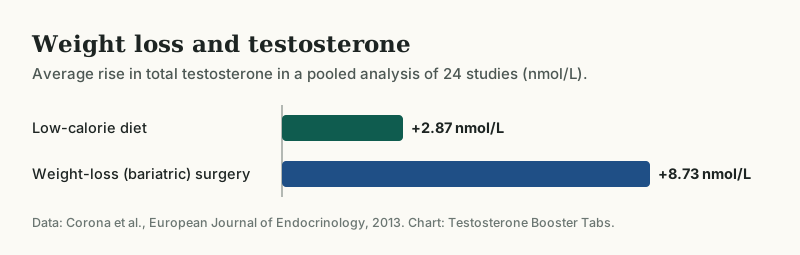
The same pattern shows up outside trials. In a European study that followed 2,395 men aged 40 to 79 for about four years, weight loss went with a rise in testosterone and weight gain with a fall. The researchers concluded that obesity-related changes in testosterone are reversible with weight reduction.[2]
We look at both directions of this link in testosterone and weight gain.
2. Protect your sleep
In a laboratory study, 10 healthy young men slept 5 hours a night for a week. Their daytime testosterone fell by 10 to 15%.[3]
Sleep quality matters as well as length. A pooled analysis of 24 studies found that men with obstructive sleep apnoea had significantly lower testosterone than men without it.[4] If you snore heavily and wake unrefreshed, that is worth raising with a doctor for its own sake.
3. Go easy on alcohol
Does alcohol lower testosterone?
It depends on how much you drink and for how long. A 2023 review of the research concluded that:[7]
- a low-to-moderate amount of alcohol raises testosterone for a short time
- a large amount is associated with lower testosterone
- drinking to excess, particularly over a long time, harms testosterone production.
Individual studies show the same split. In 13 men, a single low dose of alcohol raised testosterone from 13.5 to 16.0 nmol/L for a short time.[8] In 10 middle-aged men, 40 g of alcohol a day with dinner for three weeks lowered testosterone by 6.8%.[9] And a pooled analysis of 17 observational studies found no significant overall difference in testosterone between drinkers and non-drinkers.[10]
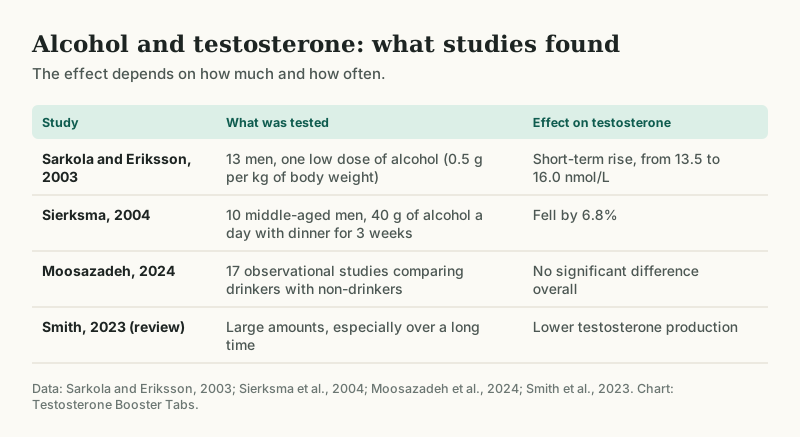
The practical reading: an occasional drink is not a testosterone problem. Regular heavy drinking is.
4. Stay active, for the right reasons
Exercise has many benefits. Raising resting testosterone is not clearly one of them.
A meta-analysis of 11 randomised trials in 421 inactive but healthy men found that exercise training had a negligible effect on resting total testosterone, whatever the type of training.[5]
Activity does seem to help men who are overweight. In 41 overweight and obese men on a 12-week programme of aerobic exercise and calorie restriction, testosterone rose, and it rose more in the men who increased their daily steps the most.[6] In 208,677 UK men, higher physical activity was linked to higher testosterone.[15]
For the detail on weights, cardio and overtraining, see does working out increase testosterone?
5. Eat enough, including fat
No single food raises testosterone much. A few dietary patterns may lower it.
A meta-analysis of six intervention studies with 206 men found that low-fat diets produced small but significant decreases in total and free testosterone compared with higher-fat diets. The authors said more randomised trials are needed.[11]
Shortages of specific nutrients can matter as well. Zinc raises testosterone in men who are deficient, though not in men who get enough. The evidence for magnesium is weaker, and vitamin D did not raise testosterone in placebo-controlled trials. Our guide to foods that boost testosterone goes through oysters, protein, soy and more.
6. Check your medicines
Some medicines lower testosterone. A pooled analysis of 17 studies found that testosterone was suppressed in men who used opioids regularly.[12] Never stop a prescribed medicine by yourself. If you are concerned, ask your doctor whether it could be affecting your hormones.
What does not need fixing?
Some things get blamed for low testosterone without good reason.
- A vasectomy. Studies have found no change in testosterone afterwards. See does a vasectomy affect testosterone?
- Creatine. It does not raise or lower testosterone in most studies. See does creatine increase testosterone?
Do natural testosterone supplements work?
Mostly not. A 2024 systematic review of 52 studies concluded that most products sold as testosterone boosters fail to raise total testosterone.[13] We go through the ingredients one by one in do testosterone boosters work?
When are lifestyle changes not enough?
If you have symptoms such as low sex drive and erection problems, lifestyle changes are worth making, but they are not a substitute for finding out what is wrong.
Guidelines recommend diagnosing low testosterone only when a man has symptoms together with clearly and repeatedly low morning blood tests, and then looking for the cause.[16] Start with low testosterone symptoms and how to test for testosterone levels. If a deficiency is confirmed, testosterone boosters vs TRT explains what treatment involves.
The bottom line
To raise testosterone naturally, deal with what lowers it. Lose excess weight, sleep properly, keep alcohol moderate, stay active and eat a diet that is not very low in fat. Expect a return towards your own normal, not a dramatic boost. If symptoms persist, get tested.
Common questions
How can I boost testosterone naturally?
The best-supported steps are losing excess weight, getting enough sleep and avoiding heavy drinking.[1, 3, 7] Each removes something that lowers testosterone. None has been shown to raise a healthy level far above normal.
How do you raise testosterone naturally and quickly?
There is no proven quick fix. The fastest change in the studies was in the wrong direction: one week of short sleep lowered testosterone by 10 to 15%.[3] Weight loss raises it in proportion to how much weight is lost.[1]
Does alcohol lower testosterone?
Large amounts do, especially over a long time. A 2023 review found that a low-to-moderate amount raises testosterone briefly, while a large volume is linked to lower levels.[7]
Does exercise increase testosterone naturally?
Not much at rest. A meta-analysis of 11 randomised trials in 421 inactive men found a negligible effect of exercise training on resting testosterone.[5] It can help indirectly through weight loss.[6]
Which supplements increase testosterone naturally?
Very few. A 2024 systematic review of 52 studies concluded that most supplements sold as testosterone boosters fail to raise total testosterone.[13]
Sources
- Body weight loss reverts obesity-associated hypogonadotropic hypogonadism: a systematic review and meta-analysis (Corona et al., 2013) European Journal of Endocrinology
- Age-associated changes in hypothalamic-pituitary-testicular function in middle-aged and older men are modified by weight change and lifestyle factors: longitudinal results from the European Male Ageing Study (Camacho et al., 2013) European Journal of Endocrinology
- Effect of 1 week of sleep restriction on testosterone levels in young healthy men (Leproult and Van Cauter, 2011) JAMA
- Obstructive sleep apnea and serum total testosterone: a system review and meta-analysis (Wang et al., 2023) Sleep & Breathing = Schlaf & Atmung
- Effects of Exercise Training on Resting Testosterone Concentrations in Insufficiently Active Men: A Systematic Review and Meta-Analysis (Potter et al., 2021) Journal of Strength and Conditioning Research
- Increased physical activity has a greater effect than reduced energy intake on lifestyle modification-induced increases in testosterone (Kumagai et al., 2016) Journal of Clinical Biochemistry and Nutrition
- The effects of alcohol on testosterone synthesis in men: a review (Smith et al., 2023) Expert Review of Endocrinology & Metabolism
- Testosterone increases in men after a low dose of alcohol (Sarkola and Eriksson, 2003) Alcoholism, Clinical and Experimental Research
- Effect of moderate alcohol consumption on plasma dehydroepiandrosterone sulfate, testosterone, and estradiol levels in middle-aged men and postmenopausal women: a diet-controlled intervention study (Sierksma et al., 2004) Alcoholism, Clinical and Experimental Research
- Association of the Effect of Alcohol Consumption on Luteinizing Hormone (LH), Follicle-Stimulating Hormone (FSH), and Testosterone Hormones in Men: A Systematic Review and Meta-Analysis (Moosazadeh et al., 2024) International Journal of Preventive Medicine
- Low-fat diets and testosterone in men: Systematic review and meta-analysis of intervention studies (Whittaker and Wu, 2021) The Journal of Steroid Biochemistry and Molecular Biology
- Testosterone suppression in opioid users: a systematic review and meta-analysis (Bawor et al., 2015) Drug and Alcohol Dependence
- Do "testosterone boosters" really increase serum total testosterone? A systematic review (Morgado et al., 2024) International Journal of Impotence Research
- The relative contributions of aging, health, and lifestyle factors to serum testosterone decline in men (Travison et al., 2007) The Journal of Clinical Endocrinology and Metabolism
- Sociodemographic, lifestyle and medical influences on serum testosterone and sex hormone-binding globulin in men from UK Biobank (Yeap et al., 2021) Clinical Endocrinology
- Testosterone Therapy in Men With Hypogonadism: An Endocrine Society Clinical Practice Guideline (Bhasin et al., 2018) The Journal of Clinical Endocrinology and Metabolism
Part of our testosterone guides. New here? Start with do testosterone boosters work?