Vitamin D and testosterone are linked in population studies, but taking vitamin D has not raised testosterone in placebo-controlled trials.
Vitamin D is on the label of a great many testosterone boosters. The idea has a reasonable starting point. The male reproductive tract responds to vitamin D, and earlier studies suggested that men with lower vitamin D tend to have lower testosterone.[1]
But a link is not proof of cause. To find out whether taking vitamin D raises testosterone, you need trials that compare it with a placebo. Those trials have now been done.
Where did the vitamin D and testosterone claim come from?
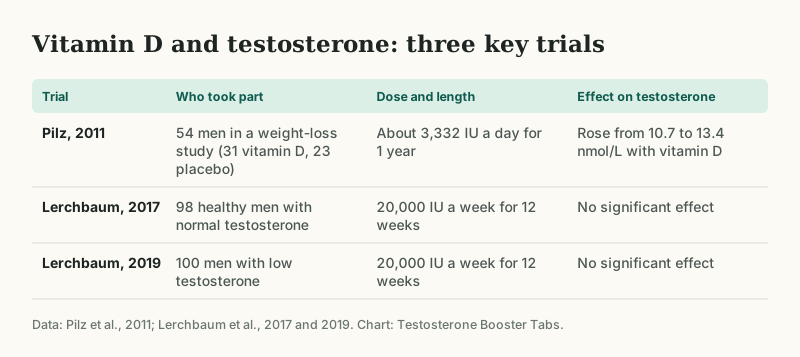
In 2011, researchers reported on healthy overweight men who took part in a weight-loss trial. Thirty-one men took about 3,332 IU of vitamin D a day for a year, and 23 took a placebo. All started with vitamin D in the deficient range and testosterone at the lower end of the reference range.[1]
In the vitamin D group, average total testosterone rose from 10.7 to 13.4 nmol/L. There was no significant change in the placebo group.[1]
This result is still quoted in supplement marketing. The authors themselves were more careful. They wrote that vitamin D might increase testosterone and that further randomised trials were needed.[1]
Does vitamin D increase testosterone? The trials designed to test it
A research centre in Graz, Austria, then ran two trials built specifically to answer the question. Both were double-blind and placebo-controlled, and both measured testosterone with mass spectrometry.[2, 3]
Men with normal testosterone (2017). Ninety-eight healthy men with normal testosterone and vitamin D below 75 nmol/L completed the trial. They took 20,000 IU of vitamin D3 a week, or a placebo, for 12 weeks. There was no significant effect on total testosterone.[2]
Men with low testosterone (2019). One hundred men with total testosterone below 10.4 nmol/L took the same dose or a placebo for 12 weeks. Ninety-four finished. Again there was no significant effect on total testosterone or on any of the other hormones measured.[3]
That second trial matters most. If vitamin D were going to help anyone, it should have helped men who started low on both.
What did the pooled analyses find?
- 2019 meta-analysis. Eight trials in men, with vitamin D doses from 600 IU a day up to 60,000 IU a week, taken for between 6 weeks and 3 years. Vitamin D had no significant effect on total testosterone. That held whatever the duration, the dosing schedule, or the starting vitamin D and testosterone levels.[4]
- 2026 meta-analysis. The main analysis combined 11 comparisons from randomised trials. It showed no clear effect on total testosterone. The average difference was 0.47 nmol/L, with a margin of error that included zero.[5]
A 2024 systematic review of testosterone boosters concluded that most fail to raise total testosterone.[6] We put vitamin D alongside the other common ingredients in do testosterone boosters work?
Why do the early study and the later trials disagree?
We cannot say for certain. A few things may explain it.
- The 2011 men were on a weight-loss programme.[1] Losing weight can raise testosterone by itself, as we explain in testosterone and weight gain.
- The 2011 analysis looked at the 54 men within a trial of 200 people that was not designed around testosterone.[1] Results like that are a reason to run a proper trial, and proper trials often fail to confirm them.
- The 2011 men started with vitamin D below 50 nmol/L.[1] The later trials enrolled men below 75 nmol/L.[2, 3] It remains possible that correcting a more severe deficiency has a small effect. The pooled analyses have not shown one.[4]
Is vitamin D still worth taking?
None of this means vitamin D is unimportant. It helps your body absorb calcium and is needed for healthy bones. If you are deficient, that is worth fixing for its own sake. According to MedlinePlus, from the US National Library of Medicine:[7]
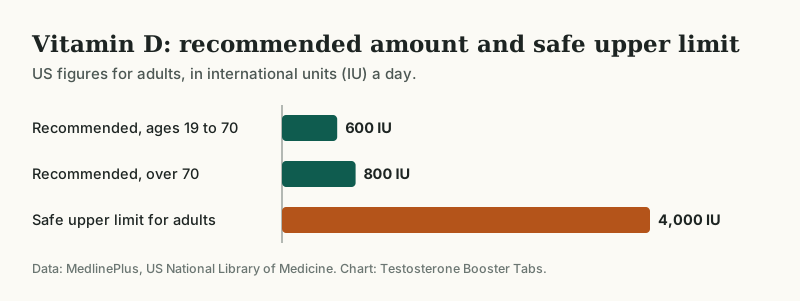
- The recommended amount for adults aged 19 to 70 is 600 IU (15 micrograms) a day, and 800 IU a day for people over 70.
- The safe upper limit for adults is 4,000 IU (100 micrograms) a day.
- The body makes vitamin D when skin is exposed to sunlight. Fatty fish such as tuna, salmon and mackerel are among the best food sources.


Food comes up again in foods that boost testosterone, and the habits with the best evidence are in how to increase testosterone naturally.
Is vitamin D safe? Side effects of too much
Very high doses over time can cause harm. MedlinePlus explains that too much vitamin D makes the gut absorb too much calcium. High blood calcium can lead to:[7]
- nausea, vomiting, constipation, poor appetite and weakness
- confusion
- kidney stones and kidney damage
- calcium deposits in soft tissues such as the heart and lungs.
Check the total you are getting from all sources, including multivitamins and any booster blend. Blends often stack vitamin D with minerals such as zinc and magnesium, and some go over safe limits, as our guide to testosterone booster side effects shows.
The bottom line
Men with low vitamin D often have lower testosterone, but giving vitamin D has not raised testosterone in well-designed trials, including in men who started low. We rate it “unlikely to work” as a testosterone booster. Correct a vitamin D deficiency for your bones, with advice from a doctor or pharmacist, and do not expect it to change your testosterone. If you have symptoms, start with low testosterone symptoms.
Common questions
Does vitamin D increase testosterone?
Well-designed trials say no. A 2019 meta-analysis of eight randomised trials found no significant effect on total testosterone, whatever the dose, the duration or the starting vitamin D and testosterone levels.[4]
Does vitamin D raise testosterone if you are deficient?
One 2011 analysis of 54 vitamin D-deficient men in a weight-loss trial found a rise.[1] Later trials designed to test the idea, in men with vitamin D below 75 nmol/L, found no effect.[2, 3]
Is low vitamin D linked to low testosterone?
Observational studies have found an association between vitamin D status and testosterone.[5] An association does not show that one causes the other, and supplement trials have not raised testosterone.[4, 5]
How much vitamin D should a man take?
The US recommended amount for adults aged 19 to 70 is 600 IU a day, and 800 IU a day over 70. The safe upper limit for adults is 4,000 IU a day.[7]
Sources
- Effect of vitamin D supplementation on testosterone levels in men (Pilz et al., 2011) Hormone and Metabolic Research = Hormon- Und Stoffwechselforschung = Hormones Et Metabolisme
- Vitamin D and Testosterone in Healthy Men: A Randomized Controlled Trial (Lerchbaum et al., 2017) The Journal of Clinical Endocrinology and Metabolism
- Effects of vitamin D supplementation on androgens in men with low testosterone levels: a randomized controlled trial (Lerchbaum et al., 2019) European Journal of Nutrition
- The effect of vitamin D supplementation on the androgenic profile in men: A systematic review and meta-analysis of clinical trials (Hosseini Marnani et al., 2019) Andrologia
- Vitamin D Supplementation, Total Testosterone, and Androgen Bioavailability Markers in Adult Men: A Systematic Review and Meta-Analysis of Randomized Controlled Trials (Paez-Allendes et al., 2026) Nutrients
- Do "testosterone boosters" really increase serum total testosterone? A systematic review (Morgado et al., 2024) International Journal of Impotence Research
- Vitamin D MedlinePlus, US National Library of Medicine
Part of our testosterone guides. New here? Start with do testosterone boosters work?