In Australia a testosterone booster supplement can be a medicine in law, not a food. The rule sits in a short legal order made under the Therapeutic Goods Act 1989, and the regulator is the Therapeutic Goods Administration (TGA). We read the order and the TGA’s own pages on 24 November 2026. This page sets out what they say. It names no products and it is not about whether boosters work. For that, see do testosterone boosters work?
Are testosterone boosters legal in Australia?
It depends on the product. In Australia a sports supplement is either a food or a therapeutic good. It cannot be both.[4]
If it is a therapeutic good, it must be entered in the Australian Register of Therapeutic Goods (ARTG) before it is imported, advertised or supplied.[4] A product on the register can be sold. A product that should be on it, and is not, cannot.
So the useful question is not “are boosters legal?” It is “is this product a therapeutic good, and if so, is it on the ARTG?”
What brings a sports supplement under the Therapeutic Goods Act?
The Therapeutic Goods (Declared Goods) Order 2019 declares certain sports supplements to be therapeutic goods.[1] The table gives its tests in our own words.
| Test | What the order looks at | Applies from |
|---|---|---|
| 1. How it is sold | Taken by mouth, and represented as improving or maintaining physical or mental performance in sport, exercise or recreation[1] | 30 November 2020[2] |
| 2. The claim | Used, advertised or presented for therapeutic use, or in a way likely to be taken as that. The listed examples include gaining muscle, losing weight or fat and changing hormone levels[1] | 30 November 2020[2] |
| 3a. Ingredients | Contains, or is represented to contain, a substance in a schedule to the Poisons Standard, an added substance named on the anti-doping Prohibited List, added dendrobium or methylliberine, or a substance with an equivalent action[1] | 30 November 2020[2] |
| 3b. Form | Supplied as a tablet, capsule or pill, unless it contains glucose only[1] | 30 November 2023[1] |
A product is covered when it meets tests 1 and 2, and then either 3a or 3b.[1, 5]
The hormone wording is direct. Among its examples of therapeutic use, the order lists “increasing testosterone levels, reducing oestrogen levels or otherwise modifying hormone levels” (Therapeutic Goods (Declared Goods) Order 2019, Schedule 1).[1]
The order’s list of uses is not closed. It says the uses include, but are not limited to, the ones it names.[1]
Which date applied to what: 30 November 2020 or 30 November 2023?
Both dates come from the same amendment. We read the instrument itself to settle it.
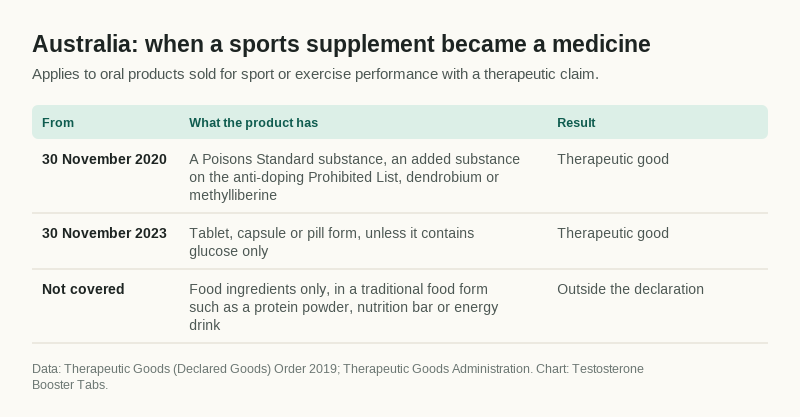
- 30 November 2020. The Therapeutic Goods (Declared Goods) Amendment (Sports Supplements) Order 2020 was made on 18 September 2020. Its commencement table gives one date for the whole instrument: 30 November 2020.[2] From that day the new sports supplement item was law, and the ingredient test (3a) applied.[2, 3]
- 30 November 2023. The same item contains the dosage form test (3b), which only bites on or after 30 November 2023.[1, 2] It was written into the 2020 order with a delayed start. It was not a second, later law.
The TGA describes the gap as a transition: 10 weeks for products with the named ingredients, and three years for tablets, capsules and pills.[3]
The version in force when we checked was compilation No. 4, dated 1 March 2023. Its only change since 2020 to this part was to update which edition of the Prohibited List the order points to.[1]
What does this mean for testosterone booster pills?
Take a booster sold as a tablet or capsule. Under test 3b, if it is sold for sport or exercise performance with a claim about raising testosterone, it has been a therapeutic good since 30 November 2023, whatever is in it.[1, 5]
A few other points from the TGA:
- Powders and drinks are caught by the declaration only through the ingredient test. Products with food ingredients only, in a traditional food form such as a protein powder, are not affected by it.[3]
- The declaration is not the only route. A supplement can also be a therapeutic good because it is presented for therapeutic use and is not excluded as a food.[4]
- A disclaimer does not help. Wording such as “not a therapeutic good” on a label does not change what the product is.[4]
- Renaming an ingredient does not help either. The TGA says a botanical name or synonym for a scheduled substance is treated the same as the substance.[4]
The common booster ingredients, such as zinc and ashwagandha, each have their own guide here on what the trials show. None of this page is about that evidence.
Which booster ingredients are restricted?
Test 3a points to three lists.[1]
The Poisons Standard. Any substance in one of its schedules counts.[1] The TGA’s examples for sports supplements include yohimbine, levodopa and high doses of caffeine.[4] One booster ingredient stands out: DHEA. Under its other name, prasterone, it is in Schedule 4, the prescription-only schedule.[10] Our DHEA guide covers the trial evidence.
The anti-doping Prohibited List. A substance named on the World Anti-Doping Agency’s list counts when it is added as an ingredient.[1]
Two named substances. Dendrobium and methylliberine count when added as ingredients.[1]
The TGA says it tests products sampled from the Australian market, to see whether they contain ingredients they should not.[4] We cover hidden ingredients in testosterone booster side effects.
What does an ARTG listing mean for a buyer?
It means the product is lawfully on the register. It does not mean the TGA has tested it or agrees that it works.
- Low-risk products go on as “listed” medicines. Listed medicines are low-risk, non-prescription products with ingredients such as vitamins, minerals and herbal substances.[7]
- Listed medicines are not individually assessed before supply. The company self-certifies that the medicine meets the safety, quality and efficacy requirements. The TGA can check any listed medicine that is on the market.[7]
- Limited claims only. Listed medicines can contain only low-risk ingredients and make only low-level health claims.[7]
- The number is on the pack. Listed medicines carry an AUST L number and registered medicines an AUST R number. The ARTG number is mandatory on medicine labels and packaging.[8]
- It is not an endorsement. The TGA says inclusion in the ARTG is not an endorsement, and advertisers must not use terms such as “TGA approved”.[8]
So a number on the label answers the legal question. The evidence question is separate: see do testosterone boosters work?
How do you check a product on the ARTG?
The register is public and can be searched online.[4, 6]
- Find the number. Look on the label or pack for “AUST L” or “AUST R” followed by a number.[8]
- Open the TGA’s ARTG search. You can search by product name, ID number or sponsor, which is the company responsible for the product.[6]
- Read the entry. Results show the product name and formulation details, and the sponsor and manufacturer.[6]
- Compare it with the pack. The name, company and ingredients should match what you are holding.
The TGA also publishes lists of products it has suspended or cancelled from the register.[9]
We have not looked up any individual product for this page, and we do not keep a list of which boosters are on the register.
How is prescription testosterone different?
Prescription testosterone is a different thing in law. It is a scheduled medicine, not a supplement.
- It is prescription only. Testosterone is in Schedule 4 of the Poisons Standard, headed prescription only medicines. The exception is implants for use in animals, which are in Schedule 6.[10]
- Possession is controlled. The Poisons Standard lists anabolic and androgenic steroidal agents among the poisons that must not be possessed without authority, for example other than under a legal prescription. Its index places testosterone in that group.[10]
- Doctors do prescribe it. healthdirect, a government-funded health information service, says a doctor can prescribe anabolic steroids for hormone problems such as low testosterone, and that they are illegal in Australia unless prescribed by your doctor.[11]
The two sets of rules meet at test 3a. A sports supplement that contains a scheduled substance, and both testosterone and DHEA are scheduled, is a therapeutic good.[1, 10] The TGA adds that products with scheduled ingredients have restrictions on where they can be sold, like any other product containing them.[3]
For how the medicine compares with the supplements, see testosterone boosters vs TRT and TRT vs steroids. For the chemistry and the rules in other countries, see is testosterone a steroid? If you think your level is low, start with the symptoms of low testosterone and a blood test, not a supplement.
What enforcement does the TGA describe?
The TGA says it routinely reviews sports supplement advertising, and tests products sampled from the market.[4]
When it finds a breach, it says its response depends on the risk to public health and safety, and ranges from education and warnings to fines and legal action.[9] The outcomes it publishes include:
- infringement notices, which can carry a financial penalty[9]
- court actions[9]
- directions and prevention notices to advertisers[9]
- suspensions and cancellations from the ARTG[9]
For importers and sellers, the TGA’s guidance states the consequences of breaching the law as heavy fines, civil or criminal court action and jail time.[4] It also warns that if the ingredients found in a product differ from those on its label, the seller may face large fines or criminal prosecution.[4]
The TGA asks to be told about breaches of the Act, counterfeit products and non-compliant advertising.[9]
One limit is worth knowing. A product that comes under a food standard, and is not caught by the declaration, stays a food even if it makes therapeutic claims. The TGA says that is then a matter for the state or territory food regulator.[4]
What does this page not cover?
- Bringing supplements into Australia for your own use. We did not read the personal importation rules.
- State and territory law. We read Commonwealth sources only.
- Any single product. Whether one product is covered depends on its label, its advertising and its formula.
- Other countries. Our guide to side effects describes how the United States treats supplements.
The bottom line
The order we read does not ban testosterone boosters by name, but it can make one a medicine in law. A sports supplement that claims to raise testosterone is a therapeutic good if it has a restricted ingredient, which has applied since 30 November 2020, or if it is a tablet, capsule or pill, which has applied since 30 November 2023. It then has to be on the ARTG to be sold. A listing shows that a product is lawfully supplied. It does not show that the TGA tested it, or that it works.
Common questions
Are testosterone boosters banned in Australia?
Not by name in the order we read. A sports supplement sold with a claim such as increasing testosterone is a therapeutic good if it has a restricted ingredient or comes as a tablet, capsule or pill. It must then be entered in the ARTG before it is imported, advertised or supplied.[1, 4]
What changed on 30 November 2023?
The dosage form test began. From that date, a sports supplement making a therapeutic claim is a therapeutic good if it is supplied as a tablet, capsule or pill, unless it contains glucose only. The ingredient test had applied since 30 November 2020.[1, 2]
Does an AUST L number mean a testosterone booster works?
No. The TGA says listed medicines are not individually assessed before supply, and that an entry in the ARTG is not an endorsement by the TGA.[7, 8]
Is DHEA legal in Australia?
DHEA, also called prasterone, is in Schedule 4 of the Poisons Standard, the schedule for prescription-only medicines. It is also in the list of steroidal agents that must not be possessed without authority, such as a legal prescription.[10]
Sources
- Therapeutic Goods (Declared Goods) Order 2019, compilation No. 4 (in force from 1 March 2023) Federal Register of Legislation, Australian Government
- Therapeutic Goods (Declared Goods) Amendment (Sports Supplements) Order 2020 Federal Register of Legislation, Australian Government
- Changes to the regulation of sports supplements in Australia Therapeutic Goods Administration (TGA)
- Importing or supplying sport supplements Therapeutic Goods Administration (TGA)
- Is my sports supplement a therapeutic good? Therapeutic Goods Administration (TGA)
- Australian Register of Therapeutic Goods (ARTG) Therapeutic Goods Administration (TGA)
- Listed medicines Therapeutic Goods Administration (TGA)
- The claim 'TGA approved' must not be used in advertising Therapeutic Goods Administration (TGA)
- Compliance and enforcement Therapeutic Goods Administration (TGA)
- Therapeutic Goods (Poisons Standard—October 2026) Instrument 2026 Federal Register of Legislation, Australian Government
- Anabolic steroids healthdirect Australia
Part of our data and research pages. New here? Start with do testosterone boosters work?