A testosterone booster label lists what is in each serving. A trial reports what dose the researchers gave. This page puts the two side by side for 11 products whose labels we could read as text on 24 November 2026.
It covers the ten ingredients we have guides on. It does not name the products, rank them or say whether any of them works. For that wider question, see do testosterone boosters work?
What did the label audit find?
We compared 46 labelled doses with the doses used in trials. 20 were below the trial dose, 19 were within it, 1 was above and 6 could not be compared.
The trial dose for each ingredient comes from the studies cited in our own guide to it. “Below” means the label gives less per day than those trials gave. It does not mean the product fails, and “within” does not mean it works.
| Ingredient | Trial dose range | Products with it | Amount disclosed | Below | Within | Above | Not comparable |
|---|---|---|---|---|---|---|---|
| Ashwagandha | 600 mg of root extract a day[2, 3] | 5 | 5 | 2 | 2 | 1 | 0 |
| Tongkat ali | 200 to 400 mg of extract a day[4, 5] | 5 | 5 | 1 | 1 | 0 | 3 |
| Fenugreek | 600 mg of seed extract a day[6, 7, 8] | 7 | 7 | 5 | 2 | 0 | 0 |
| Zinc | About 30 mg a day[9] | 8 | 8 | 6 | 2 | 0 | 0 |
| Vitamin D | 600 IU a day up to 60,000 IU a week[10] | 5 | 5 | 0 | 4 | 0 | 1 |
| D-aspartic acid | 3 to 6 g a day[13, 14] | 4 | 4 | 3 | 1 | 0 | 0 |
| Tribulus terrestris | 450 mg of extract a day, up to 20 mg per kg of body weight[15, 16] | 1 | 1 | 0 | 1 | 0 | 0 |
| Boron | 2.5 to 10 mg a day[17, 18] | 7 | 7 | 0 | 6 | 0 | 1 |
| Magnesium | 10 mg per kg of body weight a day[19] | 4 | 4 | 3 | 0 | 0 | 1 |
| DHEA | 50 to 150 mg a day[20, 21] | 0 | 0 | 0 | 0 | 0 | 0 |
Zinc was the most common of the ten ingredients, in 8 of the 11 products. Fenugreek and boron were each in 7. No product in the sample contained DHEA.
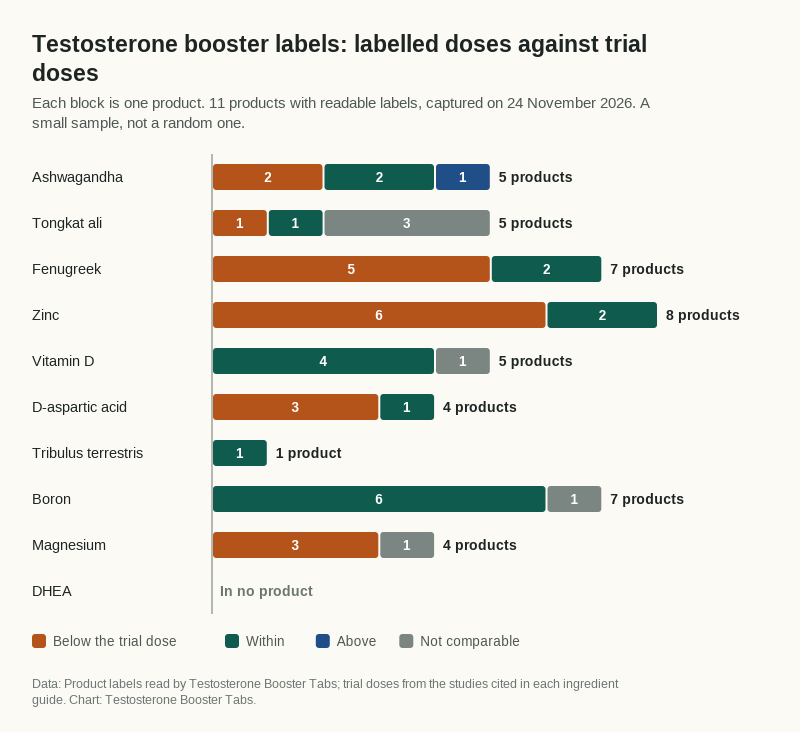
Nine of the 11 products had at least one of these ingredients below its trial dose. One product had every compared ingredient within the range.
Which ingredients were dosed below the trials?
Fenugreek, zinc, D-aspartic acid and magnesium were below the trial dose in most of the products that contained them.
- Fenugreek. The trials gave 600 mg of standardised seed extract a day, or 300 mg twice a day.[6, 7, 8] Five of 7 labels gave less. The labelled daily amounts ran from 40 mg to 600 mg.
- Zinc. One study gave marginally zinc-deficient older men 459 micromoles of zinc a day as zinc gluconate, which is about 30 mg.[9] Six of 8 labels gave less, from 10 mg to 25 mg. Two gave 30 mg.
- D-aspartic acid. Two trials in weight-trained men used 3 g a day, and one of them also tested 6 g.[13, 14] Three of 4 labels gave between 2,000 mg and 2,352 mg. One gave 3,000 mg.
- Magnesium. The one supplement trial gave 10 mg per kg of body weight a day.[19] That is 500 to 1,000 mg for an adult of 50 to 100 kg. The three labels we could compare gave 100 to 200 mg.
- Ashwagandha. The trials gave 300 mg of root extract twice a day.[2, 3] Two of 5 labels gave less (200 mg and 300 mg a day), two gave 600 mg and one gave 675 mg.
A lower dose is not always a flaw. The zinc figure comes from men who were short of zinc, and it is a study dose, not a recommended amount.[9] The magnesium trial dose is above the adult upper level for supplemental magnesium for anyone heavier than 35 kg, as a later section shows.[19, 22] Our guides to zinc and magnesium cover who those studies apply to.
Which doses matched the trials?
Boron and vitamin D were within the trial range in almost every product that listed them.
- Boron. The two human studies used 2.5 mg and 10 mg a day.[17, 18] Six of 7 labels gave between 5 mg and 10 mg of boron.
- Vitamin D. A 2019 review of trials in men covered doses from 600 IU a day up to 60,000 IU a week.[10] Four labels gave 1,000 to 5,000 IU a day, which sits inside that span.
- Tongkat ali. Only two labels gave a comparable extract. One gave 200 mg a day, which matches a trial dose, and one gave 150 mg.[4, 5]
Matching a trial dose is not the same as matching a trial result. The vitamin D review found no significant effect on total testosterone.[10] The 2.5 mg boron trial found no effect, and the 10 mg study had eight men and no separate placebo group.[17, 18] At 3 g a day, D-aspartic acid did not change testosterone in either trial, and at 6 g a day it lowered it.[13, 14] Our ranking of ingredients by number of human trials shows how thin the research is for several of them.
Why are some doses “not comparable”?
Six labelled doses could not be set against a trial dose. We kept these out of the below, within and above counts.
- Root powder, not extract (2 products). Two tongkat ali labels gave 400 mg of root powder. The trials gave extracts.[4, 5]
- Form not stated (1 product). One page listed 400 mg of tongkat ali without saying whether it was an extract or powder.
- Weight of a compound (1 product). One label gave 10 mg of boron citrate. That is the weight of the compound, not of the boron in it.
- Unit unclear (2 products). One page gave magnesium in micrograms and one gave vitamin D in milligrams. We recorded both as shown and did not convert them.
Even among extracts, weight is a rough yardstick. Two extracts of the same weight can differ in strength, and a product may use an extract with trials of its own that are not cited in our guides.
Did any product go over an upper intake level?
No, for the two nutrients we could check. We compared labelled zinc and magnesium with the adult tolerable upper intake levels in Health Canada’s dietary reference intake tables.[22]
| Nutrient | Adult upper level | What it counts | Highest labelled daily amount | Products above it |
|---|---|---|---|---|
| Zinc | 40 mg a day[22] | The table has no supplement-only note for zinc | 30 mg | 0 of 8 |
| Magnesium | 350 mg a day[22] | Supplements and medicines only, not food and water[22] | 200 mg | 0 of 3 |
Because the zinc level is not limited to supplements in that table, zinc from food would count towards it as well. One magnesium label was left out here because its unit was unclear.
We planned the same check for niacin. No label listed niacin, so it did not apply. The same tables say the niacin level covers only synthetic forms from supplements and fortified foods.[23]
We checked upper levels for zinc, magnesium and niacin only. Our vitamin D guide covers the upper limit for vitamin D, and testosterone booster side effects covers the wider risks.
Did the products hide doses in proprietary blends?
None of the 11 did. Every product gave an amount for every ingredient it listed, which made 77 label lines in all, an average of 7 per product.
This result says more about the sample than about the market. A product could only enter the sample if its page gave the amounts as text. Brands that hide amounts in a blend are less likely to publish them that way. Two of the pages we skipped described the formula only as blends or as a single total weight.
What did each product’s label say?
The table below lists every labelled dose we compared, product by product. Products are lettered in the order we captured them. The order is not a ranking.
| Product | Ingredient | Labelled daily amount | Against the trial dose |
|---|---|---|---|
| Product A | Ashwagandha root extract | 675 mg | Above |
| Product A | Fenugreek seed extract | 200 mg | Below |
| Product A | Boron citrate | 10 mg of boron citrate | Not comparable: weight of the compound, not of boron |
| Product B | Ashwagandha extract, standardised | 600 mg | Within |
| Product B | Fenugreek extract, 50% saponins | 600 mg | Within |
| Product B | Tongkat ali | 400 mg | Not comparable: form not stated |
| Product B | Vitamin D | 1,000 IU | Within |
| Product B | Zinc | 25 mg | Below |
| Product C | Vitamin D3 | 4,000 IU | Within |
| Product C | Magnesium | 18 mcg, as shown | Not comparable: unit unclear |
| Product C | Zinc | 10 mg | Below |
| Product C | D-aspartic acid | 2,000 mg | Below |
| Product C | Fenugreek seed extract | 50 mg | Below |
| Product C | Boron | 8 mg | Within |
| Product D | Tongkat ali root powder | 400 mg | Not comparable: root powder, not extract |
| Product D | Boron | 6 mg | Within |
| Product D | Zinc | 15 mg | Below |
| Product E | Vitamin D3 | 5,000 IU | Within |
| Product E | Magnesium | 200 mg | Below |
| Product E | Zinc | 30 mg | Within |
| Product E | D-aspartic acid | 3,000 mg | Within |
| Product E | Ashwagandha root extract | 300 mg | Below |
| Product E | Boron | 10 mg | Within |
| Product F | Zinc | 30 mg | Within |
| Product F | Ashwagandha root extract | 600 mg | Within |
| Product F | Tongkat ali root extract | 200 mg | Within |
| Product G | Tongkat ali root powder | 400 mg | Not comparable: root powder, not extract |
| Product H | Vitamin D3 | 4,000 IU | Within |
| Product H | Magnesium | 100 mg | Below |
| Product H | Zinc | 25 mg | Below |
| Product H | D-aspartic acid | 2,025 mg | Below |
| Product H | Ashwagandha root extract | 200 mg | Below |
| Product H | Fenugreek seed extract | 100 mg | Below |
| Product H | Boron | 5 mg | Within |
| Product I | Vitamin D3 | 50 mg, as shown | Not comparable: unit unclear |
| Product I | Magnesium | 200 mg | Below |
| Product I | Zinc | 10 mg | Below |
| Product I | D-aspartic acid | 2,352 mg | Below |
| Product I | Fenugreek seed extract | 40 mg | Below |
| Product I | Boron | 8 mg | Within |
| Product J | Fenugreek seed extract, 20% protodioscin | 500 mg | Below |
| Product K | Zinc | 15 mg | Below |
| Product K | Fenugreek seed extract, 50% saponins | 600 mg | Within |
| Product K | Tribulus extract, 45% saponins | 500 mg | Within |
| Product K | Boron, from boron citrate | 10 mg | Within |
| Product K | Tongkat ali root extract | 150 mg | Below |
Product K is taken twice a day, so its daily amounts are double the amount per serving. Its boron figure is worked out from the label, which lists 100 mg of boron citrate supplying 5% boron per serving. The other ten products are one serving a day.
The data files further down also list the 31 label lines for ingredients outside our ten guides, such as ginseng, maca and vitamin K.
How did we pick and read the labels?
We built a fixed list of products from web searches, then tried to read each product’s label with one plain page request.
The searches. We ran six searches on 24 November 2026: “testosterone booster supplement”, “testosterone support supplement for men”, “natural testosterone booster capsules”, “testosterone booster for men over 40”, “testosterone booster pills” and “shop testosterone boosters”. We planned the first three. We added the last three the same day, because the first three gave few readable labels. The extra searches added five brands, and one of those had a readable label.
The sample frame. The searches returned “best of” list pages and shop pages, not single products. So the frame is every product named as a pick on 13 of those pages: 11 list pages, one shop category page and one shop product page. We took products in order of first appearance and kept one product per brand. That gave 37 products. Other list pages in the results blocked automated reading or no longer existed, and we left them out.
Reading a label. For each product we asked for the brand’s own page first, and a shop page second. We included a product only if a page gave the full formula with amounts as text. We did not download label images or other files, use a browser, or retry pages that blocked us. Five labels were supplement facts tables in the page text. Six were formulas written out in the text. One of the 11 was read from a shop page, because the brand’s page blocked us.
What we recorded. For every ingredient: the name as labelled, the amount, the unit, the % daily value if shown, the serving size and the servings per day. Each label was read once by the editorial team. We keep the product names, page addresses and label text in a private log, with the capture date.
The comparison. The daily amount is the amount per serving times the servings per day. We set it against the lowest and highest daily dose in the trials cited in our guide to that ingredient. For the two trials dosed by body weight, we used adults of 50 to 100 kg.[16, 19]
Why were 26 products skipped?
Most skipped products showed the label only as an image.
| Reason | Products |
|---|---|
| Label amounts not in the page text (label shown as an image, or names without amounts) | 17 |
| Only some ingredient amounts in the page text | 3 |
| Page blocked automated reading | 3 |
| Product page not found | 3 |
| Skipped in total | 26 |
We do not publish the list of pages or products, because it would identify the products behind the letters.
How does this compare with the 2019 label study?
A study first published in 2019 in the World Journal of Men’s Health looked at 50 “T booster” supplements found through a Google search.[1] It is the closest published study to this page that we have read.
- 90% of the 50 supplements claimed to boost testosterone.[1]
- The study found 109 unique components, with a mean of 8.3 per product.[1]
- Its abstract reports published data showing a rise in testosterone for 24.8%, and no data on the effect on testosterone for 61.5%.[1]
- Thirteen products exceeded the upper tolerable intake level for zinc, vitamin B3 or magnesium.[1]
Our audit is smaller and asks a different question. That study checked claims against published evidence. We compared labelled doses with trial doses. This page is not a repeat of that study, and the two sets of numbers should not be read as a trend over time.
What are the limits of this audit?
The audit describes 11 labels on one day. Read the numbers with these limits in mind.
- Labels change. Each label was captured on 24 November 2026. A product may have been reformulated since.
- The sample is small and not random. The products came from “best of” lists, several of them marked as sponsored, and from two shop pages.
- Only readable labels are in it. Twenty-six products were skipped. The 11 that remain are probably more open about doses than the market as a whole.
- Labels are claims. We did not test what is inside any product. The US Food and Drug Administration generally does not approve supplement labelling before use.[24]
- A trial dose is not a proven dose. The ranges show what researchers gave, including in trials that found no effect.[10, 13, 17]
- Extracts differ. We compared weights, not strength.
- Two labels had units that looked wrong. We recorded them as shown and left them out of the comparison.
Can I download the label data?
Yes. The anonymised data is free to reuse with a link back to this page.
- Label data as a CSV file: one row per product and ingredient, 77 rows.
- Label data as a JSON file: the same rows, plus the trial dose ranges, the summary counts, the skip counts and the method.
Both files use the letters shown here. They hold no brand or product names, and ingredient trade names are replaced with plain descriptions.
Where does this fit with our other pages?
This page looks at doses on labels. Three other pages cover the questions around it.
- Do testosterone boosters work? sums up the evidence for the whole product type.
- Testosterone booster ingredients ranked by number of human trials counts the research behind each of the ten ingredients.
- Testosterone booster side effects covers the risks.
Our editorial policy explains how we handle sources and corrections.
The bottom line
In 11 testosterone booster labels read on 24 November 2026, 20 of 46 compared doses were below the dose used in trials and 19 were within it. Fenugreek and zinc were most often low. Boron and vitamin D were most often in range.
None of the 11 hid its amounts, and none went over the adult upper level for zinc or magnesium.[22] The sample is small, it leaves out every product whose label was only an image, and it compares label text, not what is in the capsule.
Common questions
Are testosterone booster doses lower than the doses used in trials?
Often, in this sample. Of 46 labelled doses we compared, 20 were below the dose used in the trials cited in our guides, 19 were within it and 1 was above. Six could not be compared. The sample was 11 products read on 24 November 2026.
Which ingredient was most often dosed below the trials?
Fenugreek and zinc. Five of 7 products gave less fenugreek seed extract than the 600 mg a day used in trials.[6, 7, 8] Six of 8 gave less zinc than the 30 mg or so a day used in a study of zinc-deficient older men.[9]
Does a dose below the trial dose mean the product does not work?
No. This page does not test whether any product works. A dose within the trial range does not prove an effect either. Several of the trials behind these ranges found no change in testosterone.[10, 13, 17]
Did any product go over a safe upper limit?
Not for the two nutrients we could check. No labelled daily amount was above the adult upper level of 40 mg for zinc or 350 mg for supplemental magnesium.[22] No label listed niacin. We did not check upper levels for other ingredients.
Why are the products not named?
The page describes a group of labels, not single products. Labels change, the sample is small, and we do not rank or recommend products. Each product appears only as a letter, in the order we captured it.
Can I reuse the label data?
Yes. The anonymised data is free to reuse with a link back to this page. It comes as a CSV file and a JSON file, with one row for each product and ingredient.
Sources
- 'Testosterone Boosting' Supplements Composition and Claims Are not Supported by the Academic Literature (Clemesha et al., 2020) The World Journal of Men's Health
- Examining the effect of Withania somnifera supplementation on muscle strength and recovery: a randomized controlled trial (Wankhede et al., 2015) Journal of the International Society of Sports Nutrition
- Effect of standardized root extract of ashwagandha (Withania somnifera) on well-being and sexual performance in adult males: A randomized controlled trial (Chauhan et al., 2022) Health Science Reports
- Standardised water-soluble extract of Eurycoma longifolia, Tongkat ali, as testosterone booster for managing men with late-onset hypogonadism? (Tambi et al., 2012) Andrologia
- Tongkat Ali as a potential herbal supplement for physically active male and female seniors--a pilot study (Henkel et al., 2014) Phytotherapy Research
- Testofen, a specialised Trigonella foenum-graecum seed extract reduces age-related symptoms of androgen decrease, increases testosterone levels and improves sexual function in healthy aging males in a double-blind randomised clinical study (Rao et al., 2016) The Aging Male
- Physiological aspects of male libido enhanced by standardized Trigonella foenum-graecum extract and mineral formulation (Steels et al., 2011) Phytotherapy Research
- Beneficial effects of fenugreek glycoside supplementation in male subjects during resistance training: A randomized controlled pilot study (Wankhede et al., 2016) Journal of Sport and Health Science
- Zinc status and serum testosterone levels of healthy adults (Prasad et al., 1996) Nutrition
- The effect of vitamin D supplementation on the androgenic profile in men: A systematic review and meta-analysis of clinical trials (Hosseini Marnani et al., 2019) Andrologia
- Effect of vitamin D supplementation on testosterone levels in men (Pilz et al., 2011) Hormone and Metabolic Research = Hormon- Und Stoffwechselforschung = Hormones Et Metabolisme
- Vitamin D and Testosterone in Healthy Men: A Randomized Controlled Trial (Lerchbaum et al., 2017) The Journal of Clinical Endocrinology and Metabolism
- D-aspartic acid supplementation combined with 28 days of heavy resistance training has no effect on body composition, muscle strength, and serum hormones associated with the hypothalamo-pituitary-gonadal axis in resistance-trained men (Willoughby and Leutholtz, 2013) Nutrition Research
- Three and six grams supplementation of d-aspartic acid in resistance trained men (Melville et al., 2015) Journal of the International Society of Sports Nutrition
- The effect of five weeks of Tribulus terrestris supplementation on muscle strength and body composition during preseason training in elite rugby league players (Rogerson et al., 2007) Journal of Strength and Conditioning Research
- The aphrodisiac herb Tribulus terrestris does not influence the androgen production in young men (Neychev and Mitev, 2005) Journal of Ethnopharmacology
- The effect of boron supplementation on lean body mass, plasma testosterone levels, and strength in male bodybuilders (Ferrando and Green, 1993) International Journal of Sport Nutrition
- Comparative effects of daily and weekly boron supplementation on plasma steroid hormones and proinflammatory cytokines (Naghii et al., 2011) Journal of Trace Elements in Medicine and Biology
- Effects of magnesium supplementation on testosterone levels of athletes and sedentary subjects at rest and after exhaustion (Cinar et al., 2011) Biological Trace Element Research
- A dose-response and meta-analysis of dehydroepiandrosterone (DHEA) supplementation on testosterone levels: perinatal prediction of randomized clinical trials (Li et al., 2020) Experimental Gerontology
- Effect of oral DHEA on serum testosterone and adaptations to resistance training in young men (Brown et al., 1999) Journal of Applied Physiology
- Dietary reference intakes tables: Reference values for elements Health Canada
- Dietary reference intakes tables: Reference values for vitamins Health Canada
- Questions and Answers on Dietary Supplements US Food and Drug Administration
Part of our data and research pages. New here? Start with do testosterone boosters work?