Some testosterone booster ingredients have been tested in people many times. Others have been tested twice. This page counts the human trials for ten common ingredients, using one fixed search of PubMed run on 24 November 2026.
It ranks ingredients by how much human research exists. It does not rank products, and it does not say which ingredient works best. For that question, see do testosterone boosters work?
Which testosterone booster ingredients have the most human trials?
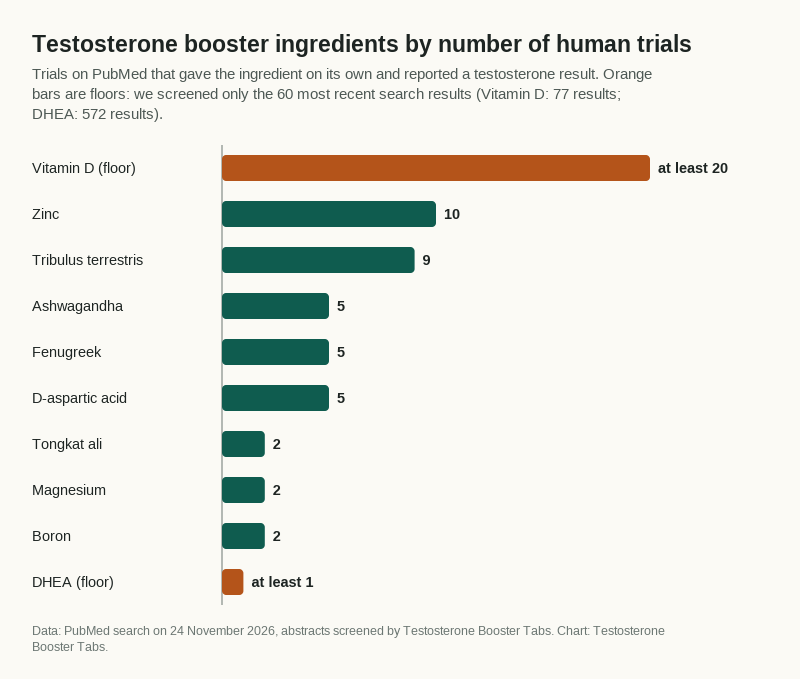
Vitamin D has the most, with at least 20 trials. Zinc is second with 10 and tribulus terrestris is third with 9.
A trial counted only if it gave the ingredient on its own, was run in people and reported a testosterone result in its abstract. The method is set out further down.
| Rank | Ingredient | Trials | With a placebo | Participants | Longest trial |
|---|---|---|---|---|---|
| 1 | Vitamin D | At least 20 | 16 | 2,245 | 3 years |
| 2 | Zinc | 10 | 7 | 289, and 3 trials gave no number | 6 to 8 months |
| 3 | Tribulus terrestris | 9 | 7 | 392 | 120 days |
| 4 | Ashwagandha | 5 | 5 | 274, and 1 trial gave no number | 12 weeks |
| 5 | Fenugreek | 5 | 4 | 398 | 12 weeks |
| 6 | D-aspartic acid | 5 | 4 | 97, and 1 trial gave no number | 12 weeks |
| 7 | Tongkat ali | 2 | 2 | 77 | 6 months |
| 8 | Magnesium | 2 | 1 | 60, and 1 trial gave no number | 8 weeks |
| 9 | Boron | 2 | 1 | 37 | 7 weeks |
| Not ranked | DHEA | At least 1 | 1 | 11 | 28 days |
Ties are split by the number of placebo-controlled trials, then by participants.
Two counts are floors. Vitamin D and DHEA each returned more than 60 search results, and we screened only the 60 most recent. Vitamin D keeps first place either way, because its floor is already double the next count. DHEA has no rank, because its true count could sit anywhere above 1.
Does more research mean an ingredient works better?
No. A long list of trials can be a long list of trials that found nothing.
Vitamin D shows this best. It has the most trials here, and 15 of the 20 found no significant change in total testosterone. The longest gave 133 men with heart failure a daily dose or a placebo for three years, and total testosterone did not differ between the groups at the end.[3] One trial did report a rise: 54 overweight men took vitamin D or a placebo for a year, and total testosterone rose in the vitamin D group only.[4]
The table gives the result each abstract reports for total testosterone.
| Ingredient | Who was studied | Rise | No significant change | Fall | Not clear |
|---|---|---|---|---|---|
| Vitamin D | Men, trained men, women, people starting low | 2 | 15 | 3 | 0 |
| Zinc | Men, women, people starting low | 5 | 3 | 0 | 2 |
| Tribulus terrestris | Men, trained men, older men, women, people starting low | 3 | 3 | 0 | 3 |
| Ashwagandha | Men, trained men, older men, women | 1 | 2 | 0 | 2 |
| Fenugreek | Men, older men, women | 1 | 1 | 0 | 3 |
| D-aspartic acid | Men, trained men | 1 | 4 | 0 | 0 |
| Tongkat ali | Men, older men, people starting low | 1 | 0 | 0 | 1 |
| Magnesium | Men, trained men, women | 1 | 1 | 0 | 0 |
| Boron | Men, trained men | 0 | 2 | 0 | 0 |
| DHEA | Women | 0 | 0 | 0 | 1 |
“People starting low” means the trial enrolled people with low testosterone, or with a low level of the nutrient.
“Not clear” means the abstract gave a result for free, salivary or urinary testosterone only, or did not give the result for the ingredient alone. Our page on free vs total testosterone explains why those are different measures.
A fall is not always a bad result. Two of the three vitamin D trials that reported one were in women with polycystic ovary syndrome.
This table is a tally. It does not weigh a trial of 11 people against a trial of 282, and it is not a rating. Our ratings, and the reasons for them, are in do testosterone boosters work?
What did the trials for each ingredient look like?
Zinc. The zinc research is old. Six of its ten trials were published before 1990. Five reported a rise, and two of those five had no control group.
Tribulus terrestris. Nine trials, seven with a placebo. In one, 35 ageing men with partial androgen deficiency took tribulus for three months and 35 took a placebo, and total testosterone rose in the tribulus group.[5] Three other trials found no significant change.
Ashwagandha. All five trials used a placebo. One reported a rise in total testosterone: 57 young men doing resistance training took the extract or a placebo for eight weeks, and testosterone rose more with the extract.[6] Two found no significant change against placebo.
Fenugreek. The largest trial gave an extract or a placebo to 120 healthy men aged 43 to 70 for 12 weeks. Total and free testosterone rose compared with placebo.[7] Three of the five abstracts did not give a clear result for total testosterone.
D-aspartic acid. Four of the five trials found no significant change. The longest ran for 12 weeks in 22 men who already lifted weights, and its authors concluded that the supplement did not change testosterone levels.[8] The one rise came from a 12-day study in which 23 men took it and 20 took a placebo.[9]
Tongkat ali. Two trials. In one, young men took an extract or a placebo for two weeks, and the testosterone results favoured the extract.[10] The other ran for six months but reported its rise for the supplement combined with training.
Magnesium. The search returned 10 results, but only two were trials that gave magnesium. One had no placebo group.
Boron. Two small trials, both from the 1990s. In one, 10 male bodybuilders took boron and 9 took a placebo for seven weeks. Total testosterone rose in both groups, and the authors found that boron had no effect on it.[11]
DHEA. One trial in the window we screened. It gave 11 young women DHEA or a placebo for 28 days, and testosterone measured in saliva rose markedly.[12] Older DHEA trials exist but fall outside the 60 results we read.
Each ingredient’s guide, linked in the first table, covers doses, safety and what the wider evidence shows. For risks across the whole category, see testosterone booster side effects.
How did we count the trials?
We searched PubMed, the database of biomedical citations and abstracts kept by the US National Library of Medicine.[1] We used its public programming interface, the E-utilities, on 24 November 2026.
1. One fixed search for each ingredient. Every search had the same form:
(ingredient terms) AND testosterone[Title/Abstract] AND clinical trial[Publication Type] AND humans[MeSH Terms]
Results were sorted by publication date, newest first.
| Ingredient | Ingredient terms, each searched in the title and abstract |
|---|---|
| Ashwagandha | ashwagandha OR "withania somnifera" |
| Tongkat ali | "tongkat ali" OR "eurycoma longifolia" OR longjack |
| Fenugreek | fenugreek OR "trigonella foenum-graecum" |
| Zinc | zinc |
| Vitamin D | "vitamin D" OR cholecalciferol OR ergocalciferol |
| D-aspartic acid | "d-aspartic acid" OR "d-aspartate" |
| Tribulus terrestris | tribulus |
| Boron | boron |
| Magnesium | magnesium |
| DHEA | dehydroepiandrosterone OR DHEA OR prasterone |
2. A cap of 60 abstracts. We read at most the 60 most recent results for each ingredient. Eight ingredients had fewer than 60, so every result was read. Two had more.
3. Three tests for each abstract. A record counted as a trial only if all three were true:
- it was a trial in people
- it gave the ingredient on its own, not in a mix of ingredients or alongside a medicine
- its abstract reported a testosterone result in blood, saliva or urine
A trial that gave the ingredient alongside exercise or a diet still counted, as long as the comparison group did the same exercise or diet.
4. The same details from each trial. We recorded the PubMed ID, the year, the number of participants, whether the abstract said placebo, the length of the trial, who was studied and the result for total testosterone. We took the result against placebo or a control group where there was one, and against the starting level where there was not. We did not infer anything the abstract did not say.
The search returned 717 results in all. We screened 188 of them, counted 61 and left out 127.
| Ingredient | Search results | Abstracts screened | Counted | Left out |
|---|---|---|---|---|
| Vitamin D | 77 | 60, published 2010 to 2026 | 20 | 40 |
| Zinc | 19 | 19 | 10 | 9 |
| Tribulus terrestris | 14 | 14 | 9 | 5 |
| Ashwagandha | 5 | 5 | 5 | 0 |
| Fenugreek | 7 | 7 | 5 | 2 |
| D-aspartic acid | 7 | 7 | 5 | 2 |
| Tongkat ali | 3 | 3 | 2 | 1 |
| Magnesium | 10 | 10 | 2 | 8 |
| Boron | 3 | 3 | 2 | 1 |
| DHEA | 572 | 60, published 2018 to 2026 | 1 | 59 |
Why records were left out:
- 90 were not trials that gave the ingredient. Most measured it, or mentioned it, in a trial of something else.
- 22 gave the ingredient with other ingredients or with a medicine.
- 12 had no testosterone result in the abstract.
- 2 were second reports of a trial already counted.
- 1 was a study of removing zinc from the diet, not adding it.
What are the limits of this count?
- One database. We searched PubMed only. A trial in a journal that PubMed does not cover is not here.
- Abstracts, not full papers. PubMed holds citations and abstracts, not the full text of journal articles.[1] We read the abstracts. A number that appears only in the full paper is recorded as “not stated”.
- The search leans on indexing. Publication types such as “clinical trial” are supplied by the publisher or added when a record is indexed, and the “humans” tag is added at indexing too. PubMed’s help pages say filters like these can miss relevant records that lack the tags.[2] A very new trial may be missing for that reason.
- The word “testosterone” had to be in the title or abstract. A trial that measured testosterone but only says so in the full paper was not found.
- Two floors. For vitamin D and DHEA we read the 60 most recent results, not all of them. Their true counts are higher than the ones shown.
- One reader, one pass. Each abstract was read once by our editorial team. Another reader could decide a borderline case differently. Every decision is in the data file so it can be checked.
- Not a quality score. We did not rate the trials for bias. A small trial counts the same as a large one.
- Counts change. New trials are published and old records are re-indexed. Run the same search later and the numbers will differ.
Can I download the trial list?
Yes. The list is free to reuse with a link back to this page.
- ingredient-trials.csv has one row for each of the 61 trials: ingredient, PubMed ID and link, year, title, journal, participants, placebo, duration, who was studied and the total testosterone result.
- ingredient-trials.json has the same trials, plus the exact search for each ingredient, the hit counts, the summary table and every record we left out with the reason.
The scripts that ran the search and built the files are kept with the site’s source, so the count can be repeated.
Where does this fit with the rest of the site?
This page adds counts to what the guides already say. It does not replace them.
- For our view of the evidence, ingredient by ingredient, read do testosterone boosters work?
- For how two of the better-studied herbs compare, see ashwagandha vs tongkat ali. For the two minerals, see zinc vs magnesium.
- For how supplements are regulated, see are testosterone boosters legal in Australia?
- For how the doses on product labels compare with the doses in these trials, see our testosterone booster label audit.
- If you think your level is low, start with the symptoms of low testosterone and a blood test, not a supplement.
The bottom line
Of ten common testosterone booster ingredients, vitamin D has the most human trials on PubMed, then zinc, then tribulus terrestris. Boron, magnesium and tongkat ali have two each. More research has not meant better results: 31 of the 61 trials we counted found no significant change in total testosterone, and 15 reported a rise. The trial list is free to download, so you can check any count on this page.
Common questions
Which testosterone booster ingredient has the most human trials?
Vitamin D, in our count. We found at least 20 trials that gave vitamin D on its own and reported a testosterone result. Zinc had 10 and tribulus terrestris had 9. The search was run on PubMed on 24 November 2026.
Does having more trials mean an ingredient works better?
No. The count shows how much research exists, not what it found. Vitamin D has the most trials here, and 15 of its 20 found no significant change in total testosterone.
Why is DHEA at the bottom of the table?
Its count is a floor, so we did not give it a rank. The search returned 572 results for DHEA and we screened only the 60 most recent, which were published from 2018 to 2026. Most of those measured DHEA as a hormone and did not give it as a supplement.
How many of the trials used a placebo?
48 of the 61. We counted a trial as placebo-controlled only when its abstract said so. Eight abstracts described a design without a placebo and five did not say.
Does this page rank testosterone booster products?
No. It ranks single ingredients by how much human research exists. We left out every trial of a product that mixed several ingredients, because the result cannot be tied to one of them.
Can I reuse the trial list?
Yes. The list is free to reuse with a link back to this page. It comes as a CSV file and a JSON file, with one row for each trial.
Sources
- About PubMed National Library of Medicine (NLM)
- PubMed Help National Library of Medicine (NLM)
- Vitamin D supplementation does not prevent the testosterone decline in males with advanced heart failure: the EVITA trial (Zittermann et al., 2019) European Journal of Nutrition
- Effect of vitamin D supplementation on testosterone levels in men (Pilz et al., 2011) Hormone and Metabolic Research = Hormon- Und Stoffwechselforschung = Hormones Et Metabolisme
- Tribulus terrestris versus placebo in the treatment of erectile dysfunction and lower urinary tract symptoms in patients with late-onset hypogonadism: A placebo-controlled study (GamalEl Din et al., 2019) Urologia
- Examining the effect of Withania somnifera supplementation on muscle strength and recovery: a randomized controlled trial (Wankhede et al., 2015) Journal of the International Society of Sports Nutrition
- Testofen, a specialised Trigonella foenum-graecum seed extract reduces age-related symptoms of androgen decrease, increases testosterone levels and improves sexual function in healthy aging males in a double-blind randomised clinical study (Rao et al., 2016) The Aging Male
- The effects of d-aspartic acid supplementation in resistance-trained men over a three month training period: A randomised controlled trial (Melville et al., 2017) PloS One
- The role and molecular mechanism of D-aspartic acid in the release and synthesis of LH and testosterone in humans and rats (Topo et al., 2009) Reproductive Biology and Endocrinology
- The effect of Eurycoma Longifolia on the regulation of reproductive hormones in young males (Chan et al., 2021) Andrologia
- The effect of boron supplementation on lean body mass, plasma testosterone levels, and strength in male bodybuilders (Ferrando and Green, 1993) International Journal of Sport Nutrition
- Short-term Dehydroepiandrosterone Intake and Supramaximal Exercise in Young Recreationally-trained Women (Gravisse et al., 2018) International Journal of Sports Medicine
Part of our data and research pages. New here? Start with do testosterone boosters work?